
India has one of the world’s largest school education systems, with schools spread across cities, villages, remote areas, and different social and economic settings. To manage such a large system, education departments need accurate information about students, teachers, classrooms, facilities, and enrollment.
Understanding the UDISE plus vs UDISE difference helps school administrators, teachers, parents, researchers, and education policymakers understand how India’s school data collection system has developed and why reliable data matters for educational planning.
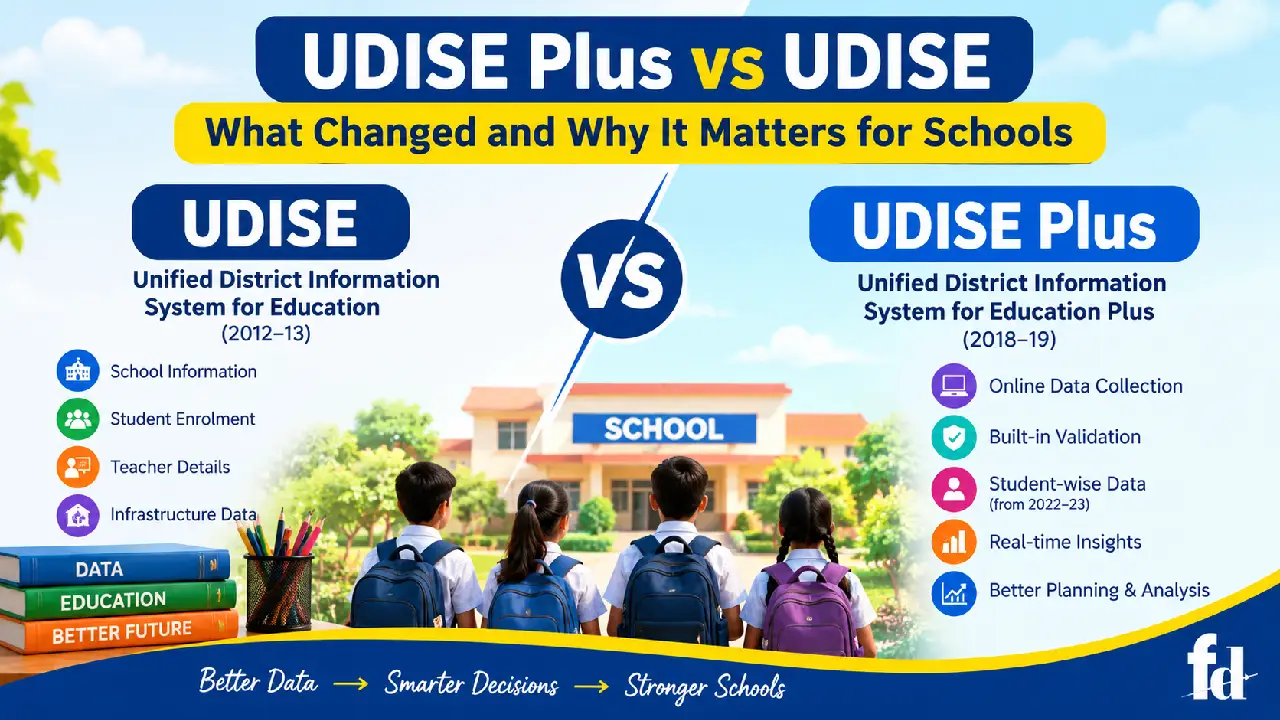
The transition from UDISE to UDISE Plus was not simply a change in name. It introduced an improved online approach to collecting, checking, managing, and analysing school information. This article explains the history of both systems, their major differences, important features, practical uses, and the reasons schools must understand the changes.
What Is UDISE?
UDISE stands for Unified District Information System for Education. It is a national school education information system developed to collect and organise data about schools across India.
The system was introduced in the 2012–13 academic year by integrating two earlier systems: the District Information System for Education (DISE), which covered elementary education, and the Secondary Education Management Information System (SEMIS), which covered secondary education. Bringing these systems together helped create a more unified source of information about school education.
Before this integration, information about different stages of education could be collected through separate systems. Combining them made it easier for education departments to study school facilities, student enrolment, teacher availability, and other important indicators across educational levels.
Why Was UDISE Introduced?
A large education system cannot be planned effectively without dependable information. Education officials need to know how many schools operate in a district, how many children attend them, whether teachers are available, and what facilities schools provide.
UDISE was designed to help answer these questions through a common reporting structure.
Its main purposes included:
- Collecting school-level information through a common framework.
- Tracking student enrolment across different classes and school categories.
- Recording teacher numbers and related information.
- Monitoring school infrastructure, including classrooms, drinking water, toilets, and electricity.
- Supporting district, state, and national education planning.
- Helping officials identify gaps in school facilities and educational access.
For example, suppose a district has 200 primary schools but many of them have insufficient classrooms. School-level information can help education officials identify the affected schools and plan infrastructure improvements.
Similarly, enrollment figures can help officials estimate the need for teachers, textbooks, classrooms, and other learning resources.
UDISE therefore established an important foundation for collecting school education statistics in a more organised manner.
What Is UDISE Plus?
UDISE Plus, also written as UDISE+, stands for Unified District Information System for Education Plus. It is an updated and improved version of UDISE developed by India’s Ministry of Education, through the Department of School Education and Literacy.
The official system states that UDISE+ introduced an online data collection process from the 2018–19 reference year. Its design aimed to improve the quality, credibility, and usefulness of school education information through online data entry, built-in validation, and stronger data management.
In simple terms, UDISE Plus provides a more technology-based way to collect and analyse information about schools, teachers, and students.
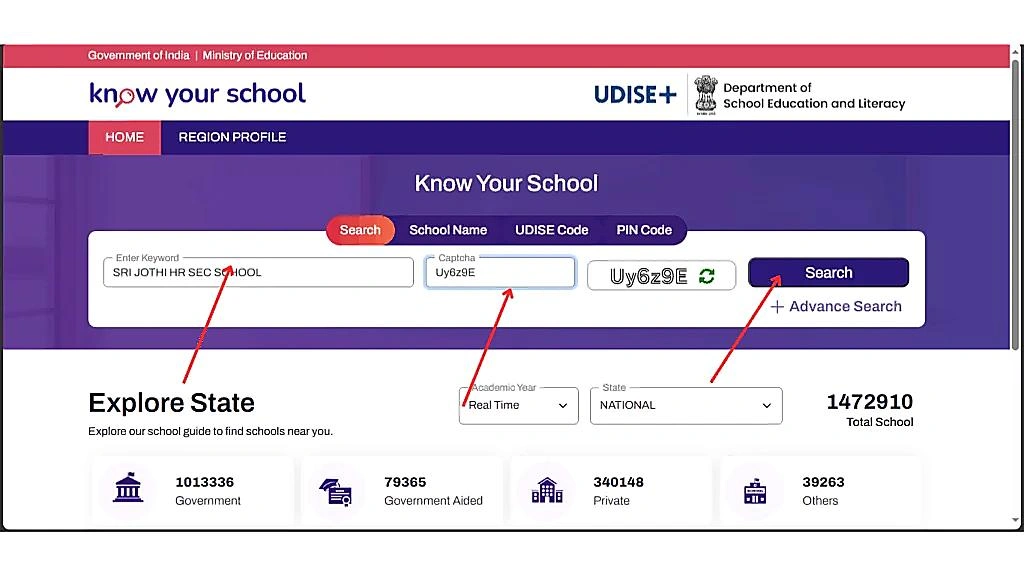
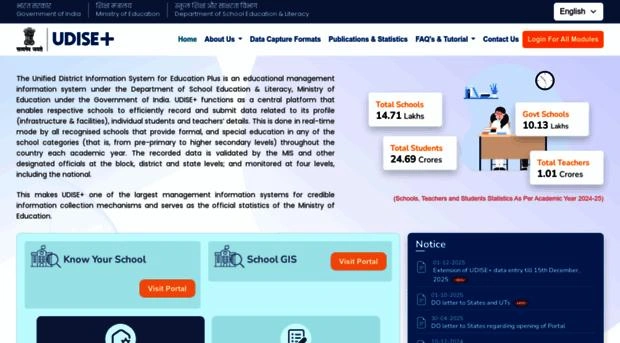
The official portal is available at UDISE+. Users can also explore published statistics through the UDISE+ dashboard and reports.
Why Was UDISE Plus Needed?
The education system changes every year. New schools open, existing schools expand, teachers retire or join, students move between schools, and infrastructure needs change.
A data collection process must be able to record these changes accurately. It must also help officials identify missing entries, incorrect totals, and inconsistencies before the information is used for planning.
UDISE Plus was developed to improve this process.
Its major aims include:
- Making school-level data submission available online.
- Introducing validation checks to identify possible errors.
- Improving consistency across schools and administrative levels.
- Supporting better analysis of education statistics.
- Making school data easier to access and use for planning.
- Moving towards more timely and detailed information collection.
Consider a school that reports 25 teachers in one section of its data but records only 20 in another related field. A well-designed validation process can flag the inconsistency for review. The school or responsible education official can then verify the correct figure before the data is finalised.
This does not mean every error is automatically detected. Validation rules can identify many inconsistencies, but people still need to check whether the information is factually correct.
UDISE Plus Launch Year and History
One common question is when UDISE Plus was launched and how it developed from the earlier UDISE system.
The distinction between the system’s historical origin and the introduction of its improved online version is important.
UDISE History: From 2012–13 to 2018–19
The development can be understood through the following timeline.
Period | Major development |
Before 2012–13 | DISE and SEMIS operated as separate systems for different stages of school education. |
2012–13 | UDISE was introduced by integrating the two systems. |
2018–19 | UDISE+ began its online data collection approach for the reference year. |
2022–23 onward | Student-wise data collection was introduced for recognised schools, marking a move towards more detailed student-level records. |
2024–25 | Official national reports continued to provide detailed information on schools, enrolment, teachers, and education indicators. |
2025–26 | The official portal provides school, student, and teacher statistics for the academic year, alongside its reporting and dashboard services. |
The timeline is based on information published by the official UDISE+ portal, the Ministry of Education, and the Government of India’s Press Information Bureau.
Is UDISE Plus a Completely Different System?
No. UDISE Plus is better understood as an improved version of UDISE rather than an unrelated replacement with an entirely different purpose.
Both systems focus on collecting and using school education data. The main change is in how the information is collected, checked, organised, and used.
UDISE created a unified reporting foundation. UDISE Plus developed that foundation into a more online and data-driven system, with greater emphasis on validation and increasingly detailed student information.
This continuity matters because historical education statistics remain useful. Researchers and officials need to compare information across years to understand changes in enrolment, infrastructure, teacher availability, and access to education.
However, comparisons must be made carefully. If definitions, reporting categories, or data collection methods change, differences between two years may partly reflect those changes rather than an actual improvement or decline in education.
UDISE vs UDISE Plus: Major Differences
The most useful way to understand the two systems is to compare their data collection methods, validation processes, reporting practices, and intended uses.
Comparison point | UDISE | UDISE Plus |
Full form | Unified District Information System for Education | Unified District Information System for Education Plus |
Main purpose | Collect and organise school education data | Continue school education reporting through an improved digital system |
Introduction | 2012–13 | Online data collection from the 2018–19 reference year |
Data collection approach | Earlier reporting framework, with processes varying by period and implementation | Online school-level data submission |
Data validation | Data checks and administrative verification under the reporting process | Built-in validation checks alongside administrative review |
Data management | Unified school information across education levels | Improved digital collection, organisation, and analysis |
Student information | Primarily established school-level reporting, including enrolment totals | Student-wise data collection introduced from 2022–23 onward for recognised schools |
Reporting and analysis | Supported school education statistics and planning | Supports digital reporting, dashboards, and more detailed analysis |
Main users | Schools, education departments, researchers, and policymakers | Schools, education departments, researchers, policymakers, and other authorised users |
Overall role | Established a common school education information system | Improved the existing system and expanded its digital and analytical capabilities |
The table describes the broad development of the system. It should not be interpreted to mean that every earlier UDISE record was inaccurate or that every UDISE Plus record is automatically correct.
The quality of both systems depends on accurate school reporting, suitable definitions, verification, and responsible use of the resulting data.
1. Online Data Collection
One of the most important changes is the use of an online reporting system.
Under UDISE Plus, schools submit their required information through the designated portal and reporting modules. The data then passes through the applicable verification and approval process.
This makes the reporting process more structured and can reduce the time needed to compile information from different administrative levels.
For example, if a school updates its infrastructure details, the information can be entered through the relevant online reporting module rather than relying entirely on separate local records that must later be combined.
Online reporting does not mean that every statistic is updated instantly. Many UDISE+ figures are collected for a particular academic year, checked, consolidated, and published after the reporting cycle. Therefore, online data collection and real-time data are not the same thing.
2. Better Data Validation
UDISE Plus includes validation checks intended to identify errors and inconsistencies in submitted information.
These checks can help detect missing entries, totals that do not match, or values that fall outside expected ranges. Education officials can then review the information and request corrections where necessary.
For example, a school may report 500 students across its classes but enter class-wise figures that add up to 470. A validation rule can flag the difference for review.
However, automated checks cannot establish whether every submitted figure reflects reality. A school could enter a plausible number that is still incorrect. Human verification and responsible reporting remain essential.
3. More Detailed Student Information
Another major development is the move towards student-wise data collection.
Earlier school reporting often focused on aggregated information, such as the total number of students enrolled in each class. Student-wise reporting allows the system to capture more detailed records for individual students, subject to the applicable reporting rules and safeguards.
This can support better analysis of enrolment, student movement, and educational participation.
For example, a school may use its records to check whether a student who previously studied in Class 5 has been correctly recorded after moving into Class 6. More detailed records can help authorised officials investigate inconsistencies that may be difficult to identify through totals alone.
Student-wise reporting also increases the need for accurate data entry, secure handling of personal information, and appropriate access controls. Detailed student records should not be treated as unrestricted public information.
4. Improved Reporting and Analysis
UDISE Plus supports digital reporting and the publication of school education statistics through official dashboards and reports.
Officials can use these reports to examine indicators such as enrolment, teacher numbers, school facilities, and differences between administrative areas.
Suppose a state wants to understand whether schools in rural areas have adequate access to electricity. Relevant infrastructure statistics can help officials identify areas where further investigation or investment may be required.
Similarly, district-level enrollment figures can help education departments estimate classroom and teacher requirements.
These reports are useful for identifying patterns and planning action, but they do not independently explain every cause behind a problem. A district with lower enrolment, for example, may need further investigation into population changes, school access, transport, household circumstances, or other local factors.
5. Greater Support for Data-Based Planning
UDISE Plus makes school education information more useful for planning when the data is complete, accurate, and interpreted in context.
Education departments can use it to study differences between schools, districts, states, and academic years. Researchers can also use published information to examine trends in access, facilities, and participation.
For example, if a district reports a large number of students but relatively few teachers, officials may investigate staffing requirements and teacher deployment. The data can help identify a possible concern, although further checks are needed before deciding how many additional teachers are required.
The central benefit is not simply that information is digital. It is that reliable school data can support better decisions when combined with local knowledge, proper verification, and clear educational goals.
UDISE Plus Features That Matter for Schools
UDISE Plus is more than an online form for submitting school details. It is a reporting system that helps organise information about schools, students, teachers, and facilities in a consistent format. Its features are useful because schools and education departments need information that can be checked, compared, and used for planning.
The exact fields and workflows available to a school may vary by academic year, reporting module, and user permissions. Schools should always follow the instructions published for their current reporting cycle.
1. School Profile and Identification
Each school needs a reliable identity within the education reporting system. School identification helps officials connect submitted information with the correct institution and distinguish one school from another.
School profiles may include information such as:
- School name and UDISE code.
- School location and administrative area.
- Management category.
- School type and education levels offered.
- Medium of instruction.
- Other details required by the applicable reporting format.
For example, two schools in the same town may have similar names. Their UDISE codes help education officials identify the correct institution when reviewing records or compiling district statistics.
A school should check its identifying details carefully. Incorrect school information can create confusion in reporting, verification, and communication with education authorities.
2. Student Enrolment Information
Enrolment information helps officials understand how many students attend school and how they are distributed across classes and other reporting categories.
This information is important for estimating demand for classrooms, textbooks, teachers, and other resources. It also helps education departments monitor changes in participation over time.
Suppose a government school reports that enrolment in Class 6 has increased from 80 to 110 students. The increase may indicate that more students are entering the school, that students are transferring from nearby schools, or that an earlier reporting figure needs verification.
Officials can investigate the change before making decisions about classroom capacity or staffing.
3. Teacher and Staff Information
Schools need enough appropriately qualified teachers to support students. Information about teacher numbers and relevant professional details can help education departments assess staffing patterns and identify areas that may require attention.
Depending on the reporting format, information may cover teacher counts, qualifications, professional training, or other prescribed details.
For instance, a school may have several sections in upper-primary classes but too few teachers for its teaching requirements. Teacher information, when reviewed alongside enrolment and class structure, can help officials identify a possible staffing issue.
However, a simple teacher-to-student ratio does not tell the whole story. Subject requirements, teacher deployment, class organisation, school location, and the applicable staffing norms also matter.
4. School Infrastructure and Facilities
Infrastructure information helps officials understand whether schools have facilities needed to support teaching and learning.
Relevant reporting categories may include:
- Classrooms and their condition.
- Drinking water facilities.
- Separate toilets and sanitation facilities.
- Electricity and other basic amenities.
- Libraries, laboratories, and learning resources.
- Facilities for students with disabilities.
- Digital and other educational infrastructure where applicable.
Imagine that a district identifies several schools without suitable drinking water facilities. Officials can use the information to prioritise verification, maintenance, and improvement work.
The reported figures must still be checked against conditions on the ground. A facility may be recorded as available even though it is damaged or not functioning properly. Schools should therefore report their actual circumstances rather than merely whether an item exists.
5. Digital Dashboards and Published Reports
UDISE Plus supports the presentation of education statistics through online reports and dashboards.
These tools can help users examine school education information at different administrative levels, depending on the report available.
Students and researchers can use published data to study broad education trends. Parents can learn about the types of information that education authorities collect. Teachers and school administrators can understand how their school’s reporting contributes to a larger picture.
The official UDISE+ portal is the appropriate starting point for current reporting services. Published statistics should be checked against the relevant academic year and report notes before being quoted.
UDISE Plus Objectives: What Is the System Trying to Achieve?
The main udise plus objectives are to improve school education data collection, support reliable reporting, and make information more useful for planning and monitoring.
These objectives matter because education decisions affect students, teachers, schools, and entire communities. Incomplete or inconsistent information can lead to resources being directed to the wrong places or important needs being overlooked.
Improving Data Quality
A major objective is to improve the consistency and reliability of school data. Common reporting fields and validation checks help identify missing information and inconsistencies.
For example, class-wise enrolment figures should agree with the corresponding totals when the reporting definitions require them to do so. A discrepancy can be investigated before the figures are used in a report.
Data quality also depends on accurate source records, careful entry, and meaningful verification. A digital system cannot replace these responsibilities.
Supporting Educational Planning
Education departments need information to estimate school resource requirements and identify gaps between regions.
UDISE Plus data can help planners examine questions such as:
- Where might additional classrooms be required?
- Which schools report inadequate facilities?
- How does enrollment vary between districts?
- Are teacher numbers consistent with local educational needs?
- Which areas require more detailed investigation?
The system provides evidence for planning, not automatic answers to every policy question. Local inspections, budget information, population trends, and consultation with schools may also be needed.
Monitoring Access and Participation
School education data can help authorities examine participation in education and identify changes that need further attention.
For example, a decline in enrolment in a particular class may require officials to check whether students have moved to another school, whether the local population has changed, or whether some children face barriers to attendance.
A fall in reported enrolment does not automatically prove that children have dropped out. Proper interpretation requires additional evidence.
Encouraging Consistent Reporting
A common national reporting structure allows information from different schools and administrative areas to be organised using shared categories.
This is important in a country where education is delivered through many types of institutions and different state-level administrative arrangements.
Consistent reporting makes comparisons more useful, provided that the definitions, coverage, and reference periods are understood.
UDISE Plus Student-Wise Data: What Schools Need to Understand
One of the most important developments in UDISE Plus is the introduction of student-wise data collection from the 2022–23 reference year for recognised schools. This approach provides more detailed information than reporting only total enrollment figures.
Student-wise reporting can support the examination of individual student records and help authorised officials identify inconsistencies that may not be visible in aggregate totals.
However, the exact information collected and the permitted uses of that information depend on the current reporting requirements and applicable safeguards.
Aggregate Data vs Student-Wise Data
Aggregate data combines information into totals. Student-wise data records information about individual students.
The following example illustrates the difference.
Reporting method | Example | What it helps show |
Aggregate reporting | A school reports 120 students in Class 5 | Total enrolment in that class |
Student-wise reporting | The school maintains a separate record for each of its 120 students | Individual records that can be checked for consistency |
Combined analysis | Student records are reviewed alongside class totals | Whether the individual records and reported totals agree |
This does not mean every student-level record is publicly available. Detailed personal information requires appropriate protection and access controls.
How Student-Wise Data Can Help
Student-level records can support several practical tasks.
Checking enrolment: Schools and authorised officials can investigate inconsistencies between individual records and reported totals.
Understanding student movement: Where the relevant systems and rules permit it, more detailed records can help officials examine transfers and changes in school participation.
Reducing duplicate or inconsistent entries: Individual-level records may help identify possible duplicate entries, although these must be reviewed before any correction is made.
Improving planning: Better enrolment information can support estimates of classroom, teacher, and learning-resource needs.
Consider a student who changes schools after completing Class 7. If the applicable records are updated and linked correctly, authorised officials may be better able to understand the student’s movement through the school system.
Nevertheless, student-wise data does not guarantee that every transfer will be recorded correctly or that all students can always be tracked without errors. Schools must follow the prescribed process and verify their records.
Privacy and Responsible Data Handling
More detailed data can improve reporting, but it also creates greater responsibility.
Schools should:
- Use authorised accounts and approved reporting channels.
- Avoid sharing login credentials with unauthorised people.
- Keep student records secure.
- Follow applicable privacy and data protection requirements.
- Correct inaccurate information through the prescribed process.
- Avoid publishing personal student details in public reports or informal messages.
Parents should also distinguish between public school statistics and confidential individual records. A published report showing the total number of students in a school is different from a file containing identifiable student information.
UDISE Plus Benefits for Students, Teachers, Parents, and Schools
The benefits of UDISE Plus depend on the accuracy of the information entered and how effectively education authorities use it. When data is reliable, it can support better planning and a clearer understanding of school needs.
Benefits for School Administrators
School administrators can use the reporting process to organise institutional information and review whether required details are complete.
A school that regularly checks its enrollment, teacher, and infrastructure records may be better prepared for reporting deadlines and administrative reviews.
The system also encourages schools to maintain consistent records across reporting periods.
Benefits for Teachers
Teachers may benefit indirectly when reliable school data helps authorities identify staffing shortages, classroom requirements, or gaps in educational facilities.
For example, a district with increasing enrollment and limited classroom capacity may use school statistics to investigate whether additional teaching space or staffing is needed.
UDISE Plus does not automatically provide every school with extra teachers or facilities. Its value lies in helping officials identify needs and make better-informed decisions.
Benefits for Students
Students benefit when education planning is based on dependable information.
Accurate enrolment and infrastructure data can help officials assess where more classrooms, sanitation facilities, teachers, or learning resources may be required.
Students may also benefit from better monitoring of participation and student movement, provided the information is handled accurately and responsibly.
Benefits for Parents
Parents can use published school information to better understand how education authorities monitor schools and plan resources.
However, UDISE Plus data should not be treated as a complete rating of school quality. A school may report strong infrastructure while facing teaching challenges, or it may have limited facilities while providing effective classroom instruction.
Parents should consider multiple sources of information, including school visits, discussions with teachers, learning support, and relevant official records.
Benefits for Education Departments and Researchers
Education departments can use the data to compare administrative areas, identify possible gaps, and monitor changes over time.
Researchers can examine patterns in enrolment, infrastructure, staffing, and other published indicators.
For example, a researcher may compare the proportion of schools reporting electricity across two states. A meaningful comparison must use the same academic year, compatible definitions, and the correct school coverage.
UDISE Plus Real-Time Data: What Does It Actually Mean?
The phrase UDISE plus real time data is often used when describing the digital system. It is important to understand that online submission does not necessarily mean that every published statistic changes instantly.
UDISE Plus supports online data entry and digital reporting. However, the data may still pass through collection periods, validation, verification, approval, consolidation, and publication before appearing in a final report.
Online Data Is Not Always Live Data
Suppose a school submits its annual information in August. The submitted figures may then need to be reviewed by the relevant authorities. A national report published later may reflect the consolidated information available for that reporting cycle rather than the school’s latest day-to-day position.
For this reason, users should always check:
- The academic year covered by a report.
- Whether the figures are provisional or final.
- The date on which the report was published or updated, if provided.
- Whether the information refers to school-level submissions or consolidated statistics.
- Any notes about coverage, definitions, or revisions.
This distinction is particularly important for researchers and journalists who quote official figures. A report for one academic year should not be described as a live count unless the source explicitly supports that description.
UDISE Plus Statistics: How to Use the Numbers Correctly
UDISE Plus produces extensive information about Indian school education, but statistics are useful only when their context is clear.
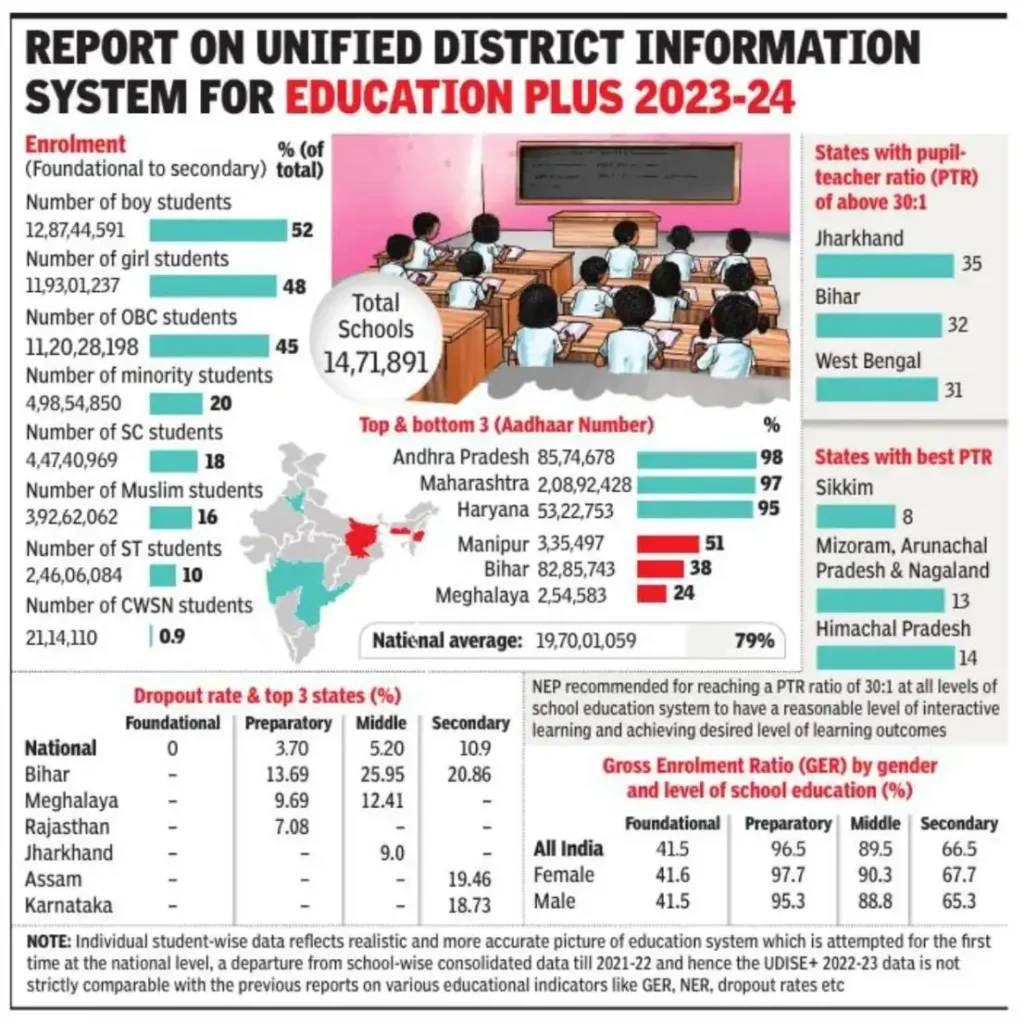
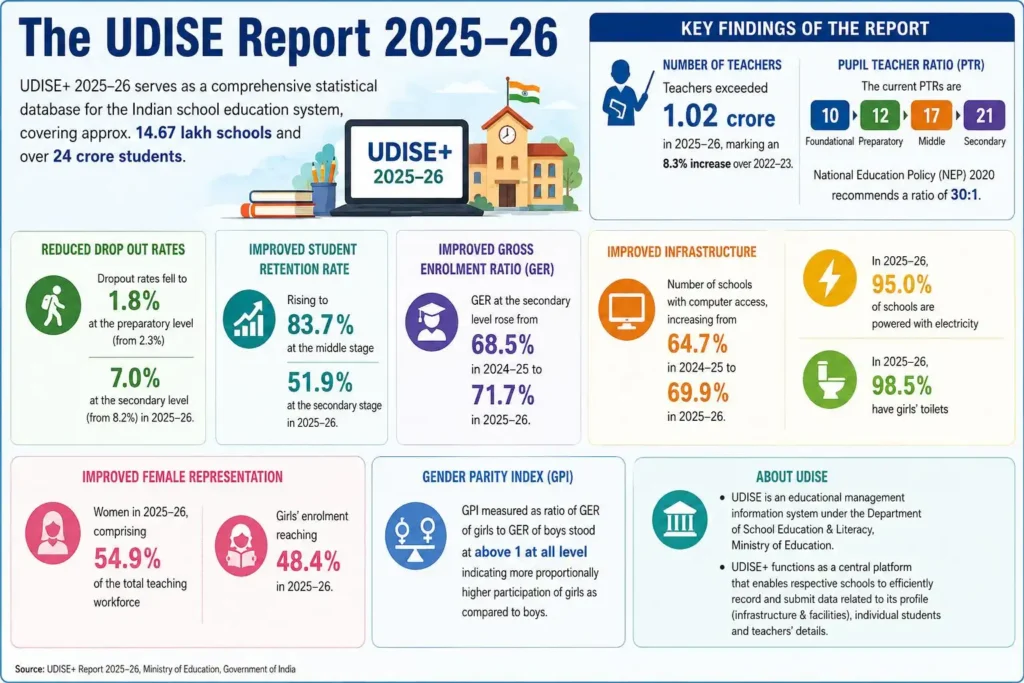
The Ministry of Education publishes reports covering school counts, enrolment, teachers, infrastructure, and other education indicators. For the latest available figures, readers should consult the official UDISE+ portal and the national dashboard.
National education statistics can involve very large numbers because India has a school system serving children across thousands of administrative areas. However, figures should always be linked to a specific report and academic year rather than copied without context.
Which Statistics Should Readers Look For?
Indicator | What it tells you | Why it matters |
Number of schools | Reported school count within the stated coverage | Helps assess the scale and distribution of the system |
Student enrolment | Number of students reported as enrolled | Supports resource planning and participation analysis |
Teacher count | Number of teachers reported under the relevant definition | Helps examine staffing patterns |
School facilities | Reported availability of infrastructure and amenities | Helps identify potential gaps in school facilities |
Class or school transitions | Changes in enrolment or student movement were supported by the data | Can help identify patterns requiring investigation |
District and state comparisons | Differences between administrative areas | Supports planning and further research |
Why Figures May Differ Between Reports
Two official reports may show different figures without either necessarily being incorrect.
Possible reasons include:
- Different academic years.
- Different school categories or reporting coverage.
- Provisional versus final data.
- Updated submissions or corrections.
- Different definitions of an indicator.
- Different reporting cut-off dates.
For example, a report covering a particular academic year may include a different set of submitted or verified school records than an earlier publication. Before comparing the numbers, check the report notes and definitions.
Researchers should cite the original report wherever possible and clearly identify the reporting period.
Practical Example: How a School Can Use UDISE Plus Data
Consider a hypothetical government secondary school named Sunrise Public School. It has 600 students, 18 teachers, and several infrastructure needs.
The school is preparing its annual data submission and wants to ensure that its information is complete.
Step 1: Check the School Profile
The school verifies its name, UDISE code, location, management details, and other required identifying information.
This helps prevent errors that could affect reporting or administrative communication.
Step 2: Verify Student Enrolment
The school checks its admission records and class-wise enrolment figures. If its reported total is 600 but the individual class totals add up to 580, the staff investigate the difference before submitting the data.
The discrepancy might arise from an incomplete entry, a calculation mistake, or a difference in the records being used.
Step 3: Review Teacher Information
The school checks the teacher information required for the current reporting cycle. It also examines whether the recorded figures agree with its official staff records.
Any mismatch is reviewed and corrected through the appropriate process.
Step 4: Check Infrastructure
The school reviews its records for classrooms, toilets, drinking water, electricity, and other applicable facilities.
If a toilet is listed as available but is currently unusable, the school should report the situation according to the prescribed definitions rather than assume that physical presence alone is sufficient.
Step 5: Complete Validation and Verification
The school reviews the entered information and resolves any flagged inconsistencies. It then follows the prescribed submission and approval process.
Step 6: Use the Information for Planning
After reviewing its records, the school may identify a need for additional classroom space or repairs to existing facilities.
The data can help communicate those needs to education officials. Decisions about funding or infrastructure improvements still depend on the relevant administrative process, available resources, and further verification.
This example shows that UDISE Plus is most useful when data collection is treated as a way to improve school records and support planning, rather than merely a formality.
Common Challenges and Limitations of UDISE Plus
Although UDISE Plus improves digital reporting, the system still faces practical challenges. Recognising these limitations helps schools and researchers use the information more responsibly.
Incorrect or Incomplete Data
The system depends on the information submitted by schools and verified through the applicable process. Incorrect source records or data-entry mistakes can affect the final figures.
What schools can do: Maintain reliable records throughout the year, check totals before submission, and correct discrepancies promptly.
Internet and Technical Problems
Some schools may face unreliable internet access, device limitations, or difficulty using online reporting tools.
What schools can do: Prepare records in advance, use authorised technical support, and follow official instructions for resolving portal or access issues. Schools should not use unofficial websites to submit sensitive information.
Different Levels of Data Quality
Data quality can vary because schools operate in different circumstances and may have different levels of administrative support.
What education departments can do: Provide clear guidance, training, verification, and suitable support for schools that face reporting difficulties.
Misinterpretation of Statistics
A statistic rarely explains the whole situation. High enrollment, for example, does not automatically mean that students are learning effectively. Similarly, the presence of a facility does not necessarily prove that it is functional or adequate.
What readers can do: Examine definitions, compare compatible reporting periods, and use additional evidence before drawing conclusions.
Privacy and Access Control
Detailed student information requires careful handling. Unauthorised access, unnecessary sharing, or careless storage can create privacy risks.
What schools can do: Restrict access to authorised staff, use secure credentials, and follow official data-handling instructions and applicable law.
How Schools Can Prepare for UDISE Plus Reporting
Schools can make annual reporting easier by preparing their information before the reporting window opens.
A simple checklist can reduce errors and last-minute confusion.
- Verify the school’s identifying details and UDISE code.
- Review student admission and enrollment records.
- Check class-wise totals and related figures.
- Verify teacher and staff information required by the reporting format.
- Review infrastructure and facility records.
- Check all required fields in the current reporting module.
- Resolve validation errors and inconsistencies.
- Follow the official submission and approval procedure.
- Retain appropriate supporting records according to school policy.
- Protect login credentials and confidential student information.
- Keep a record of relevant submission acknowledgements where available.
- Monitor official instructions for corrections, deadlines, and reporting updates.
Schools should use the current academic year’s instructions rather than relying entirely on an older guide. Reporting fields, deadlines, and procedures can change.
Actionable Takeaways: What Every Reader Should Remember
The development from UDISE to UDISE Plus reflects a wider effort to improve how school education information is collected, checked, and used. Understanding the main changes helps school staff complete reporting tasks correctly and helps readers interpret published education statistics without drawing misleading conclusions.
Here are the most important points to remember:
- UDISE came first: It unified earlier school education reporting systems during the 2012–13 academic year.
- UDISE Plus improved digital reporting: Its online data collection approach began with the 2018–19 reference year.
- Validation is important: Automated checks can identify inconsistencies, but accurate reporting still depends on people and reliable records.
- Student-wise data adds detail: Individual-level reporting can support better record checking and analysis, subject to applicable rules.
- Online does not always mean real time: Published statistics may reflect a completed reporting and verification cycle.
- School data supports planning: Enrolment, staffing, and infrastructure information can help authorities identify potential needs.
- Statistics require context: Always check the academic year, definitions, coverage, and publication date.
- Privacy matters: Student information must be handled through authorised and secure processes.
- Official sources are essential: Use government portals and published reports when quoting statistics or checking reporting requirements.
- Schools should prepare early: Accurate records and timely verification help reduce reporting problems.
Conclusion: Why the Change from UDISE to UDISE Plus Matters
The difference between UDISE and UDISE Plus is mainly about the development of a common school education information system into a more digitally supported and detailed reporting process. UDISE established the foundation by bringing earlier education data systems together. UDISE Plus built on that foundation through online data collection, validation checks, digital reporting, and the introduction of student-wise data collection.
These improvements matter because good education planning depends on reliable information. School enrollment figures, teacher records, and infrastructure details can help officials identify possible gaps and decide where further investigation or resources may be needed. For schools, careful reporting supports better record management. For parents and researchers, published statistics offer a way to understand the wider education system, provided the figures are interpreted correctly.
At the same time, technology alone cannot guarantee accurate information or better learning outcomes. Schools must maintain dependable records, education departments must verify the data, and decision-makers must combine statistics with local knowledge and other evidence.
Anyone who wants to understand the system further should begin with the official UDISE+ portal and the Ministry of Education website. Checking the latest official reporting instructions is especially important for schools preparing their annual submissions.
Ultimately, the move from UDISE to UDISE Plus is significant because it strengthens the process through which school education information is collected and used. When that information is accurate, protected, and applied responsibly, it can help schools and education authorities make more informed decisions for students across India.
Official References and Further Reading
The following resources provide a reliable starting point for readers who want to verify system details, explore education statistics, or learn about India’s school education policies.
- UDISE+ official portal: https://udiseplus.gov.in/ — Official portal for school education data collection and related reporting services.
- UDISE+ dashboard: https://dashboard.udiseplus.gov.in/ — Explore available dashboards and published school education statistics.
- Ministry of Education, Government of India: https://www.education.gov.in/udise-plus — Official ministry resource for UDISE+ information.
- Press Information Bureau, Government of India: https://www.pib.gov.in/ — Government announcements and background information about education data and policy developments. Search the site for official UDISE+ releases.
- Ministry of Education publications: https://www.education.gov.in/ — Reports and publications that can help readers examine school education indicators and policy context.
When citing any UDISE+ statistic in another article, presentation, or research project, identify the original report, academic year, relevant table or indicator, and publication date whenever that information is available. This makes the information easier for readers to verify and reduces the risk of comparing figures that use different definitions or reporting periods.
FAQs
1. What is the full form of UDISE Plus?
UDISE Plus stands for Unified District Information System for Education Plus. It is an improved digital school education information system developed under India’s Ministry of Education.
2. What is the main difference between UDISE and UDISE Plus?
UDISE established a unified system for collecting school education data. UDISE Plus introduced an improved online reporting approach, with validation checks and expanded capabilities for organising and analysing school information.
3. When was UDISE Plus launched?
UDISE Plus introduced its online data collection approach from the 2018–19 reference year. UDISE itself was introduced earlier, in the 2012–13 academic year, by integrating DISE and SEMIS.
4. Is UDISE Plus compulsory for schools?
Schools covered by the applicable official reporting requirements must follow the instructions issued by the relevant education authorities. The precise reporting obligations and timelines should be confirmed through the official portal and the appropriate state or district authority.
5. What is a UDISE code?
A UDISE code is an identifying code used to distinguish a school in the education information system. Schools should verify their code through official records or the relevant education authority.
6. Does UDISE Plus contain student-wise information?
Student-wise data collection was introduced from the 2022–23 reference year for recognised schools. The exact fields, access arrangements, and uses depend on the applicable reporting rules.
7. Can parents access student records through UDISE Plus?
Parents can consult publicly available school education statistics and reports where provided. Individual student records are different from public aggregate statistics and should only be accessed or handled through authorised channels.
8. Is UDISE Plus data updated in real time?
Online submission does not mean all published statistics are updated instantly. Data may need to be checked, verified, consolidated, and published. Users should check the academic year and reporting date of the figures they use.
9. Is UDISE Plus only for government schools?
The system covers recognised schools according to the applicable reporting framework, including schools under different management categories. The precise coverage of a particular report should be checked before making comparisons.
10. Where can I find official UDISE Plus reports?
Start with the official UDISE+ portal and the UDISE+ dashboard. The Ministry of Education website also provides information and links to official education reports.
11. Does UDISE Plus measure the quality of teaching?
It provides information about schools, students, teachers, facilities, and other reported indicators. These statistics can help identify areas for investigation, but they do not by themselves provide a complete measure of teaching quality or student learning.
12. What should a school do if it finds an error in its submitted data?
The school should follow the correction process prescribed by the relevant reporting module and education authority. It should verify the original records, obtain any required approval, and avoid making changes through unofficial channels.

Hey, I am Sachin Ramdurg. I run and manage futuredecider.com website that helps students, graduates, and professionals, to find and decide on their future career with ultimate future career advices and future career guides. I have an overall 12+ years of career guidance experience in multiple domains which has helped multiple students, graduates, and professionals to find the best career path for their future.