
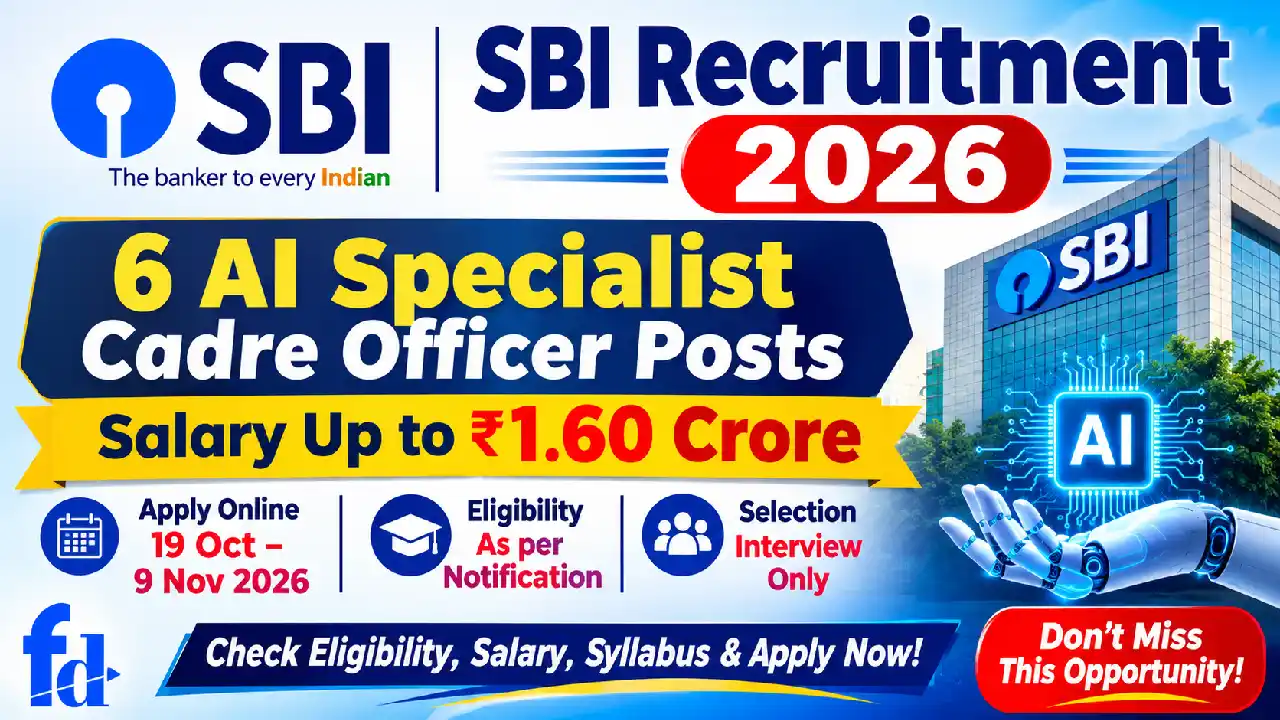
SBI Recruitment 2026 offers 6 AI Specialist Officer posts with CTC up to ₹1.60 crore. Check eligibility, experience, salary, selection process and apply by 9 November.
SBI Recruitment 2026
The State Bank of India (SBI) has announced an exceptional career opportunity for experienced professionals in Artificial Intelligence (AI), Machine Learning (ML), Data Engineering, Risk Analytics and Enterprise Technology through its SBI Specialist Cadre Officers Recruitment 2026.
Under Advertisement No. CRPD/SCO/2026-27/30, SBI is inviting online applications for six senior-level AI specialist positions.
Unlike conventional bank recruitment drives that primarily target graduates and freshers, this recruitment is designed for experienced technology professionals with substantial industry exposure, specialist qualifications and leadership capabilities.
The most attractive feature of this recruitment is its remuneration package. Depending on the position, eligible candidates can negotiate an annual Cost to Company (CTC) of up to ₹1.60 crore.
The highest-paying position is General Manager and Chief AI Officer, while the other senior specialist positions offer maximum annual CTC packages ranging from ₹90 lakh to ₹1.20 crore.
The six vacancies cover several strategically important areas:
- Chief-level AI leadership and institutional AI strategy.
- Risk and operational analytics.
- AI governance, compliance and responsible AI.
- Data engineering, model application development and AI operations.
- AI solution architecture.
- Enterprise AI architecture.
These appointments reflect the increasing importance of artificial intelligence in India’s banking industry. Banks are progressively adopting AI-powered systems for fraud detection, customer service, credit assessment, regulatory compliance, predictive analytics, automation and operational efficiency.
For experienced professionals working in technology companies, financial institutions, consulting firms, fintech organisations and enterprise AI divisions, this recruitment provides an opportunity to move into a senior leadership role within India’s largest public-sector bank.
SBI Recruitment 2026 – Overview
Particular | Details |
Organisation | State Bank of India |
Recruitment name | SBI Specialist Cadre Officers Recruitment 2026 |
Advertisement number | CRPD/SCO/2026-27/30 |
Post category | AI Specialist Cadre Officers |
Total vacancies | 6 |
Job type | Contractual |
Application mode | Online |
Application commencement | 19 October 2026 |
Last date to apply | 9 November 2026 |
Selection process | Shortlisting and Interview |
Written examination | Not prescribed |
Maximum annual CTC | ₹1.60 crore |
Initial contract period | 3 years |
Maximum contract period | 5 years |
Suggested posting | Mumbai |
Application fee | ₹750 for General/EWS/OBC |
SC/ST/PwBD fee | Nil |
Official advertisement | CRPD/SCO/2026-27/30 |
Current recruitment status: Applications are open according to the published notification. Interested candidates should complete registration and fee payment before 9 November 2026.
About State Bank of India (SBI)
The State Bank of India is India’s largest public-sector banking institution and one of the country’s most prominent financial services organisations. Headquartered in Mumbai, Maharashtra, SBI plays a central role in India’s banking ecosystem by providing financial services to individuals, businesses, government institutions, corporate customers and international clients.
History and establishment
SBI has a banking legacy extending back more than two centuries.
Its origins can be traced to the establishment of the Bank of Calcutta on 2 June 1806. The institution was subsequently renamed the Bank of Bengal in 1809. Alongside the Bank of Bombay and Bank of Madras, it formed part of the presidency banking system.
These three banks were amalgamated into the Imperial Bank of India on 27 January 1921.
Following recommendations arising from the All India Rural Credit Survey, the Government of India established the State Bank of India by taking over the Imperial Bank of India. SBI officially came into existence on 1 July 1955.
Over the decades, SBI expanded its operations across India and internationally, becoming a major provider of retail banking, corporate banking, investment services, digital banking and financial products.
Vision, mission and values
SBI’s stated vision is:
“Be the Bank of Choice for a Transforming India.”
Its mission focuses on providing simple, responsive and innovative financial solutions.
The organisation emphasises values such as:
- Service and customer satisfaction.
- Transparency and ethical conduct.
- Professionalism and accountability.
- Sustainability and social responsibility.
- Innovation and technological advancement.
These values are particularly relevant to the AI recruitment because technology professionals working at SBI must develop solutions that are not only technically advanced but also secure, explainable, reliable and suitable for a highly regulated banking environment.
Why is SBI recruiting AI specialists?
Artificial intelligence is becoming increasingly important in modern banking. Financial institutions process enormous volumes of transactions and customer information, making AI-driven systems valuable for identifying suspicious activities, predicting financial risks, automating workflows and improving customer experiences.
SBI’s recruitment of dedicated AI leadership and architecture professionals indicates an emphasis on building and governing enterprise-level AI capabilities.
The selected professionals may contribute to initiatives involving:
- AI-based fraud detection and prevention.
- Advanced credit and risk analytics.
- Generative AI applications for banking operations.
- Automated customer support and intelligent assistants.
- Enterprise data platforms and analytics infrastructure.
- Model governance, monitoring and regulatory compliance.
- AI-powered operational efficiency and decision-making.
Work culture and career environment
Working at SBI offers exposure to a large institutional environment where technology projects must satisfy stringent requirements relating to security, availability, customer data protection and regulatory compliance.
Unlike a small technology startup, a public-sector bank operates with complex legacy systems, multiple business divisions, large customer databases and extensive operational dependencies.
Candidates should therefore expect an environment requiring:
- Cross-functional collaboration with banking and technology teams.
- Formal project governance and documentation.
- Strong cybersecurity and data protection practices.
- Coordination with senior management and business stakeholders.
- Long-term technology planning.
- Strict operational and regulatory accountability.
This opportunity is especially suitable for professionals who want to combine enterprise technology leadership with large-scale financial services transformation.
Complete SBI Vacancy Details 2026
SBI has announced six vacancies across six different AI-specialist positions. Each position has a distinct area of responsibility, experience requirement and leadership expectation.
All vacancies are reported under the Unreserved category.
Post-wise vacancy distribution
Post name | Vacancies | Minimum age | Maximum age |
GM & Chief AI Officer | 1 | 40 | 55 |
DGM – Risk and Operational Analytics | 1 | 35 | 50 |
DGM – AI Governance and Compliance | 1 | 35 | 50 |
DGM – Data Engineering, Model Application Development and AI Ops | 1 | 35 | 50 |
AI Solution Architect | 1 | 30 | 45 |
Enterprise AI Architect | 1 | 30 | 45 |
Total | 6 |
Age is calculated as specified in the official notification, with 30 September 2026 as the cut-off date.
Current job status
Recruitment parameter | Status |
Notification released | Published |
Online registration | Open |
Application acceptance | Yes |
Fee payment | Open |
Last date | 9 November 2026 |
Interview schedule | Awaited |
Written examination | Not prescribed |
Final selection | Awaited |
The official SBI careers page lists this recruitment under current openings with the registration window from 19 October to 9 November 2026.
Reservation and category details
The six positions are advertised as Unreserved (UR) vacancies.
This means that candidates from different communities may apply, subject to the applicable eligibility conditions. However, candidates seeking any age relaxation or other reserved-category concession must satisfy the specific provisions of the notification.
Candidates should not assume that an unreserved vacancy automatically carries a reserved-category benefit.
Job location
The suggested place of posting is Mumbai. However, the bank reserves the right to post selected professionals elsewhere in India depending on administrative requirements.
Candidates should therefore be prepared for a Mumbai-based appointment as well as possible relocation within the country.
Detailed Job Profile and Key Responsibilities
The six positions cover different levels of AI leadership and technical specialisation. Understanding these differences is important because applicants should select positions that match their actual experience rather than applying solely based on the advertised salary.
A. General Manager and Chief AI Officer
Highest CTC: ₹1.60 crore
The Chief AI Officer is the most senior position in this recruitment drive.
The selected professional will be expected to provide strategic leadership for the bank’s artificial intelligence initiatives and establish a coordinated approach to AI adoption across different business functions.
Key responsibilities may include:
- Developing the organisation’s overall AI strategy.
- Identifying opportunities for AI adoption across banking operations.
- Leading enterprise AI transformation programmes.
- Establishing AI governance and responsible AI practices.
- Overseeing AI research, development and implementation.
- Coordinating with senior executives and business leaders.
- Monitoring the performance and business value of AI investments.
- Establishing technology partnerships and innovation initiatives.
- Ensuring that AI deployments satisfy security and regulatory requirements.
Ideal candidate: A senior technology executive, AI leader, data science head or enterprise digital transformation professional with extensive leadership experience.
B. Deputy General Manager – Risk and Operational Analytics
This position focuses on using advanced analytics and artificial intelligence to strengthen the bank’s risk management and operational decision-making capabilities.
Key responsibilities:
- Developing predictive risk analytics models.
- Improving credit risk assessment methodologies.
- Supporting fraud detection and transaction monitoring.
- Building analytical frameworks for operational risk.
- Identifying unusual patterns in financial transactions.
- Improving model accuracy and reliability.
- Supporting data-driven management decisions.
- Coordinating with risk, compliance and technology teams.
Ideal candidate: An experienced professional in quantitative finance, risk analytics, statistical modelling, machine learning or financial data science.
C. Deputy General Manager – AI Governance and Compliance
AI adoption in banking must be supported by effective governance and compliance frameworks.
This role focuses on ensuring that AI systems are developed, deployed and monitored responsibly.
Key responsibilities:
- Designing AI governance policies.
- Establishing model-risk management frameworks.
- Monitoring AI model performance and reliability.
- Developing procedures for model validation.
- Supporting explainability and transparency.
- Identifying algorithmic bias and other ethical risks.
- Ensuring alignment with applicable regulatory requirements.
- Coordinating audits and compliance assessments.
- Maintaining appropriate AI documentation.
Ideal candidate: A professional with experience in AI governance, technology risk, regulatory compliance, model validation or responsible AI.
D. Deputy General Manager – Data Engineering, Model Application Development and AI Ops
This position is focused on the technical infrastructure required to build, deploy and operate enterprise AI systems.
Key responsibilities:
- Designing scalable data engineering platforms.
- Managing data pipelines and integration systems.
- Supporting machine learning model deployment.
- Establishing MLOps and AI operations processes.
- Monitoring model performance in production.
- Improving infrastructure reliability and scalability.
- Coordinating application development and engineering teams.
- Supporting cloud-based AI environments.
- Managing technical integration across enterprise systems.
Ideal candidate: A senior data engineering, machine learning engineering, platform engineering or MLOps professional.
E. AI Solution Architect
An AI Solution Architect translates business requirements into practical AI-based technology solutions.
Key responsibilities:
- Designing AI solution architectures.
- Identifying suitable AI and machine learning technologies.
- Developing proof-of-concept solutions.
- Integrating AI models with existing applications.
- Evaluating technical feasibility and scalability.
- Supporting digital transformation projects.
- Coordinating with development and infrastructure teams.
- Ensuring solutions meet enterprise security requirements.
Ideal candidate: An experienced AI architect, technical consultant or solution engineering professional.
F. Enterprise AI Architect
The Enterprise AI Architect focuses on designing the overall architecture through which AI technologies can be adopted across a large organisation.
Key responsibilities:
- Developing enterprise AI architecture frameworks.
- Designing scalable AI platforms.
- Establishing architecture standards and principles.
- Integrating AI services with enterprise systems.
- Evaluating cloud and hybrid infrastructure.
- Supporting technology modernisation.
- Defining reusable architecture components.
- Coordinating with enterprise architects and technology leadership.
Ideal candidate: A senior enterprise architect or technology architect with significant experience in enterprise platforms and AI architecture.
Comparison of all six roles
Position | Main professional focus |
Chief AI Officer | Strategic AI leadership |
DGM – Risk Analytics | Financial and operational risk |
DGM – AI Governance | Responsible AI and compliance |
DGM – Data Engineering and AI Ops | AI infrastructure and deployment |
AI Solution Architect | AI solution design |
Enterprise AI Architect | Organisation-wide AI architecture |
Eligibility Criteria for SBI AI Specialist Recruitment 2026
The recruitment is intended for experienced professionals. Candidates must carefully examine educational qualifications, relevant work experience, age limits and certification requirements before submitting an application.
Educational qualifications
The notification specifies relevant technical and quantitative educational backgrounds for the different positions.
Accepted qualifications include applicable disciplines such as:
- Computer Science Engineering.
- Information Technology.
- Electronics and Communication Engineering.
- Artificial Intelligence and Machine Learning.
- Data Science.
- Statistics.
- Mathematics.
- Related engineering or technical disciplines.
- MCA and other specified postgraduate qualifications.
The precise accepted degree combinations and certification conditions differ by post. Candidates should match their qualifications against the relevant post-specific provisions rather than assuming that every listed degree is accepted for all six positions.
Experience requirements
Position | Minimum professional experience | Additional leadership/specialist requirement |
GM & Chief AI Officer | 15 years | 3 years in senior leadership |
DGM – Risk and Operational Analytics | 10 years | 2 years in senior leadership |
DGM – AI Governance and Compliance | 10 years | 2 years in senior leadership |
DGM – Data Engineering and AI Ops | 10 years | 2 years in senior leadership |
AI Solution Architect | 8 years | 3 years in AI/analytics solutioning and digital transformation |
Enterprise AI Architect | 8 years | 3 years in enterprise, platform or AI architecture |
Important: Experience must be relevant to the advertised role. Merely having the required number of years in an unrelated IT position may not establish eligibility.
Certification requirements
Certain positions also require specific professional certifications.
Examples include:
- AI Solution Architecture certification for the AI Solution Architect position.
- TOGAF and AI Architecture certifications for the Enterprise AI Architect position.
Candidates should verify the accepted certification names and conditions in the notification before applying.
Age limits
Post | Minimum age | Maximum age |
GM & Chief AI Officer | 40 years | 55 years |
DGM positions | 35 years | 50 years |
AI Solution Architect | 30 years | 45 years |
Enterprise AI Architect | 30 years | 45 years |
The age cut-off date is 30 September 2026.
Nationality
The recruitment is open to eligible Indian citizens.
Foreign nationals without the required Indian citizenship eligibility should not assume that they can apply simply because they possess the necessary educational qualifications or international work experience.
Physical standards and medical fitness
There is no conventional physical efficiency test or physical measurement examination prescribed for these AI specialist positions.
However, selected candidates must satisfy the bank’s applicable medical fitness requirements.
Important eligibility advice
Before applying, candidates should check:
- Whether their degree is accepted for the selected position.
- Whether their experience is relevant to the post.
- Whether they satisfy the minimum leadership experience.
- Whether their age falls within the prescribed range.
- Whether mandatory certifications are available and valid.
- Whether they can provide documentary evidence of their employment history.
SBI AI Specialist Salary 2026, CTC, Perks and Benefits
One of the biggest attractions of SBI Recruitment 2026 is its high annual CTC package.
Unlike traditional bank recruitment, where salaries are determined by standard pay scales and allowances, these contractual specialist positions offer individually negotiated compensation based on the candidate’s experience, current remuneration and professional suitability.
Post-wise salary structure
Position | Maximum annual CTC |
GM & Chief AI Officer | ₹160 lakh |
DGM – Risk and Operational Analytics | ₹120 lakh |
DGM – AI Governance and Compliance | ₹120 lakh |
DGM – Data Engineering and AI Ops | ₹120 lakh |
AI Solution Architect | ₹90 lakh |
Enterprise AI Architect | ₹90 lakh |
These are upper CTC limits, not guaranteed salaries or fixed take-home amounts.
Fixed and variable pay
The notification specifies the following CTC composition:
Component | Percentage |
Fixed pay | 90% |
Variable pay | 10% |
Maximum annual increment | Up to 5% |
For illustration, if a candidate negotiates the maximum ₹160 lakh annual CTC:
- Fixed component: ₹144 lakh.
- Variable component: ₹16 lakh.
- Total annual CTC: ₹160 lakh.
For a ₹120 lakh CTC package:
- Fixed component: ₹108 lakh.
- Variable component: ₹12 lakh.
For a ₹90 lakh CTC package:
- Fixed component: ₹81 lakh.
- Variable component: ₹9 lakh.
Actual payment will depend on the agreed compensation structure and applicable performance conditions.
Other contractual benefits
The recruitment notification provides for an initial three-year contractual engagement, which may be extended by another two years at the bank’s discretion.
Candidates should understand that contractual employment is different from regular SBI officer recruitment.
In particular:
- Appointment is for a fixed term.
- Renewal is not automatic.
- Compensation is negotiated.
- Variable pay is linked to applicable performance conditions.
- Annual increments may be up to 5%.
- Posting may be in Mumbai or elsewhere in India.
- Contract termination is governed by the applicable notice and termination provisions.
Is the salary competitive?
The advertised CTC ceilings are substantial for senior AI and technology professionals.
For experienced candidates currently working in fintech, banking technology, enterprise consulting, analytics and AI product organisations, the opportunity may be attractive because it combines significant compensation with responsibility for large-scale financial technology projects.
However, candidates should compare their existing compensation with the complete SBI offer, including fixed pay, variable pay, benefits, contractual security, relocation requirements and future career prospects.
Career advice: Do not evaluate the offer only by its headline CTC. A ₹1.20 crore package with a strong fixed component and a suitable role may be more attractive than a higher headline package with uncertain variable compensation.
Important Dates – SBI Recruitment 2026
Candidates must keep track of all important dates to avoid missing the registration and payment deadlines.
SBI AI Specialist Recruitment Schedule
Event | Important date |
Official notification | October 2026 |
Online registration begins | 19 October 2026 |
Online application closes | 9 November 2026 |
Last date for fee payment | 9 November 2026 |
Eligibility cut-off | 30 September 2026 |
Shortlisting | To be announced |
Interview date | To be announced |
Presentation schedule | To be announced |
Final result | To be announced |
Deadline: 9 November 2026
The online application and fee payment must be completed within the prescribed registration window.
There is no separate written examination date because the notification specifies shortlisting and interview-based selection.
Candidates should regularly visit the official SBI careers page for interview announcements, corrigenda and other recruitment updates.
Selection Process and Interview Pattern
The SBI AI Specialist Officer recruitment process is different from regular SBI PO, Clerk or other competitive bank examinations.
The selection process focuses on professional experience, technical expertise, leadership ability and suitability for the advertised role.
Stage 1: Shortlisting
SBI will scrutinise applications and identify candidates who meet the prescribed educational, experience and other eligibility conditions.
The bank may consider factors such as:
- Relevant professional experience.
- Experience in AI and advanced analytics.
- Senior management responsibilities.
- Technical achievements.
- Educational qualifications.
- Professional certifications.
- Relevance of previous assignments to the advertised role.
Meeting the minimum eligibility criteria does not guarantee an interview call.
Stage 2: Personal Interview
Shortlisted candidates will be invited for a personal interview carrying 100 marks.
The interview is expected to evaluate:
- Technical knowledge.
- Understanding of AI applications in banking.
- Relevant professional experience.
- Problem-solving capabilities.
- Leadership and management skills.
- Communication and presentation abilities.
- Ability to manage enterprise-scale projects.
- Awareness of AI governance and regulatory requirements.
Candidates should be prepared to discuss real projects they have implemented, their technical architecture, business impact, challenges and measurable outcomes.
Stage 3: Presentation for senior positions
Candidates applying for the GM and three DGM positions are also required to deliver a 10-minute presentation.
The presentation should cover relevant professional projects and achievements.
A strong presentation should include:
- The business problem.
- The proposed technical solution.
- Architecture and implementation methodology.
- Technologies and platforms used.
- Challenges encountered.
- Measurable results.
- Business value generated.
- Lessons learned.
Candidates should avoid presenting only theoretical AI concepts. The emphasis should be on demonstrable professional achievements.
Stage 4: CTC negotiation
The remuneration will be negotiated individually.
The bank will consider the candidate’s professional background, current compensation, experience and suitability for the role.
Candidates should prepare a realistic compensation expectation supported by their current salary structure and professional achievements.
Stage 5: Final selection
Final selection will be based on the prescribed interview assessment and applicable recruitment conditions.
The notification does not prescribe a conventional written examination or a preliminary and mains examination structure.
Selection process summary
Selection stage | Details |
Application screening | Eligibility verification |
Shortlisting | Based on prescribed criteria |
Written examination | Not prescribed |
Personal interview | 100 marks |
Presentation | 10 minutes for GM and DGM posts |
CTC negotiation | Individual negotiation |
Final selection | As per SBI selection criteria |
Is there negative marking?
No negative marking system is prescribed because there is no objective written examination in this recruitment.
Comprehensive Technical Syllabus and Preparation Strategy
Although SBI has not prescribed a conventional examination syllabus, candidates should prepare thoroughly for the technical interview.
The following preparation framework is based on the responsibilities of the six advertised positions. It is a suggested interview-preparation syllabus, not an official SBI examination syllabus.
A. Artificial Intelligence and Machine Learning
Candidates applying for AI leadership and architecture roles should understand the fundamentals and practical implementation of machine learning.
Important topics:
- Supervised learning.
- Unsupervised learning.
- Reinforcement learning.
- Classification and regression.
- Clustering techniques.
- Decision trees and random forests.
- Gradient boosting.
- Neural networks.
- Deep learning.
- Natural Language Processing.
- Computer vision.
- Model evaluation and validation.
- Feature engineering.
- Overfitting and underfitting.
- Model explainability.
Preparation tip: Be ready to explain how machine learning can improve credit scoring, fraud detection, transaction monitoring and customer segmentation.
B. Generative AI and Large Language Models
Generative AI is particularly relevant to enterprise banking applications.
Important topics:
- Large Language Models (LLMs).
- Transformer architecture.
- Prompt engineering.
- Retrieval-Augmented Generation (RAG).
- Vector databases.
- Embeddings.
- Fine-tuning.
- AI agents and agentic workflows.
- Hallucination prevention.
- LLM evaluation.
- Model deployment.
- Enterprise AI security.
Candidates should understand the limitations of generative AI, especially where financial decisions and customer information are involved.
C. Data Engineering and Big Data
This section is particularly important for the DGM – Data Engineering and AI Ops position.
Important topics:
- SQL and advanced database concepts.
- Data warehousing.
- Data lakes and lakehouses.
- ETL and ELT pipelines.
- Apache Spark.
- Apache Kafka.
- Batch and streaming data processing.
- Data integration.
- Data quality management.
- Metadata management.
- Data lineage.
- Distributed computing.
- Database performance optimisation.
Interview preparation: Be prepared to explain how you would design a scalable banking data platform that processes high volumes of transaction information.
D. MLOps and AI Operations
Candidates must understand the complete machine learning lifecycle.
Important topics:
- Model training and deployment.
- Model versioning.
- CI/CD pipelines.
- Model monitoring.
- Model drift.
- Performance tracking.
- Automated retraining.
- Containerisation.
- Docker.
- Kubernetes.
- Cloud infrastructure.
- API integration.
- Production incident management.
A strong candidate should be able to explain how an AI model can be moved from experimentation into a secure production environment.
E. AI Governance and Responsible AI
This is especially important for the DGM – AI Governance and Compliance position.
Important topics:
- AI governance frameworks.
- Model-risk management.
- Responsible AI.
- Algorithmic bias.
- Fairness and transparency.
- Explainable AI.
- Model validation.
- Audit trails.
- Data privacy.
- AI security.
- Regulatory compliance.
- Third-party AI risk.
- Human oversight.
Candidates should also understand the relevance of India’s Digital Personal Data Protection Act, 2023 and applicable banking and technology regulations.
F. Banking Risk and Financial Analytics
For the DGM – Risk and Operational Analytics position, banking-specific knowledge is particularly important.
Topics include:
- Credit risk.
- Market risk.
- Operational risk.
- Liquidity risk.
- Fraud analytics.
- Anti-money laundering concepts.
- Transaction monitoring.
- Customer risk profiling.
- Predictive risk modelling.
- Statistical analysis.
- Financial forecasting.
- Anomaly detection.
Candidates should understand how AI models can improve risk identification while maintaining explainability and appropriate human oversight.
G. Enterprise Architecture
For the Enterprise AI Architect and AI Solution Architect positions, the following subjects are important:
- Enterprise architecture principles.
- TOGAF framework.
- Application architecture.
- Data architecture.
- Cloud architecture.
- Microservices.
- API management.
- Enterprise integration.
- Hybrid infrastructure.
- Security architecture.
- Scalability and resilience.
- Architecture governance.
Role-specific preparation priorities
Position | Highest-priority preparation areas |
Chief AI Officer | AI strategy, leadership, governance and enterprise transformation |
DGM – Risk Analytics | Financial risk, predictive modelling and fraud analytics |
DGM – AI Governance | Responsible AI, compliance, model validation and privacy |
DGM – Data Engineering | Big data, MLOps, data architecture and cloud |
AI Solution Architect | AI solution design, integration and deployment |
Enterprise AI Architect | TOGAF, enterprise architecture and scalable AI platforms |
Practical interview preparation plan
Days 1–3: Review your professional experience
Prepare a detailed record of your major projects, technical responsibilities, achievements and measurable business outcomes.
Days 4–5: Revise technical fundamentals
Focus on the AI, machine learning, architecture and data engineering topics relevant to your selected post.
Days 6–7: Study banking applications
Understand how AI is used in fraud prevention, credit risk, customer service, transaction monitoring and regulatory reporting.
Days 8–9: Prepare governance and security concepts
Revise model validation, data privacy, responsible AI, cybersecurity and technology risk management.
Days 10–11: Prepare leadership examples
Develop examples demonstrating team management, project execution, stakeholder engagement and handling complex technical challenges.
Days 12–13: Prepare your presentation
For eligible GM and DGM applicants, prepare a concise 10-minute presentation showcasing professional achievements.
Day 14: Conduct a mock interview
Practise answering technical, managerial and scenario-based questions.
Sample interview questions
- How would you develop an enterprise AI strategy for a large public-sector bank?
- How can machine learning improve fraud detection?
- What is the difference between traditional machine learning and generative AI?
- How would you prevent hallucinations in an enterprise banking LLM?
- Explain the purpose of Retrieval-Augmented Generation.
- What are the biggest risks associated with deploying AI in banking?
- How would you monitor model drift in production?
- What is the importance of explainable AI in credit decision-making?
- How would you design a scalable data architecture for millions of transactions?
- How would you measure the business value of an AI transformation programme?
Important preparation advice: Experienced professionals should focus on real-world implementation, architecture decisions, business impact and leadership experience rather than preparing as if they were appearing for a fresher-level competitive examination.
SBI Recruitment 2026 Application Fee and Payment Mode
Candidates must pay the prescribed application fee according to their category.
Category-wise application fee
Category | Application fee |
General | ₹750 |
OBC | ₹750 |
EWS | ₹750 |
SC | Nil |
ST | Nil |
PwBD | Nil |
Payment methods
The application fee can be paid through the online payment facilities available on the SBI recruitment portal, including:
- Debit card.
- Credit card.
- Internet banking.
- UPI.
Candidates should retain the payment confirmation and application receipt for future reference.
Important: The application fee, once paid, is generally non-refundable and cannot be adjusted against another recruitment application.
Step-by-Step Guide to Apply Online for SBI Recruitment 2026
Eligible candidates must submit their applications through the official SBI recruitment portal. Applications submitted through email, postal correspondence or unofficial websites will not be accepted as substitutes for the prescribed online application.
Step 1: Visit the official SBI careers website
Open the official SBI careers portal:
https://sbi.bank.in/web/careers/current-openings1
Locate the notification titled:
Engagement of Specialist Cadre Officers on Fixed Term Employment Basis – Advertisement No. CRPD/SCO/2026-27/30.
Step 2: Read the official notification
Download and carefully examine the recruitment advertisement.
Check the following:
- Post-specific educational qualifications.
- Minimum experience requirements.
- Age limits.
- Mandatory professional certifications.
- Job responsibilities.
- Salary and contractual conditions.
- Application fee.
- Document upload requirements.
Candidates should select the position that best matches their professional qualifications and experience.
Step 3: Register online
Open the application link and complete the initial registration.
Provide the required details, including:
- Candidate’s full name.
- Mobile number.
- Email address.
- Basic personal information.
After successful registration, the portal will generate login credentials or registration details as applicable.
Keep these details secure.
Step 4: Complete the application form
Log in to the application portal and enter the required information.
The form may require:
- Personal details.
- Educational qualifications.
- Professional experience.
- Current employment information.
- Previous employment details.
- Relevant technical certifications.
- Other declarations.
Ensure that the information is consistent with your supporting documents.
Step 5: Upload the photograph and signature
Prepare your photograph and signature according to the specifications.
Document | File size | Preferred dimensions |
Photograph | 20–50 KB | 200 × 230 pixels |
Signature | 10–20 KB | 140 × 60 pixels |
Use a clear photograph with a plain background and ensure that the signature is readable.
Step 6: Upload the resume and supporting documents
Prepare the documents in the required PDF format.
Important documents include:
- Updated resume.
- Prescribed biodata.
- Educational qualification certificates.
- Professional experience certificates.
- Date-of-birth proof.
- Identity proof.
- Professional certification documents.
- Current employment and salary-related documents, wherever required.
- Any other supporting documents specified in the application instructions.
The notification specifies PDF upload limits for the resume and supporting certificates. Candidates should follow the individual portal field instructions rather than assuming that all documents have identical file-size limits.
Step 7: Complete the application fee payment
Candidates belonging to General, OBC and EWS categories must pay ₹750.
SC, ST and PwBD candidates are exempted from the application fee.
Use the payment options available on the official portal and wait for successful payment confirmation.
Step 8: Preview the application
Before final submission, carefully verify:
- Name and personal information.
- Selected post.
- Date of birth.
- Educational qualifications.
- Work experience.
- Contact details.
- Uploaded documents.
- Payment status.
Errors in professional experience or qualifications can create problems during document verification.
Step 9: Submit the application
After verifying all details, complete the final submission.
Download or print the submitted application form and payment receipt.
Keep a copy for interview preparation and future correspondence.
Step 10: Monitor recruitment updates
After submission, regularly visit the SBI careers portal.
Check for:
- Shortlisting announcements.
- Interview call letters.
- Presentation instructions.
- Document verification schedules.
- CTC negotiation instructions.
- Final selection announcements.
Application checklist
- Read the official recruitment notification.
- Verify post-wise educational eligibility.
- Confirm the required professional experience.
- Check the age cut-off.
- Prepare an updated resume.
- Complete the prescribed biodata.
- Scan photograph and signature.
- Arrange educational certificates.
- Arrange experience certificates.
- Upload the documents in the specified formats.
- Pay the application fee, if applicable.
- Submit the final application.
- Save the application and payment receipts.
Final application deadline: 9 November 2026.
Official Notification, Apply Online Link and Important Websites
Candidates should use only the official SBI recruitment website for registration and application submission.
The following links are important for SBI Recruitment 2026.
Purpose | Official link |
Official notification PDF | |
Direct online application | |
SBI current openings | |
SBI official website |
Important instructions regarding official links
- Download the notification before applying.
- Verify that the advertisement number is CRPD/SCO/2026-27/30.
- Ensure that the application page corresponds to the AI Specialist recruitment.
- Do not share login credentials or payment information with third parties.
- Avoid unofficial websites claiming guaranteed selection or interview calls.
Conclusion – Should You Apply for SBI Recruitment 2026?
The SBI AI Specialist Cadre Officer Recruitment 2026 is a significant opportunity for experienced professionals seeking senior-level careers in artificial intelligence, machine learning, banking analytics and enterprise technology.
With only six vacancies, the competition is likely to be highly specialised. Unlike conventional bank recruitment, where candidates compete through large-scale written examinations, this recruitment prioritises relevant professional experience, technical expertise, leadership capabilities and the ability to deliver measurable business outcomes.
The opportunity is particularly attractive because of its remuneration structure, with annual CTC ceilings of ₹1.60 crore for the Chief AI Officer, ₹1.20 crore for the DGM positions and ₹90 lakh for the architect positions.
However, candidates must carefully evaluate the contractual nature of the appointment, experience requirements, certification conditions and individual compensation negotiations before applying.
Who should seriously consider applying?
This recruitment is particularly suitable for:
- Senior AI and machine learning professionals.
- Technology executives and Chief Technology Officers.
- Banking risk and analytics specialists.
- Data engineering and MLOps leaders.
- AI governance and compliance professionals.
- Enterprise and solution architects.
- Experienced professionals working in fintech and financial technology companies.
Final recommendations for candidates
- Apply for the right position: Select a role that matches your actual experience and professional specialisation.
- Prepare your experience documents: Ensure that every employment claim can be supported by documentary evidence.
- Focus on practical achievements: Demonstrate measurable business impact rather than relying only on technical qualifications.
- Prepare for leadership interviews: Senior positions require strategic thinking, communication and stakeholder management.
- Understand the CTC structure: Evaluate fixed pay, variable pay and contractual conditions before negotiating.
- Apply before the deadline: Complete registration and payment by 9 November 2026.
Final application date: 9 November 2026
Final verdict: If you have substantial experience in AI, machine learning, enterprise architecture, risk analytics or banking technology, SBI Recruitment 2026 deserves serious consideration. It offers the opportunity to work on large-scale financial technology transformation while taking on responsibilities that can influence the future of AI adoption in India’s banking sector.
Do not miss the opportunity if you meet the eligibility requirements. Read the official notification carefully, prepare your documents and submit your application through the authorised SBI recruitment portal.
Apply Online: SBI AI Specialist Recruitment 2026
Official References and Verification Sources
The following official sources should be used for recruitment-related verification:
- State Bank of India Careers – Current Openings.
Careers - SBI – Official Recruitment Notification PDF.
- SBI – Online Application Portal.
- SBI – About the Organisation and History.
About Us - SBI – Official Corporate Website.
Disclaimer: This article is an informational recruitment guide. The official SBI advertisement, subsequent corrigenda and instructions displayed on the application portal shall prevail in case of any discrepancy. Salary figures are maximum CTC limits and do not represent guaranteed take-home pay.
Frequently Asked Questions (FAQs)
Q1. How many vacancies are available under SBI Recruitment 2026?
SBI has announced six vacancies for AI Specialist Cadre Officers under Advertisement No. CRPD/SCO/2026-27/30. The vacancies include one Chief AI Officer, three Deputy General Manager positions, one AI Solution Architect and one Enterprise AI Architect.
Q2. What is the last date to apply for SBI AI Specialist Recruitment 2026?
The last date for online registration and application fee payment is 9 November 2026. Candidates should complete their applications before the deadline rather than waiting until the final day.
Q3. What is the highest salary offered under SBI Recruitment 2026?
The maximum annual CTC is ₹1.60 crore for the GM and Chief AI Officer position. The DGM positions offer up to ₹1.20 crore, while the two architect positions offer up to ₹90 lakh annually.
These figures represent upper CTC limits and are subject to individual negotiation.
Q4. Is SBI AI Specialist Recruitment 2026 permanent or contractual?
The positions are offered on a fixed-term contractual basis. The initial engagement period is three years and may be extended for another two years at the bank’s discretion, making the maximum possible tenure five years.
This is not regular permanent SBI officer recruitment.
Q5. Is there a written examination for SBI AI Specialist Officer Recruitment?
No conventional written examination is prescribed for this recruitment. The selection process involves shortlisting and a personal interview. Candidates for the GM and three DGM positions must also deliver a 10-minute presentation.
Q6. What is the educational qualification required for SBI AI Specialist posts?
Candidates need relevant technical or quantitative educational qualifications, depending on the position. Accepted qualifications include applicable engineering degrees, computer science, IT, AI, data science, statistics and MCA qualifications.
Some positions also require specific professional certifications. Candidates must verify the exact post-wise conditions in the official notification.
Q7. What is the age limit for SBI AI Specialist Recruitment 2026?
The age limits differ according to the post:
- GM & Chief AI Officer: 40–55 years.
- DGM positions: 35–50 years.
- AI Solution Architect: 30–45 years.
- Enterprise AI Architect: 30–45 years.
The age is calculated as of 30 September 2026.
Q8. What is the application fee for SBI Recruitment 2026?
The application fee is ₹750 for General, OBC and EWS candidates. SC, ST and PwBD candidates are exempted from paying the fee.
Q9. Can freshers apply for SBI AI Specialist Officer vacancies?
No. These positions are intended for experienced professionals. Depending on the post, applicants need approximately 8–15 years of relevant professional experience, along with additional specialist or leadership experience.
Fresh graduates and entry-level IT professionals will generally not satisfy these requirements.
Q10. Where will selected candidates be posted?
Mumbai is the suggested posting location. However, SBI may post selected professionals elsewhere in India depending on administrative requirements. Candidates should be prepared for possible relocation.
Q11. Are all six SBI AI Specialist vacancies reserved for the General category?
The advertised vacancy distribution shows all six posts under the Unreserved category. Candidates from different communities can apply if they satisfy the applicable eligibility conditions. Reserved-category concessions should not be assumed for these unreserved vacancies.
Q12. What documents are required to apply for SBI AI Specialist Recruitment?
Candidates should prepare their photograph, signature, resume, prescribed biodata, educational certificates, professional experience certificates, identity proof, age proof and relevant professional certifications.
All documents must satisfy the upload specifications in the official notification and application portal.
Q13. Is the Chief AI Officer position suitable for an experienced IT manager?
Not necessarily. The position is intended for a senior AI and technology professional with substantial relevant experience and leadership exposure. General IT management experience without appropriate AI strategy, implementation or leadership experience may not be sufficient.
Q14. How can candidates download the SBI AI Specialist Recruitment notification?
Candidates can download the official advertisement from the SBI careers website or directly through this link:
Download Official SBI Recruitment 2026 Notification PDF
Q15. How can candidates apply online for SBI Recruitment 2026?
Eligible candidates can visit the official SBI application portal, register, complete the application form, upload the required documents, pay the applicable fee and submit their application.
Click here to access the SBI online application portal.

Hey, I am Sachin Ramdurg. I run and manage futuredecider.com website that helps students, graduates, and professionals, to find and decide on their future career with ultimate future career advices and future career guides. I have an overall 12+ years of career guidance experience in multiple domains which has helped multiple students, graduates, and professionals to find the best career path for their future.