
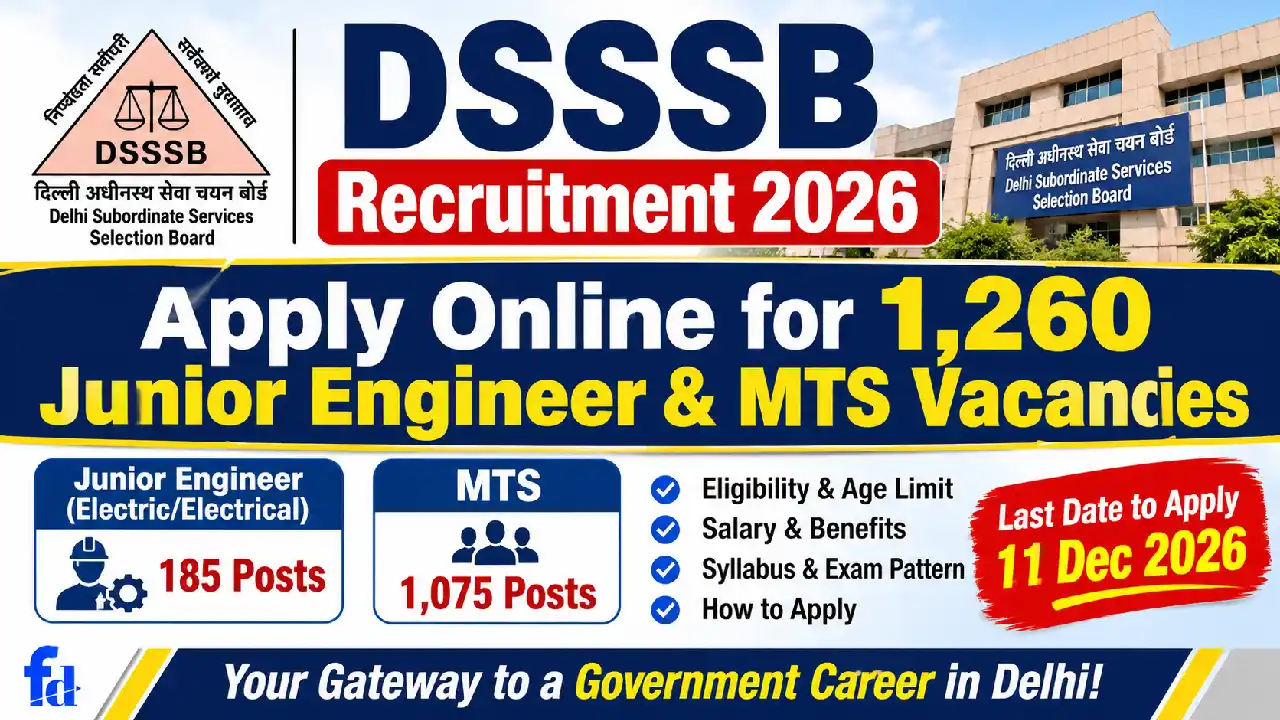
DSSSB Recruitment 2026 notification out for 1,260 JE and MTS posts. Check eligibility, salary, vacancies, syllabus, exam pattern and apply online by 11 December.
DSSSB Recruitment 2026 – Overview
The Delhi Subordinate Services Selection Board (DSSSB) has announced a major government recruitment opportunity through Advertisement No. 06/2026.
The latest recruitment drive invites applications for 1,260 Junior Engineer (Electric/Electrical) and Multi-Tasking Staff (MTS) vacancies across several departments and autonomous bodies under the Government of the National Capital Territory of Delhi.
The recruitment notification, dated 6 November 2026, covers two major post codes: 809/26 for Junior Engineer positions and 810/26 for Multi-Tasking Staff positions.
These vacancies are distributed among organizations such as the New Delhi Municipal Council (NDMC), Municipal Corporation of Delhi (MCD), Delhi Transco Limited, Delhi Urban Shelter Improvement Board (DUSIB), Directorate of Education and other government departments.
This recruitment is particularly attractive because it offers opportunities to candidates with different educational backgrounds. Engineering graduates and diploma holders can apply for the Junior Engineer positions, subject to department-specific experience requirements, while candidates who have completed Class 10 can apply for most MTS positions.
The online application process will begin on 12 November 2026 at 12:00 noon and continue until 11 December 2026 at 11:59 PM. Candidates must submit their applications through the official DSSSB Online Application Registration System.
The selection process consists of a two-tier technical examination for Junior Engineer candidates and a one-tier general examination for MTS candidates. Successful candidates will subsequently undergo document scrutiny and departmental allocation according to merit and preferences.
Here is a quick overview of the recruitment:
Particular | Details |
Recruiting Organization | Delhi Subordinate Services Selection Board |
Recruitment Name | DSSSB Combined Examination 2026 |
Advertisement Number | 06/2026 |
Advertisement Date | 6 November 2026 |
Total Vacancies | 1,260 |
Post 1 | Junior Engineer (Electric/Electrical) |
Post 2 | Multi-Tasking Staff (MTS) |
Post Codes | 809/26 and 810/26 |
Job Category | Delhi Government Jobs |
Application Mode | Online |
Application Start Date | 12 November 2026 |
Last Date to Apply | 11 December 2026 |
Selection Process | Online Written Examination and Document Verification |
Application Fee | ₹100 (applicable candidates) |
Job Location | Delhi |
Official Website | dsssb.delhi.gov.in |
The vacancies are tentative and may change depending on departmental requirements. Candidates should refer to the official advertisement before submitting their applications.
About the Delhi Subordinate Services Selection Board (DSSSB)
The Delhi Subordinate Services Selection Board is an important recruitment organization functioning under the Government of the National Capital Territory of Delhi. It was established through a government resolution dated 4 October 1996, with the objective of creating a centralized, transparent and merit-based recruitment mechanism for various government departments and local bodies in Delhi.
Before DSSSB was established, different departments and organizations followed separate recruitment procedures. This created administrative difficulties and resulted in multiple recruitment authorities handling similar categories of government positions.
To improve the recruitment system, the Delhi Government established DSSSB as an independent selection board responsible primarily for recruiting candidates to Group B (Non-Gazetted) and Group C positions.
The Board conducts examinations and other selection procedures to identify qualified candidates for various technical and non-technical government positions.
Major responsibilities of DSSSB
The Board performs several important recruitment-related functions:
- Conducting competitive written examinations for notified government vacancies.
- Recruiting candidates for technical and non-technical positions.
- Coordinating recruitment for Delhi Government departments and local bodies.
- Preparing examination schedules and publishing admit cards.
- Releasing answer keys and providing an objection mechanism.
- Preparing merit lists and recommending eligible candidates.
- Coordinating document verification and e-dossier processes.
DSSSB recruitment covers a wide range of departments, including education, municipal administration, infrastructure, public services and other government organizations.
Organizations covered under this recruitment
The present recruitment drive includes vacancies in:
- New Delhi Municipal Council (NDMC).
- Municipal Corporation of Delhi (MCD).
- Delhi Transco Limited.
- Delhi Urban Shelter Improvement Board (DUSIB).
- Delhi Agricultural Marketing Board.
- Directorate of Education.
- Department of Trade and Taxes.
- Directorate of Higher Education.
- Weights and Measures Department.
- Principal Accounts Office.
- Land and Building Department.
- Office of the Chief Electoral Officer.
Candidates should understand that DSSSB conducts the recruitment examination, whereas the concerned user departments handle the eventual appointment and service-related matters.
Official organizational information is available on the DSSSB website: https://dsssb.delhi.gov.in/dsssb/about-us.
DSSSB Recruitment 2026 – Complete Vacancy Details
The recruitment notification advertises a total of 1,260 vacancies under two post codes.
- Post Code 809/26: Junior Engineer (Electric/Electrical).
- Post Code 810/26: Multi-Tasking Staff, including MTS General Duty and MTS Aaya (Female).
A. Junior Engineer vacancies – 185 posts
The Junior Engineer vacancies are distributed across five organizations.
Department | Post | Vacancies |
NDMC | Junior Engineer (Electric) | 67 |
Delhi Agricultural Marketing Board | Junior Engineer (Electrical) | 3 |
MCD | Junior Engineer (Electrical) | 26 |
Delhi Transco Limited | Junior Engineer (Electrical) | 75 |
DUSIB | Junior Engineer (Electrical) | 14 |
Total | 185 |
Delhi Transco Limited has the highest number of Junior Engineer vacancies, with 75 posts, followed by NDMC with 67 posts.
Candidates should carefully compare the qualifications, experience requirements and pay levels of these departments before selecting their preferences.
B. Multi-Tasking Staff vacancies – 1,075 posts
The MTS vacancies are distributed across nine departments.
Department | Post | Vacancies |
Directorate of Education | MTS General Duty | 757 |
Directorate of Education | MTS Aaya (Female) | 239 |
Department of Trade & Taxes | MTS | 26 |
DUSIB | MTS | 20 |
Weights and Measures Department | MTS | 19 |
Land and Building Department | MTS | 7 |
Directorate of Higher Education | MTS | 3 |
Principal Accounts Office | MTS | 2 |
Office of the Chief Electoral Officer | MTS | 2 |
Total | 1,075 |
The Directorate of Education accounts for 996 MTS vacancies, including 757 General Duty positions and 239 Aaya positions.
Important: The MTS Aaya vacancies are specifically designated for female candidates. Candidates must check the department-specific suitability and eligibility requirements.
C. Category-wise vacancy distribution
The combined reservation distribution is as follows:
Category | Junior Engineer | MTS | Total |
General / UR | 98 | 439 | 537 |
OBC | 33 | 292 | 325 |
SC | 23 | 158 | 181 |
ST | 14 | 80 | 94 |
EWS | 17 | 106 | 123 |
Total | 185 | 1,075 | 1,260 |
The notification also identifies horizontal reservation figures of 52 PwBD, 107 Ex-Servicemen and 52 Meritorious Sportspersons vacancies. These are included within the advertised category-wise totals and must not be added separately.
The vacancy figures are tentative and can be revised by the concerned departments.
Detailed Job Profile and Key Responsibilities
Candidates should understand the actual nature of the work before choosing between Junior Engineer and MTS positions.
These jobs differ significantly in their technical requirements, working environments and daily responsibilities.
A. Junior Engineer (Electric/Electrical)
Junior Engineers will work in technical departments responsible for electrical infrastructure, installations, maintenance and related engineering operations.
Depending on the appointing department, their duties may involve:
- Electrical installation and maintenance
- Supervising electrical installations.
- Inspecting electrical equipment and infrastructure.
- Identifying technical faults.
- Coordinating repair and maintenance activities.
- Ensuring that electrical systems operate safely.
- Technical supervision
- Monitoring electrical maintenance work.
- Checking the quality of electrical installations.
- Coordinating with technicians and contractors.
- Ensuring compliance with technical specifications.
- Reporting maintenance requirements to senior engineers.
- Inspection and documentation
- Preparing technical inspection reports.
- Maintaining equipment and maintenance records.
- Recording breakdowns and repair activities.
- Monitoring material requirements.
- Assisting with estimates and technical documentation.
- Safety and compliance
- Ensuring adherence to electrical safety procedures.
- Identifying hazardous installations.
- Monitoring appropriate protective measures.
- Supporting preventive maintenance programmes.
Department-specific work environments
Department | Likely nature of work |
NDMC | Electrical infrastructure and municipal services |
MCD | Municipal electrical installations and maintenance |
Delhi Transco Limited | Electrical transmission infrastructure and related technical operations |
DUSIB | Electrical facilities associated with housing and urban shelter infrastructure |
Delhi Agricultural Marketing Board | Electrical installations and maintenance in departmental facilities |
The actual responsibilities will depend on departmental recruitment rules and work allocation.
B. Multi-Tasking Staff (MTS)
MTS employees generally provide administrative, operational and support services to government departments.
Their duties may include:
- Maintaining office cleanliness and basic workplace organization.
- Moving files and official documents.
- Assisting with photocopying and document distribution.
- Supporting record management.
- Delivering official correspondence.
- Assisting departmental staff with routine administrative work.
- Helping with general office arrangements.
MTS Aaya (Female)
The Aaya designation is specifically associated with the female MTS vacancies advertised under the Directorate of Education.
Depending on the institution and departmental assignment, responsibilities may include assisting with child-care-related support activities, maintaining cleanliness and helping with routine support requirements.
Candidates should refer to the applicable departmental service rules for the precise duties.
MTS departmental responsibilities
MTS employees working in departments such as Trade and Taxes, DUSIB, Higher Education and the Principal Accounts Office may be assigned duties according to the operational needs of their respective offices.
The role is generally suitable for candidates seeking entry-level government employment.
DSSSB Recruitment 2026 – Eligibility Criteria
Eligibility is one of the most important aspects of this recruitment because the educational qualifications and experience requirements differ between departments.
Candidates must satisfy the prescribed conditions on the crucial eligibility date, 11 December 2026.
A. Educational qualifications
Junior Engineer (Electric/Electrical)
The educational qualification depends on the department.
Department | Required qualification |
NDMC | Degree in Electrical Engineering OR Diploma with 2 years of professional experience |
MCD | Degree in Electrical Engineering OR Diploma with 2 years of professional experience |
Delhi Transco Limited | Degree or Diploma in Electrical Engineering |
DUSIB | Diploma in Electrical Engineering |
Delhi Agricultural Marketing Board | Diploma in Electrical Engineering with 2 years of electrical installation/maintenance experience |
Candidates must possess qualifications from recognized institutions as prescribed in the notification.
An important point is that a diploma holder cannot automatically apply to every Junior Engineer vacancy. Some departments specifically require two years of relevant professional experience.
MTS positions
For most MTS vacancies, the minimum qualification is:
- Matriculation (Class 10) or equivalent from a recognized board.
For the DUSIB MTS position, the notification additionally accepts an Industrial Training Institute (ITI) qualification from a recognized institute.
No previous work experience is prescribed for the MTS vacancies.
B. Age limit
The general age limit for most positions is 18 to 27 years.
However, the NDMC Junior Engineer (Electric) position allows an upper age limit of 32 years.
Position | Minimum age | Maximum age |
Junior Engineer – NDMC | 18 | 32 |
Junior Engineer – MCD | 18 | 27 |
Junior Engineer – Delhi Transco | 18 | 27 |
Junior Engineer – DUSIB | 18 | 27 |
Junior Engineer – DAMB | 18 | 27 |
MTS – All departments | 18 | 27 |
The age calculation will be based on 11 December 2026.
C. Age relaxation
Applicable age relaxations include:
Category | Upper-age relaxation |
SC/ST | 5 years |
OBC (Delhi) | 3 years |
PwBD | 10 years |
PwBD + SC/ST | 15 years |
PwBD + OBC | 13 years |
Departmental candidates for eligible Group B posts | Up to 5 years |
Meritorious Sportspersons (eligible Group C posts) | As prescribed in the notification |
Ex-Servicemen | As per applicable government rules |
Additional provisions apply to certain departmental and contractual employees, widows and other eligible categories.
OBC reservation warning: OBC candidates from outside Delhi are generally treated as Unreserved candidates. Only candidates satisfying the Delhi Government’s prescribed OBC reservation conditions can claim the OBC benefits.
D. Nationality
Candidates must be Indian citizens.
They should possess valid supporting documents to establish their eligibility and reservation claims wherever applicable.
E. Physical standards
The advertisement does not prescribe a universal physical endurance test or common physical measurement standard for all these positions.
However, candidates with benchmark disabilities must check the post-specific disability suitability conditions listed in the official notification.
DSSSB Recruitment 2026 – Salary and Benefits
One of the biggest attractions of DSSSB recruitment is the opportunity to work in government departments with structured pay levels.
The salary depends on the post and the department.
A. Junior Engineer salary
Department | Pay scale | Pay level |
NDMC | ₹35,400–₹1,12,400 | Level 6 |
MCD | ₹35,400–₹1,12,400 | Level 6 |
DUSIB | ₹35,400–₹1,12,400 | Level 6 |
Delhi Transco Limited | ₹52,000–₹1,51,100 | Level 8 |
Delhi Agricultural Marketing Board | ₹9,300–₹34,800 + ₹4,200 Grade Pay | As specified in notification |
Delhi Transco Limited offers the highest advertised Junior Engineer pay scale among these departments.
B. MTS salary
MTS employees are placed in:
Pay Level 1 – ₹18,000 to ₹56,900.
This applies to the MTS positions advertised under the different departments.
C. Additional benefits
Depending on the applicable service rules and employment conditions, government employees may receive:
- Dearness Allowance (DA).
- House Rent Allowance (HRA), where admissible.
- Transport Allowance.
- Medical facilities or applicable medical reimbursement.
- Leave benefits.
- Retirement benefits under the applicable government pension framework.
- Other allowances permitted by the employing organization.
The actual in-hand salary will depend on the pay level, current allowance rates, posting location and statutory deductions.
Understanding basic and in-hand salary
Candidates should not assume that the maximum pay-scale figure is their starting salary.
For example, an MTS employee starts at the basic pay applicable to Level 1, not ₹56,900.
Similarly, a Junior Engineer appointed at Level 6 generally begins at the corresponding entry basic pay, subject to the applicable pay rules.
The final gross salary includes admissible allowances, while the in-hand salary is calculated after deductions.
Important Dates and Deadlines
Candidates must keep track of all important dates to avoid missing the application deadline.
Recruitment Event | Important Date |
Official notification released | 6 November 2026 |
Online application begins | 12 November 2026 |
Application opening time | 12:00 noon |
Last date to submit application | 11 December 2026 |
Application closing time | 11:59 PM |
Eligibility cut-off date | 11 December 2026 |
Admit card release | To be announced |
Junior Engineer examination | To be announced |
MTS examination | To be announced |
Result declaration | To be announced |
The examination dates have not been announced in the advertisement. Candidates should regularly visit the official DSSSB website for updates.
Application status as of 8 November 2026: Notification released; online applications have not yet opened.
DSSSB Recruitment 2026 – Selection Process and Exam Pattern
DSSSB has prescribed different examination schemes for Junior Engineer and MTS candidates.
The Junior Engineer selection process consists of a two-tier technical examination, whereas MTS candidates will appear for a one-tier general examination.
A. Junior Engineer selection process
The selection procedure includes:
- Tier-I online examination.
- Tier-II technical examination.
- Preparation of the final merit list.
- Online e-dossier submission.
- Department preference and allocation.
- Verification of eligibility documents by the concerned department.
Tier-I examination pattern
Subject | Questions | Marks |
General Awareness | 20 | 20 |
General Intelligence and Reasoning | 20 | 20 |
Arithmetical and Numerical Ability | 20 | 20 |
Hindi Language and Comprehension | 20 | 20 |
English Language and Comprehension | 20 | 20 |
Electrical Engineering | 100 | 100 |
Total | 200 | 200 |
- Examination duration: 2 hours.
- Question type: Multiple Choice Questions.
- Total marks: 200.
- Tier-I is qualifying in nature and used to shortlist candidates for Tier-II.
The qualifying requirements apply to the domain-specific section and cumulative examination marks. Section A does not have a separate minimum qualifying requirement.
Tier-II examination pattern
Component | Questions | Marks |
Part I – Technical subject | 100 | 100 |
Part II – Application and problem-solving | 50 | 100 |
Total | 150 | 200 |
- Examination duration: 2 hours 30 minutes.
- Part I contains one-mark questions.
- Part II contains two-mark questions.
- Both parts contribute to the final merit list.
Tier-II tests not only theoretical knowledge but also the ability to apply engineering concepts to practical situations.
B. MTS examination pattern
MTS candidates will appear for a single-tier general examination.
Subject | Questions | Marks |
General Awareness | 40 | 40 |
General Intelligence and Reasoning | 40 | 40 |
Arithmetical and Numerical Ability | 40 | 40 |
Hindi Language and Comprehension | 40 | 40 |
English Language and Comprehension | 40 | 40 |
Total | 200 | 200 |
- Duration: 2 hours.
- Total questions: 200.
- Total marks: 200.
- Question type: Objective multiple-choice questions.
- Final merit is based on examination performance, subject to qualifying requirements.
C. Negative marking
Negative marking applies to both recruitment examinations.
Question Type | Deduction |
Incorrect one-mark question | 0.25 marks |
Incorrect two-mark question | 0.50 marks |
For MTS, each incorrect answer results in a deduction of 0.25 marks.
Candidates should avoid random guessing and develop a strategy that balances accuracy with speed.
D. Minimum qualifying marks
The prescribed minimum qualifying percentages are:
Category | Minimum qualifying marks |
General | 40% |
EWS | 40% |
OBC (Delhi) | 35% |
SC | 30% |
ST | 30% |
PwBD | 30% |
Eligible Ex-Servicemen receive the prescribed relaxation within their category, subject to the minimum qualifying requirement of 30%.
Meeting the minimum qualifying marks does not guarantee selection. Final selection depends on merit, vacancies, applicable reservation rules and departmental preferences.
E. Language of examination
The examination questions are generally bilingual in Hindi and English, except for the respective language sections, which are presented in the concerned language.
Comprehensive DSSSB Syllabus 2026
The syllabus is one of the most important parts of the recruitment preparation process.
Candidates should prepare according to the examination scheme prescribed for their respective post codes.
The notification specifies the examination subjects and technical-domain requirements. The following chapter-wise topics are recommended preparation coverage, not a claim that DSSSB has published every topic as a separate official syllabus heading.
A. MTS syllabus
1. General Awareness
Candidates should prepare:
- Indian history and freedom movement.
- Indian Constitution and political system.
- Indian geography.
- Indian economy.
- General science.
- Important national and international events.
- Government schemes.
- Sports and awards.
- Important days and observances.
- Books and authors.
- Current affairs.
- Delhi-related general knowledge.
Preparation tip: Read daily current affairs and revise static General Knowledge regularly. Focus on factual accuracy rather than memorizing too many unrelated details.
2. General Intelligence and Reasoning
Important topics include:
- Analogy.
- Classification.
- Number series.
- Alphabet series.
- Coding and decoding.
- Blood relations.
- Direction sense.
- Ranking and order.
- Venn diagrams.
- Syllogism.
- Statement and conclusion.
- Missing numbers.
- Non-verbal reasoning.
- Figure-based problems.
- Logical sequences.
Preparation tip: Practise reasoning questions every day. Begin with basic questions and gradually move towards timed mock tests.
3. Arithmetical and Numerical Ability
Important topics include:
- Number system.
- Simplification.
- Percentage.
- Ratio and proportion.
- Average.
- Profit and loss.
- Discount.
- Simple and compound interest.
- Time and work.
- Time, speed and distance.
- Mensuration.
- HCF and LCM.
- Fractions and decimals.
- Data interpretation.
Preparation tip: Build calculation speed and revise mathematical formulas. Practise questions under timed conditions because numerical accuracy can significantly influence your final score.
4. Hindi Language and Comprehension
Important topics include:
- हिंदी व्याकरण.
- संज्ञा, सर्वनाम और विशेषण.
- क्रिया और काल.
- विलोम शब्द.
- पर्यायवाची शब्द.
- मुहावरे और लोकोक्तियाँ.
- संधि और समास.
- वाक्य शुद्धि.
- अशुद्धि सुधार.
- गद्यांश आधारित प्रश्न.
- शब्दावली और भाषा प्रयोग.
5. English Language and Comprehension
Important topics include:
- Grammar.
- Vocabulary.
- Synonyms and antonyms.
- Sentence correction.
- Error detection.
- Articles.
- Prepositions.
- Tenses.
- Active and passive voice.
- Direct and indirect speech.
- Fill in the blanks.
- Idioms and phrases.
- Reading comprehension.
- Sentence rearrangement.
B. Junior Engineer Electrical syllabus
Junior Engineer candidates should give particular attention to the technical section because it accounts for a substantial portion of the examination.
Recommended preparation topics include:
1. Basic Electrical Engineering
- Electrical quantities and units.
- Ohm’s Law.
- Kirchhoff’s Laws.
- Series and parallel circuits.
- Electrical power and energy.
- Network theorems.
- Magnetic circuits.
- Electromagnetic induction.
- Single-phase and three-phase circuits.
2. Electrical Machines
- DC generators.
- DC motors.
- Transformers.
- Three-phase induction motors.
- Single-phase induction motors.
- Synchronous generators.
- Synchronous motors.
- Motor starting methods.
- Speed control.
- Efficiency and losses.
3. Power Systems
- Electrical power generation.
- Transmission and distribution.
- Transmission line parameters.
- Substations.
- Electrical switchgear.
- Circuit breakers.
- Protective relays.
- Earthing systems.
- Power system faults.
- Load management.
- Power factor improvement.
4. Electrical Measurements and Instruments
- Ammeter and voltmeter.
- Wattmeter.
- Energy meter.
- Multimeter.
- Instrument transformers.
- Measurement errors.
- Measurement of electrical quantities.
- Calibration principles.
5. Electrical Installation and Maintenance
- Electrical wiring systems.
- Cable selection.
- Electrical protection.
- Electrical safety.
- Insulation resistance.
- Maintenance procedures.
- Fault identification.
- Testing of electrical equipment.
- Electrical installation standards.
6. Power Electronics
- Semiconductor devices.
- Diodes.
- Thyristors.
- Rectifiers.
- Inverters.
- Choppers.
- AC voltage controllers.
- Power electronic applications.
7. Control Systems
- Open-loop and closed-loop systems.
- Transfer functions.
- Block diagrams.
- Feedback systems.
- Stability concepts.
- Time response.
- Basic control system applications.
8. Electrical Utilization
- Electric heating.
- Electric traction.
- Illumination.
- Industrial drives.
- Electrical energy utilization.
- Power factor correction.
9. Basic Electronics
- Semiconductor fundamentals.
- Diode applications.
- Transistors.
- Amplifiers.
- Digital electronics.
- Logic gates.
- Boolean algebra.
Candidates should use their recognized Electrical Engineering diploma or degree syllabus as the foundation for technical preparation.
DSSSB 2026 Preparation Strategy
A well-planned preparation strategy can help candidates improve their examination performance.
The most effective approach is to combine conceptual learning, revision, previous-question practice and regular mock examinations.
A. Preparation strategy for MTS candidates
Step 1: Understand the examination structure
Start by understanding the five examination subjects and their equal weightage.
Each subject carries 40 marks, so neglecting any one subject can reduce the overall score.
Step 2: Build fundamentals
Focus on arithmetic, grammar and reasoning fundamentals before attempting advanced practice questions.
Step 3: Prepare General Awareness consistently
Maintain a daily current-affairs routine and revise important static GK topics.
Step 4: Practise language sections
Improve Hindi and English comprehension through regular reading, grammar exercises and vocabulary revision.
Step 5: Attempt mock examinations
Take full-length mock tests under the actual two-hour time limit.
Analyse mistakes and identify subjects requiring additional attention.
B. Preparation strategy for Junior Engineer candidates
Step 1: Prioritize technical subjects
The technical component carries 100 marks in Tier-I. It should receive substantial preparation time.
Step 2: Revise engineering fundamentals
Start with circuit theory, electrical machines, power systems and electrical measurements.
Step 3: Practise numerical problems
Solve problems involving circuits, transformers, motors, power calculations and electrical networks.
Step 4: Prepare for application-based questions
Tier-II Part II tests the ability to apply theoretical concepts and solve technical problems.
Therefore, avoid relying exclusively on memorized definitions.
Step 5: Prepare General Awareness and Reasoning
Although technical knowledge is important, candidates should not ignore the non-technical Tier-I subjects.
C. Suggested weekly preparation schedule
Day | Main preparation focus |
Monday | Technical subjects / Mathematics |
Tuesday | Electrical Machines / Reasoning |
Wednesday | Power Systems / General Awareness |
Thursday | Electrical Measurements / English |
Friday | Power Electronics / Hindi |
Saturday | Technical revision / Numerical practice |
Sunday | Full-length mock test and analysis |
MTS candidates can substitute the technical subjects with arithmetic, reasoning and General Awareness practice.
D. Recommended preparation resources
Candidates can use:
- NCERT books for basic science and General Knowledge.
- Standard competitive examination reasoning books.
- Quantitative aptitude practice books.
- Standard Hindi and English grammar books.
- Diploma and degree-level Electrical Engineering textbooks.
- DSSSB previous examination papers where available.
- Official DSSSB mock-test resources.
The Board also provides access to an online mock-test facility through its official website.
Application Fees and Payment Mode
The application fee for DSSSB Advertisement No. 06/2026 is ₹100 for applicable candidates.
The category-wise fee structure is:
Candidate Category | Application Fee |
General Male | ₹100 |
OBC Male | ₹100 |
EWS Male | ₹100 |
Women (all categories) | Exempted |
SC | Exempted |
ST | Exempted |
PwBD | Exempted |
Eligible Ex-Servicemen | Exempted |
The payment must be completed through SBI e-pay.
Candidates should remember:
- The application fee is non-refundable.
- Payments through other methods are not accepted.
- Eligible exempted candidates do not need to pay the application fee.
- Ex-Servicemen who have already secured regular civil employment after using ESM reservation benefits are not eligible for the fee concession described in the advertisement.
Step-by-Step Guide to Apply Online for DSSSB Recruitment 2026
Candidates must submit their applications online through the official DSSSB Online Application Registration System (OARS).
The application process is expected to open on 12 November 2026.
Follow these instructions carefully.
Step 1: Visit the official DSSSB website
Open:
Navigate to the Vacancies section and locate Advertisement No. 06/2026.
Step 2: Download and read the official notification
Download the detailed advertisement PDF and verify:
- Post code.
- Department.
- Educational qualification.
- Age limit.
- Experience requirements.
- Reservation conditions.
- Pay scale.
- Examination scheme.
Do not select a post simply because you meet the minimum educational qualification. Department-specific eligibility is important.
Step 3: Open the online application portal
Visit:
Select the new registration option if you do not already have an OARS registration.
Step 4: Complete the registration process
Enter the required personal information, including:
- Candidate’s name.
- Father’s name.
- Date of birth.
- Gender.
- Mobile number.
- Email address.
- Other prescribed registration details.
Use an active mobile number and email address.
Important: DSSSB permits only one OARS registration. Multiple registrations can lead to cancellation of candidature and possible debarment.
The notification also warns that certain basic registration particulars, including name, gender and father’s name, cannot be edited later. Enter them carefully.
Step 5: Log in to your account
After completing registration, use your registration number and password to access the application portal.
Select the relevant recruitment advertisement.
Candidates should select:
- Post Code 809/26 for Junior Engineer.
- Post Code 810/26 for MTS.
Step 6: Fill in the application form
Enter all required information accurately.
This may include:
- Personal details.
- Communication address.
- Educational qualifications.
- Technical qualifications.
- Professional experience, where applicable.
- Reservation category.
- Other eligibility-related details.
For Junior Engineer applicants, ensure that the qualification and experience details match the selected department’s requirements.
Step 7: Upload photograph and signature
Upload a recent, clear colour photograph with a plain white or off-white background.
The photograph and signature must be legible and comply with the portal’s displayed upload specifications.
The official notification does not establish one universal pixel-dimension and file-size specification for every upload. Therefore, follow the actual instructions displayed in OARS rather than relying on dimensions published by unofficial websites.
Step 8: Pay the application fee
Candidates who are not exempted must pay ₹100 through SBI e-pay.
Verify the payment status before proceeding.
Step 9: Review the complete application
Before final submission, carefully check:
- Name and date of birth.
- Educational qualifications.
- Category selection.
- Post code.
- Department eligibility.
- Contact details.
- Uploaded photograph and signature.
- Fee payment status.
Step 10: Submit the application
Submit the completed form through the portal.
Download or print the final application confirmation for future reference.
Important: DSSSB does not permit corrections after final application submission under the advertised instructions. Candidates should therefore avoid rushing through the application process.
Important Documents Required
Candidates should keep the following documents and information ready before applying.
Document | Purpose |
Recent photograph | Online application |
Signature | Online application |
Class 10 certificate | Date of birth and educational qualification |
Diploma certificate | Junior Engineer eligibility, where applicable |
Degree certificate | Junior Engineer eligibility, where applicable |
Experience certificate | Applicable Junior Engineer vacancies |
Caste certificate | SC/ST/OBC reservation |
EWS certificate | EWS reservation |
PwBD certificate | Disability-related benefits |
Ex-Servicemen documents | Applicable reservation and relaxation |
Identity proof | Verification |
Active mobile number | Registration and communication |
Active email address | Recruitment updates |
Additional documents may be required during the e-dossier and verification stages.
Important reservation-document instructions
OBC candidates: The notification specifies Delhi-specific OBC reservation conditions. Candidates from other states who do not meet the prescribed Delhi eligibility conditions will generally be treated as Unreserved.
EWS candidates: The prescribed Income and Asset Certificate must be valid for financial year 2026–2027 and based on income for financial year 2025–2026.
SC/ST candidates: Valid certificates issued by competent authorities must be produced.
PwBD candidates: The disability certificate must satisfy the relevant government requirements and post-specific suitability provisions.
Official Links – DSSSB Recruitment 2026
Candidates should use only the official government recruitment websites for notifications and applications.
Purpose | Official Link |
Official Notification PDF | |
Direct Online Application | |
Official DSSSB Website | |
Latest Vacancy Notifications | |
Official Notifications | |
About DSSSB |
Note: The online application portal will accept applications within the prescribed application window. Candidates should not confuse the notification release date with the application opening date.
Conclusion – Should You Apply for DSSSB Recruitment 2026?
The DSSSB Recruitment 2026 for 1,260 Junior Engineer and Multi-Tasking Staff vacancies is an important opportunity for candidates seeking employment in Delhi Government departments.
The recruitment offers opportunities at different educational levels, making it accessible to both engineering-qualified applicants and candidates who have completed Class 10.
For engineering diploma holders and graduates, the Junior Engineer positions offer technical career opportunities, with particularly attractive pay scales in departments such as Delhi Transco Limited.
For candidates seeking entry-level government employment, the MTS vacancies provide a valuable opportunity to enter public service without requiring a university degree.
However, applicants should not make their decisions based only on the total vacancy count. Department-specific qualifications, age limits, experience requirements and reservation conditions must be examined carefully.
Here are the most important recommendations for applicants:
- Download the official notification and read the department-wise eligibility requirements.
- Confirm that your educational qualifications and experience match the selected post.
- Check the OBC, EWS and other reservation conditions before applying.
- Complete your OARS registration carefully.
- Prepare according to the prescribed examination pattern.
- Practise mock tests and previous examination questions.
- Monitor the official website for admit cards, examination schedules and corrigenda.
- Submit your application before 11 December 2026.
Final Advice: Do not wait until the final application day. Complete your registration and application as soon as the portal opens on 12 November 2026, and begin your examination preparation without delay.
A government career requires patience, consistency and focused preparation. Candidates who understand the examination pattern, select the correct department and prepare strategically will be better positioned to compete for these opportunities.
Research sources and accuracy notes
The article is based primarily on the official 32-page DSSSB Advertisement No. 06/2026, with additional organizational information from DSSSB’s official website.
- Official advertisement and vacancy distribution: DSSSB Official Notification
- Department-wise qualifications, age limits and salary: DSSSB announcement
- Examination scheme and negative marking: DSSSB Examination Scheme
- Application fees and reservation conditions: DSSSB Application Fees
- DSSSB history and organizational mandate: About Delhi Subordinate Services Selection Board
Editorial accuracy note: The technical and general preparation topics are recommended study areas, not a claim that the notification publishes a fully itemized chapter-wise syllabus. Job responsibilities are indicative and depend on the appointing department. Salary allowances and actual take-home pay are not guaranteed figures.
Frequently Asked Questions (FAQs)
Q1. How many vacancies are available under DSSSB Recruitment 2026?
DSSSB has advertised 1,260 vacancies under Advertisement No. 06/2026.
These include 185 Junior Engineer vacancies and 1,075 Multi-Tasking Staff vacancies.
Q2. What is the last date to apply for DSSSB Recruitment 2026?
The last date for online application submission is 11 December 2026, 11:59 PM.
Candidates should complete the application well before the deadline to avoid last-minute technical difficulties.
Q3. When will the DSSSB JE and MTS applications begin?
The online application process begins on 12 November 2026 at 12:00 noon through the official OARS portal.
Q4. What is the educational qualification for DSSSB MTS Recruitment 2026?
Most MTS positions require candidates to have passed Class 10 or an equivalent examination from a recognized board.
For DUSIB MTS vacancies, an ITI qualification from a recognized institute is also accepted.
Q5. Can diploma holders apply for DSSSB Junior Engineer Recruitment 2026?
Yes. Diploma holders in Electrical Engineering can apply for the relevant Junior Engineer vacancies.
However, some departments require two years of relevant professional experience. For example, NDMC and MCD accept diploma holders with the prescribed experience, while Delhi Transco and DUSIB do not require that additional experience.
Q6. What is the age limit for DSSSB Recruitment 2026?
The general age limit is 18–27 years for MTS and most Junior Engineer positions.
For the NDMC Junior Engineer (Electric) position, the upper age limit is 32 years.
Applicable category-based age relaxations are available under government rules.
Q7. What is the salary of DSSSB MTS employees?
MTS employees are placed in Pay Level 1, with a pay scale of ₹18,000–₹56,900.
Allowances and deductions depend on applicable service rules and the employing department.
Q8. What is the salary of DSSSB Junior Engineers?
The advertised pay scales differ by department.
- NDMC, MCD and DUSIB: ₹35,400–₹1,12,400.
- Delhi Transco Limited: ₹52,000–₹1,51,100.
- Delhi Agricultural Marketing Board: ₹9,300–₹34,800 plus ₹4,200 Grade Pay.
Q9. Is there negative marking in the DSSSB examination?
Yes. DSSSB has prescribed negative marking.
A deduction of 0.25 marks applies to incorrect one-mark questions, while a deduction of 0.50 marks applies to incorrect two-mark questions.
Q10. What is the examination pattern for DSSSB MTS Recruitment 2026?
The MTS examination consists of 200 multiple-choice questions carrying 200 marks.
The five subjects are General Awareness, Reasoning, Numerical Ability, Hindi and English.
The examination duration is two hours.
Q11. Is the DSSSB Junior Engineer examination conducted in two stages?
Yes. The Junior Engineer examination follows a two-tier technical examination scheme.
Tier-I consists of 200 questions for 200 marks, while Tier-II consists of 150 questions for 200 marks.
Tier-I is qualifying in nature, while Tier-II marks determine final merit.
Q12. Are female candidates eligible for DSSSB MTS Recruitment 2026?
Yes. Female candidates can apply for the general MTS vacancies if they meet the applicable eligibility requirements.
Additionally, 239 vacancies have been specifically notified for MTS Aaya (Female) under the Directorate of Education.
Q13. What is the application fee for DSSSB Recruitment 2026?
The application fee is ₹100 for applicable candidates.
Women, SC, ST, PwBD and eligible Ex-Servicemen candidates are exempted from paying the fee, subject to the conditions in the advertisement.
Q14. When will the DSSSB JE and MTS examination be conducted?
The examination date has not yet been announced.
DSSSB will publish the examination schedule and admit-card updates on its official website.
Q15. Can OBC candidates from other states claim reservation under DSSSB Recruitment 2026?
Generally, candidates belonging to OBC categories outside Delhi are treated as Unreserved.
Only candidates satisfying the specific Delhi Government OBC reservation conditions can claim OBC reservation benefits.
Candidates should read the OBC eligibility provisions in the official advertisement carefully.
