
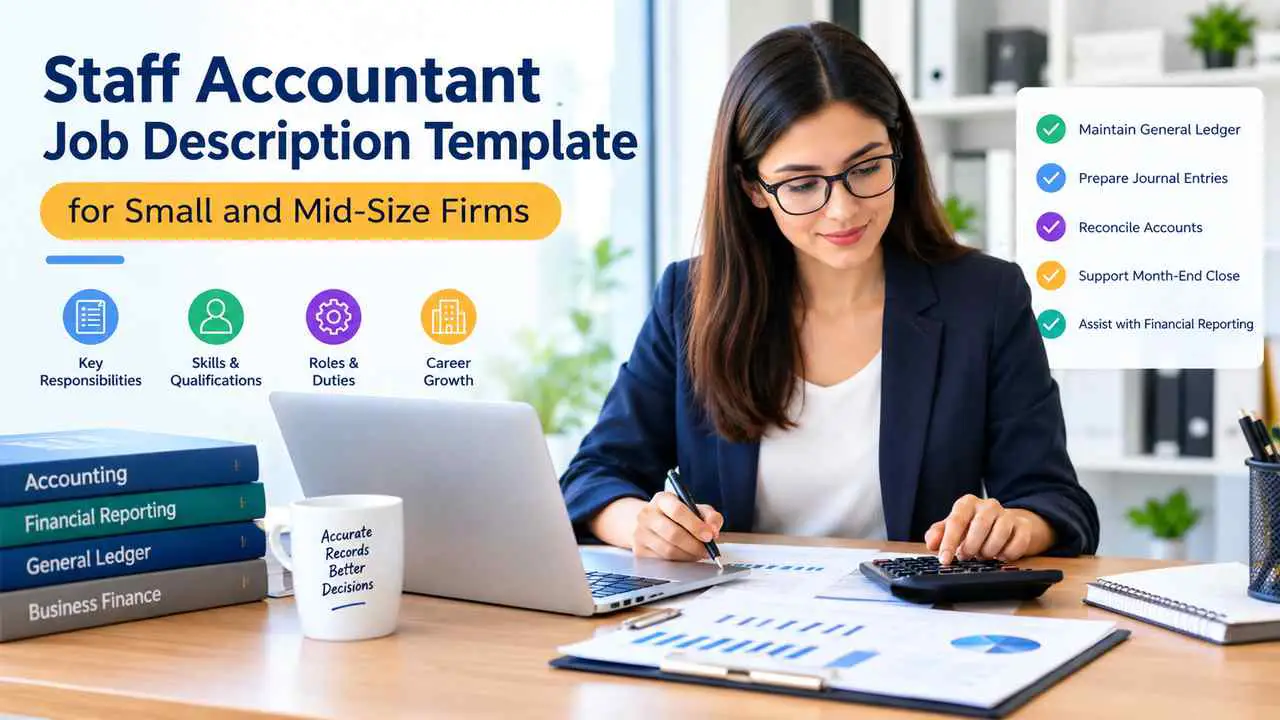
Small and mid-size firms need accurate financial records without building a large accounting department, which is why a well-written staff accountant job description template example can help employers define the position clearly, attract suitable candidates, and set realistic expectations from the first day.
A Staff Accountant often handles a broad mix of accounting work, including journal entries, reconciliations, accounts payable and receivable support, general ledger maintenance, month-end close activities, financial reporting, and documentation. Unlike highly specialized accounting positions found in large corporations, this role may require one person to manage several parts of the accounting cycle.
This article explains the role, responsibilities, qualifications, skills, reporting structure, hiring considerations, and practical job description elements that small and mid-size U.S. firms should consider.
What Is a Staff Accountant?
A Staff Accountant is an accounting professional responsible for maintaining accurate financial records and supporting the company’s day-to-day and period-end accounting processes.
The position usually sits between entry-level accounting support and more senior accounting positions. However, the exact level can vary significantly between companies.
In a small company, a Staff Accountant may work directly with the owner, Controller, CFO, or outside CPA. In a mid-size organization, the same position may sit within a structured accounting team and focus on a defined group of accounts or processes.
Typical work may include:
- Recording journal entries
- Reconciling bank and credit-card accounts
- Maintaining the general ledger
- Supporting accounts payable
- Supporting accounts receivable
- Preparing account reconciliations
- Assisting with month-end close
- Reviewing financial transactions
- Preparing accounting schedules
- Supporting financial reporting
- Maintaining documentation
- Helping with audits and tax requests
The main goal is simple: keep the company’s financial information accurate, complete, organized, and available when management needs it.
The IRS explains that a good business recordkeeping system should summarize business transactions through records such as journals and ledgers and should clearly support income, deductions, and credits.
That makes the Staff Accountant an important operational role rather than simply an employee who enters numbers into accounting software.
Why Small and Mid-Size Firms Need a Staff Accountant
A growing business can reach a point where financial activity becomes too complex for an owner, office manager, bookkeeper, or part-time accounting provider to manage alone.
Consider a growing professional-services company with 75 employees.
It may have:
- Multiple bank accounts
- Payroll transactions
- Client invoices
- Vendor payments
- Credit-card expenses
- Fixed assets
- Employee reimbursements
- Accrued expenses
- Deferred revenue
- Monthly reporting requirements
- Tax and audit requests
As transaction volume increases, accounting mistakes can become harder to detect.
A Staff Accountant provides another layer of financial control and review while helping management receive more reliable financial information.
The IRS notes that good records help businesses monitor performance, prepare financial statements, identify income sources, track deductible expenses, and support tax returns.
For small and mid-size employers, this is especially important because the accounting team is often lean. One employee may influence several stages of the accounting process.
The role becomes more important as a company grows
A startup with 10 employees may rely on an external accountant and bookkeeping software.
A company with 100 employees may need internal accounting support to handle:
- Monthly reconciliations
- Journal entries
- Vendor transactions
- Customer balances
- Payroll-related accounting
- Fixed assets
- Accruals
- Financial reporting
This is why employers should avoid copying a generic accounting job description without adjusting it to their actual business.
Staff Accountant Roles and Responsibilities
The staff accountant roles and responsibilities should be clearly defined before the job is posted.
A strong description tells candidates what they will actually do instead of using broad statements such as “assist with accounting activities.”
For most small and mid-size organizations, responsibilities fall into several major areas.
1. General Ledger Management
One of the most important areas is maintaining the general ledger.
The Staff Accountant may:
- Record journal entries
- Review account activity
- Investigate unusual balances
- Reconcile ledger accounts
- Correct accounting errors
- Maintain supporting schedules
- Assist with account analysis
- Ensure transactions are recorded in the correct period
These activities form part of the general ledger accountant duties that keep the company’s financial records organized.
For example, if a company pays an annual insurance premium in January, the Staff Accountant may need to ensure that the accounting treatment properly reflects the relevant accounting periods rather than treating the entire amount as one month’s expense.
The exact accounting treatment will depend on the company’s policies and applicable accounting standards, but the example shows why the position requires more than basic data entry.
2. Account Reconciliations
Reconciliations are another core responsibility.
A Staff Accountant may reconcile:
- Bank accounts
- Credit cards
- Accounts receivable
- Accounts payable
- Payroll-related accounts
- Prepaid expenses
- Accrued liabilities
- Fixed assets
- Intercompany balances
The purpose is to compare accounting records with supporting information and identify differences.
A strong Staff Accountant does not simply make the numbers match.
They investigate why the numbers do not match.
For example, a bank reconciliation may reveal an outstanding check, bank fee, duplicate transaction, timing difference, or posting error.
That investigative ability is one reason employers should evaluate both technical knowledge and attention to detail during hiring.
3. Month-End Close Support
Month-end close is often one of the most important parts of the position.
A typical month end close accountant description may include responsibilities such as:
- Preparing recurring journal entries
- Recording accruals
- Reviewing account balances
- Completing reconciliations
- Updating schedules
- Investigating unusual variances
- Supporting financial statement preparation
- Completing assigned close tasks by deadline
The exact close process varies by company.
A small company may complete its close within several weeks, while a more mature organization may have a formal close calendar with specific deadlines for each accounting activity.
For example:
Day 1–2: Bank and cash reconciliations
Day 2–4: Accounts payable and receivable review
Day 3–5: Accruals and recurring entries
Day 4–6: Account reconciliations
Day 5–7: Review and corrections
Day 7+: Management reporting and final review
These are illustrative timelines rather than universal accounting requirements.
The job description should therefore describe the employer’s actual close process instead of promising a specific close timeline that may not fit the business.
Staff Accountant Job Duties List
A practical staff accountant job duties list for a small or mid-size U.S. firm may include the following:
- Prepare and post journal entries.
- Reconcile assigned balance sheet accounts.
- Review general ledger transactions.
- Maintain accounting schedules and supporting documentation.
- Assist with monthly and year-end close.
- Support accounts payable and accounts receivable activities.
- Research discrepancies in financial records.
- Assist with financial statement preparation.
- Maintain accurate accounting files.
- Support internal and external audits.
- Provide documentation for tax and compliance requests.
- Assist with budgeting and forecasting activities when required.
- Monitor assigned accounting deadlines.
- Communicate accounting issues to the Controller or Accounting Manager.
- Follow company accounting policies and internal controls.
- Suggest process improvements where appropriate.
Employers should not automatically include every responsibility above.
The best job description is specific to the actual vacancy.
If the Staff Accountant will not handle payroll, do not list payroll as a core responsibility. If the employee will own fixed assets, say so. If the position is heavily focused on reconciliations and close, make those duties prominent.
Staff Accountant vs. Junior Accountant
Candidates and employers sometimes confuse a Staff Accountant position with a Junior Accountant position.
A junior accountant job description usually describes a role with a narrower scope and greater supervision.
A Junior Accountant may spend more time on:
- Transaction processing
- Data entry
- Basic reconciliations
- Accounts payable
- Accounts receivable
- Routine accounting support
A Staff Accountant generally has greater responsibility for understanding accounting records and completing assigned accounting processes independently.
However, titles are not standardized across employers.
One company may call someone with two years of experience a Staff Accountant, while another may use the title Junior Accountant for a similar position.
Therefore, responsibilities should matter more than the title when writing the job description.
A simple comparison
Area | Junior Accountant | Staff Accountant |
Typical experience | 0–2 years | 1–4+ years |
Supervision | Higher | Moderate |
Journal entries | Basic | Regular |
Reconciliations | Basic/assigned | Multiple account types |
Month-end close | Support | Active responsibility |
General ledger | Support | Regular ownership of assigned areas |
Financial reporting | Assists | Prepares/supports |
Problem solving | Basic | Moderate to advanced |
Process improvement | Limited | Often expected |
Audit support | Assists | Frequently coordinates assigned requests |
These ranges are guidelines rather than strict industry standards.
Entry-Level Staff Accountant Role
An entry level staff accountant role can be an excellent starting point for graduates who have completed accounting coursework or earned a degree in accounting, finance, or a related field.
An entry-level hire may not be expected to independently manage every accounting process on day one.
Instead, the employer may provide training in:
- Accounting software
- Company policies
- Chart of accounts
- Reconciliation procedures
- Month-end close
- Internal controls
- Documentation standards
- Reporting processes
For example, a recent graduate may understand debits and credits but have limited experience completing a full bank reconciliation in a live business environment.
A well-designed onboarding plan can close that gap.
Employers should therefore distinguish between required skills on day one and skills that can reasonably be learned during the first three to six months.
This can widen the candidate pool without lowering the quality of the hire.
Staff Accountant Skills Required
The staff accountant skills required generally combine technical accounting ability, analytical thinking, communication, and attention to detail.
Technical accounting skills
Candidates may need experience with:
- General ledger accounting
- Journal entries
- Account reconciliation
- Month-end close
- Financial statements
- Accounts payable
- Accounts receivable
- Accrual accounting
- Expense analysis
- Fixed asset accounting
- Accounting software
The specific requirements should reflect the employer’s technology environment.
For example, requiring experience with three different accounting platforms may unnecessarily eliminate otherwise capable candidates if the company can train the new hire on its system.
Excel and spreadsheet skills
Spreadsheet ability remains useful for Staff Accountants.
Depending on the position, employers may look for familiarity with:
- Excel formulas
- Pivot tables
- Sorting and filtering
- Lookups
- Data cleanup
- Reconciliation worksheets
- Basic financial analysis
A practical hiring test can be more useful than simply asking candidates whether they are “proficient in Excel.”
For example, an employer could provide a small fictional reconciliation and ask the candidate to identify two or three discrepancies.
Soft skills
The strongest Staff Accountants also need:
- Attention to detail
- Time management
- Organization
- Accountability
- Clear communication
- Problem-solving
- Confidentiality
- Ability to meet deadlines
Accounting is deadline-driven work.
A candidate who understands accounting concepts but repeatedly misses close deadlines may not succeed in a small accounting department where there is little backup.
Staff Accountant Qualifications Sample
A staff accountant qualifications sample for a typical U.S. small or mid-size firm might include:
Required qualifications
- Bachelor’s degree in accounting, finance, or a related field, or equivalent relevant experience.
- Working knowledge of accounting principles.
- Experience with general ledger accounting.
- Ability to prepare account reconciliations.
- Strong Excel or spreadsheet skills.
- Strong attention to detail.
- Ability to meet recurring deadlines.
- Clear written and verbal communication skills.
Preferred qualifications
- 1–3 years of accounting experience.
- Experience with month-end close.
- Experience with ERP or accounting software.
- Public accounting or corporate accounting experience.
- Experience supporting audits.
- CPA eligibility or progress toward CPA certification, where relevant.
Employers should be careful with degree requirements.
The BLS currently identifies a bachelor’s degree as the typical entry-level education for accountants and auditors, while also noting that certification such as the CPA may improve job prospects.
That does not mean every Staff Accountant vacancy must require a bachelor’s degree. The appropriate requirement depends on the employer, complexity of the work, regulatory environment, and internal career structure.
How the Role Changes From Small to Mid-Size Firms
The title may remain the same while the actual job changes significantly.
Small firms
A Staff Accountant in a small company may be a broad generalist.
The employee could touch:
- AP
- AR
- General ledger
- Bank reconciliation
- Payroll accounting
- Fixed assets
- Close
- Reporting
- Tax support
They may work directly with the owner or Controller.
Mid-size firms
A mid-size company may have a more structured accounting team.
The Staff Accountant may report to:
CFO → Controller → Accounting Manager → Staff Accountant
The position may focus on specific areas while collaborating with AP, AR, payroll, FP&A, tax, or external accounting professionals.
This distinction should be reflected in the job posting.
A small company looking for a broad accounting generalist should not advertise the position as though it were a narrowly specialized corporate accounting role.
Why a Clear Job Description Improves Hiring
A strong accounting job description helps solve three hiring problems.
First, it improves candidate fit.
Candidates can see what they will actually be doing.
Second, it helps recruiters screen consistently.
Recruiters can distinguish between essential qualifications and preferences.
Third, it creates a performance baseline.
Once the employee joins, the same responsibilities can be used when setting goals and conducting performance discussions.
This is especially useful in small companies where job titles may be flexible and responsibilities can otherwise become unclear.
Modern content strategy also favors useful, experience-based information over pages created simply to target search terms. Ahrefs’ current guidance similarly emphasizes usefulness, clear search intent, practical examples, and content that genuinely answers the user’s questions rather than relying on keyword repetition.
For an accounting job description, that means employers should focus on what the employee will actually own, how success will be measured, and what qualifications genuinely matter.
What Should Be Included in a Staff Accountant Job Description?
A complete job description should normally contain:
- Job title
- Company overview
- Position summary
- Reporting relationship
- Key responsibilities
- Required qualifications
- Preferred qualifications
- Technical skills
- Soft skills
- Technology or software requirements
- Work arrangement
- Location
- Compensation information, where appropriate
- Benefits
- Equal employment opportunity statement
- Application instructions
The description should be written for the actual job rather than for search engines.
A candidate should be able to read it and answer three questions quickly:
What will I do?
What do I need to qualify?
What will success look like?
When those answers are clear, the job posting becomes much more useful to both the employer and applicant.
Practical takeaway so far
Before publishing a Staff Accountant vacancy, an employer should confirm:
- What accounting processes will this person own?
- Which tasks will they only support?
- Who will review their work?
- What accounting software will they use?
- How much month-end close responsibility will they have?
- How much experience is genuinely necessary?
- Is a degree required or preferred?
- Is CPA eligibility relevant?
- Which Excel skills are actually needed?
- What will the employee be expected to accomplish during the first 90 days?
Getting these answers right is the foundation of an effective accounting hiring process.
Staff Accountant Daily, Weekly, and Monthly Responsibilities
A Staff Accountant’s workload usually changes throughout the accounting cycle. Some tasks are performed every day, while others are tied to weekly deadlines, month-end close, quarterly reporting, or year-end activities.
A useful job description should make this difference clear. Candidates should understand whether the role is mainly transaction-focused, close-focused, reporting-focused, or a combination of all three.
Daily responsibilities
Typical daily responsibilities may include:
- Reviewing accounting transactions.
- Posting approved journal entries.
- Monitoring assigned accounts.
- Reviewing accounts payable and receivable activity.
- Responding to accounting questions.
- Investigating transaction discrepancies.
- Updating accounting schedules.
- Reviewing supporting documentation.
- Communicating with vendors or internal departments when needed.
For example, if a department submits an expense that does not have adequate documentation, the Staff Accountant may need to contact the employee or department manager before the transaction can be properly recorded.
That small interaction can help prevent incorrect financial reporting later.
Weekly responsibilities
Weekly activities may include:
- Bank transaction reviews.
- Credit-card reconciliation support.
- Accounts receivable review.
- Accounts payable review.
- Cash activity monitoring.
- Aging report review.
- Accrued expense tracking.
- Follow-up on unresolved accounting issues.
- Updating management schedules.
The exact workload depends on transaction volume and the size of the accounting team.
A Staff Accountant at a growing construction company, for example, may spend considerable time reviewing project-related costs, while someone at a professional-services firm may focus more heavily on client billing, payroll-related entries, and operating expenses.
Monthly responsibilities
Monthly activities are usually more structured.
They may include:
- Preparing journal entries.
- Completing bank reconciliations.
- Reconciling balance sheet accounts.
- Reviewing general ledger activity.
- Recording accruals and prepaids.
- Reviewing fixed asset activity.
- Supporting revenue recognition processes where applicable.
- Investigating account variances.
- Preparing financial schedules.
- Supporting financial statement preparation.
- Completing month-end close tasks.
This is where the Staff Accountant becomes particularly valuable to a lean accounting department.
Month-End Close Responsibilities
Month-end close is one of the most important areas to define in the job description.
A Staff Accountant may be responsible for several close activities, but employers should clearly identify which activities the employee owns and which activities require review or approval.
A practical close responsibility framework can look like this:
Close Activity | Staff Accountant Role |
Bank reconciliation | Prepare and investigate differences |
Credit-card reconciliation | Prepare and resolve discrepancies |
Journal entries | Prepare and post approved entries |
Accruals | Prepare supporting calculations |
Prepaid expenses | Update schedules and entries |
Fixed assets | Update records and depreciation schedules |
General ledger review | Investigate unusual transactions |
Balance sheet reconciliation | Prepare assigned reconciliations |
Variance analysis | Identify significant changes |
Financial statements | Support preparation |
Audit support | Provide requested schedules |
The employee should also understand the company’s close calendar.
For example, management may require all assigned reconciliations to be completed by the fifth business day of the following month.
That deadline should appear in the job description if it is genuinely an expectation.
Example of a close responsibility
Imagine that a company has a $24,000 annual software subscription paid in advance.
The Staff Accountant may maintain the prepaid expense schedule, determine the appropriate monthly accounting entry according to company policy, and reconcile the remaining balance each month.
The important point is not the specific dollar amount.
The point is that the employee must understand how individual transactions affect financial statements over time.
General Ledger Responsibilities
General ledger work is central to the position.
A Staff Accountant may be responsible for assigned general ledger accounts from transaction review through reconciliation and reporting.
Responsibilities can include:
- Reviewing account activity.
- Posting approved entries.
- Identifying unusual transactions.
- Correcting errors.
- Reconciling balances.
- Maintaining supporting schedules.
- Investigating variances.
- Ensuring transactions are assigned to appropriate accounts.
- Escalating unresolved issues.
The job description should avoid vague wording such as “maintain the general ledger” without explaining what that means.
A stronger statement would be:
“Maintain assigned general ledger accounts by reviewing transactions, preparing reconciliations, investigating unusual balances, and maintaining supporting documentation.”
That wording gives both the candidate and hiring manager a clearer expectation.
Financial Reporting Support
Staff Accountants often support internal financial reporting.
Depending on the company, this can involve preparing:
- Income statement schedules.
- Balance sheet schedules.
- Cash reports.
- Expense reports.
- Account analysis.
- Budget-versus-actual reports.
- Revenue schedules.
- Departmental reports.
- Management accounting packages.
A Staff Accountant may not own the final financial statements.
In many organizations, the Controller or Accounting Manager reviews the work before reports are distributed to senior leadership.
This distinction should be stated clearly.
For example:
Staff Accountant: prepares supporting schedules and assigned financial reports.
Accounting Manager: reviews reports and investigates significant issues.
Controller: oversees the accounting function and approves final reporting.
Clear ownership reduces confusion and improves internal controls.
Accounts Payable and Accounts Receivable Support
In smaller firms, accounting roles frequently overlap.
A Staff Accountant may therefore support both accounts payable and accounts receivable.
Accounts payable support
Responsibilities may include:
- Reviewing vendor invoices.
- Checking coding.
- Reconciling vendor balances.
- Reviewing payment records.
- Investigating duplicate invoices.
- Supporting payment runs.
- Maintaining vendor documentation.
Accounts receivable support
Responsibilities may include:
- Reviewing customer balances.
- Reconciling customer accounts.
- Investigating unapplied payments.
- Reviewing aging reports.
- Supporting collection activities.
- Recording cash receipts.
- Communicating discrepancies to relevant teams.
The employer should identify whether the Staff Accountant actually performs these functions or simply provides accounting oversight.
That distinction can materially affect the candidate profile.
Accounting Software and ERP Responsibilities
Technology requirements should be practical rather than excessive.
Depending on the organization, the Staff Accountant may work with:
- Microsoft Excel.
- QuickBooks.
- NetSuite.
- Sage.
- Microsoft Dynamics.
- SAP.
- Oracle.
- Xero.
- Industry-specific accounting systems.
The specific platform is less important than the candidate’s ability to understand accounting processes and learn systems.
For example, an applicant with strong general ledger experience in one ERP may be able to learn another system relatively quickly.
Employers should therefore distinguish between:
Required: experience using accounting or ERP software.
Preferred: experience using the company’s specific platform.
This approach can increase the qualified candidate pool without compromising the role’s requirements.
Internal Controls and Compliance
A Staff Accountant may also support internal control procedures.
These can include:
- Maintaining proper documentation.
- Following approval procedures.
- Performing account reconciliations.
- Separating transaction responsibilities where possible.
- Maintaining audit trails.
- Supporting authorization controls.
- Investigating unusual transactions.
- Protecting confidential financial information.
Internal controls are particularly important in small companies because accounting teams are often small.
When only two or three people handle most financial transactions, management should carefully consider who can initiate, approve, record, and reconcile transactions.
The Staff Accountant may not design the entire control environment, but they should understand and follow the controls relevant to their responsibilities.
Audit and Tax Support
A Staff Accountant may work with external CPAs, auditors, tax professionals, or internal audit teams.
Common responsibilities include:
- Preparing requested schedules.
- Locating supporting documentation.
- Providing account reconciliations.
- Explaining account activity.
- Responding to routine information requests.
- Tracking outstanding requests.
- Supporting year-end procedures.
For example, an auditor may request a reconciliation supporting a particular balance sheet account.
The Staff Accountant may retrieve the reconciliation, supporting ledger detail, invoices, payment records, and other relevant documentation.
The employee should know how to organize this information clearly.
Strong documentation can reduce unnecessary back-and-forth during audit work.
Staff Accountant Performance Expectations
A job description becomes more useful when it explains how performance will be evaluated.
Instead of saying:
“Must be detail-oriented.”
Employers can describe measurable expectations such as:
- Complete assigned reconciliations accurately and on schedule.
- Maintain organized supporting documentation.
- Resolve discrepancies within established timelines.
- Complete assigned month-end close tasks by deadline.
- Escalate material or unusual issues promptly.
- Follow accounting policies and internal controls.
- Communicate clearly with accounting and operational teams.
These expectations provide a better basis for performance management.
They also help candidates determine whether the role matches their working style.
Key Performance Indicators for a Staff Accountant
Not every Staff Accountant needs formal KPIs, but measurable indicators can be useful.
Possible measures include:
Performance Area | Example Measure |
Reconciliations | Completed accurately by deadline |
Month-end close | Assigned tasks completed within close calendar |
Errors | Number and significance of recurring errors |
Documentation | Supporting records complete and organized |
Issue resolution | Outstanding discrepancies resolved within target |
Reporting | Schedules delivered accurately and on time |
Process improvement | Useful improvements identified and implemented |
Communication | Timely escalation of accounting issues |
These should be used carefully.
The goal is not to create a system where employees rush through accounting work just to meet a numerical target.
Accuracy and control should remain more important than speed alone.
Staff Accountant Career Progression
A Staff Accountant position can provide a foundation for several accounting career paths.
A common progression may look like:
Accounting Assistant → Junior Accountant → Staff Accountant → Senior Staff Accountant → Accounting Manager → Controller
However, career paths differ by employer.
Some professionals move into:
- Financial reporting.
- FP&A.
- Internal audit.
- Tax accounting.
- Cost accounting.
- Revenue accounting.
- Technical accounting.
- Finance management.
- Corporate accounting.
Employers can make the role more attractive by explaining potential development opportunities.
For example:
“This position offers opportunities to develop experience in general ledger accounting, month-end close, financial reporting, and process improvement, with potential progression into senior accounting responsibilities.”
That is more useful than promising a promotion by a particular date.
Senior Staff Accountant Requirements
The senior staff accountant requirements are generally broader than those for a standard Staff Accountant.
A Senior Staff Accountant may be expected to:
- Handle complex reconciliations.
- Review journal entries.
- Lead portions of month-end close.
- Analyze financial variances.
- Assist with technical accounting matters.
- Review junior team members’ work.
- Coordinate audit requests.
- Improve accounting processes.
- Help prepare management reports.
- Serve as a subject-matter resource.
A senior employee may also be expected to identify problems before they become reporting issues.
For example, instead of simply noticing that an account does not reconcile, a senior professional may identify a recurring process problem that causes the reconciliation difference every month and recommend a permanent solution.
Staff Accountant Hiring Checklist
A practical accounting hiring checklist can help HR teams and hiring managers evaluate candidates consistently.
Before posting
- Define the actual responsibilities.
- Identify the reporting manager.
- Determine required experience.
- Separate required and preferred qualifications.
- Identify accounting software.
- Establish the salary range.
- Define work location and schedule.
- Determine whether remote or hybrid work is available.
- Identify essential month-end responsibilities.
During screening
Check whether the candidate has:
- Relevant accounting education or experience.
- General ledger exposure.
- Reconciliation experience.
- Excel skills.
- Accounting software experience.
- Month-end close experience.
- Strong communication skills.
- Appropriate attention to detail.
During interviews
Ask candidates to explain:
- How they perform a bank reconciliation.
- How they investigate an accounting discrepancy.
- How they prepare for month-end close.
- How they handle competing deadlines.
- How they identify unusual general ledger activity.
- How they document accounting work.
- How they respond when they discover an error.
Before making the offer
Confirm:
- Employment eligibility.
- References where applicable.
- Compensation expectations.
- Start-date availability.
- Required qualifications.
- Background-check requirements, if applicable.
- Any company-specific hiring requirements.
The process should be applied consistently to similarly situated candidates.
Staff Accountant Interview Questions
A strong interview should test practical accounting judgment rather than only textbook knowledge.
Technical questions
- Walk me through how you would reconcile a bank account.
Look for an explanation involving comparison of the ledger and bank records, identification of outstanding items, investigation of differences, appropriate adjustments, and documentation.
- What steps do you take before posting a journal entry?
A strong candidate should discuss supporting documentation, account selection, period, amount, approval requirements, and review.
- How do you investigate an unexpected general ledger balance?
Look for a structured approach involving transaction detail, prior-period comparison, supporting documentation, and communication with relevant departments.
- What is your experience with month-end close?
The interviewer should ask the candidate to explain the actual tasks they performed rather than accepting a simple “yes.”
Behavioral questions
- Tell me about a time you found an accounting error. What did you do?
- Tell me about a month-end deadline you had difficulty meeting. How did you handle it?
- Describe a process you improved.
- How do you organize several accounting deadlines at once?
These questions help determine whether the candidate can function effectively in a lean accounting environment.
Practical Accounting Assessment
For certain Staff Accountant positions, a short work sample can be more informative than another round of general interview questions.
For example, an employer could provide a fictional spreadsheet containing:
- Bank transactions.
- General ledger transactions.
- A few outstanding checks.
- A bank fee.
- One duplicate transaction.
- Several deposits.
The candidate could be asked to:
- Identify discrepancies.
- Explain the likely causes.
- Prepare the reconciliation.
- Identify any necessary adjustment.
- Explain how they would document the work.
The exercise should be reasonable in length and directly related to the job.
It should not be designed to trick candidates.
Common Hiring Mistakes
Small and mid-size firms often make several mistakes when hiring accounting professionals.
Mistake 1: Making the job description too broad
If the description says the Staff Accountant will handle “all accounting functions,” candidates may assume the company expects one person to perform bookkeeping, payroll, AP, AR, tax, financial reporting, budgeting, audit coordination, and CFO-level analysis.
That can discourage strong candidates.
Mistake 2: Requiring too many years of experience
A company may ask for five years of experience for work that realistically requires two or three.
This can unnecessarily shrink the candidate pool.
Mistake 3: Listing every accounting software platform
Requiring experience with several systems can create an artificial barrier.
Strong accounting fundamentals and adaptability may matter more.
Mistake 4: Ignoring communication skills
Accounting professionals frequently interact with operations, HR, sales, vendors, customers, managers, auditors, and executives.
Technical accounting ability alone may not be enough.
Mistake 5: Failing to define ownership
Candidates should know whether they are responsible for preparing, reviewing, approving, or simply supporting an accounting activity.
These are different levels of responsibility.
How to Make the Job Description More Candidate-Friendly
A good job description should be professional without sounding like a legal document.
Instead of:
“Responsible for performing all duties assigned by management.”
Use:
“Prepare assigned journal entries, reconciliations, and accounting schedules while meeting established month-end deadlines.”
Instead of:
“Must have excellent attention to detail.”
Use:
“Review accounting records for discrepancies and maintain complete supporting documentation.”
Instead of:
“Must be a team player.”
Use:
“Work closely with accounting and operational teams to resolve transaction and reporting issues.”
Specific language makes the position easier to understand and gives candidates a clearer picture of the actual work.
Compensation and Benefits Considerations
Compensation should reflect:
- Geographic market.
- Industry.
- Company size.
- Accounting complexity.
- Required experience.
- Technical requirements.
- ERP experience.
- Scope of responsibility.
- Work arrangement.
National salary data should not automatically be used as the salary range for every U.S. employer.
The BLS reported a $83,680 median annual wage for accountants and auditors in May 2025, but Staff Accountant salaries can differ substantially because the BLS occupational category covers a broad range of accounting and auditing jobs rather than one specific job title.
Employers should therefore conduct local market research before setting the final range.
Benefits may include:
- Medical insurance.
- Dental and vision coverage.
- Retirement plans.
- Paid time off.
- Paid holidays.
- Professional-development support.
- CPA exam support.
- Flexible or hybrid work.
- Performance bonuses.
For accounting professionals, development opportunities can also be valuable.
An employer that supports continuing education, professional certifications, and increasing responsibility may have an advantage when competing for experienced candidates.
Building a Strong Accounting Team
Hiring one good Staff Accountant is useful.
Building a clear accounting structure is better.
A small company might use:
Bookkeeper → Staff Accountant → Controller/CFO
A larger mid-size organization might use:
AP/AR Specialists → Staff Accountants → Senior Staff Accountant → Accounting Manager → Controller → CFO
The exact structure depends on transaction volume and complexity.
The important principle is that responsibilities should be distributed so that critical accounting activities receive appropriate review.
A Staff Accountant should not necessarily be responsible for initiating, approving, recording, and reconciling the same transaction without appropriate controls.
Example: Staff Accountant in a 50-Employee Company
Consider a U.S.-based professional-services company with 50 employees.
The company has:
- One Controller.
- One Staff Accountant.
- One Accounts Receivable Specialist.
- One Accounts Payable Specialist.
- An external CPA firm.
The Staff Accountant might own:
- Bank reconciliations.
- Credit-card reconciliations.
- General ledger maintenance.
- Prepaid expenses.
- Accruals.
- Fixed assets.
- Month-end journal entries.
- Selected financial reporting schedules.
- Audit support.
The Controller reviews the work and manages the overall close.
This is a realistic example of how the position can operate in a small accounting department.
Now consider a 250-employee company.
The Staff Accountant may have a narrower scope because specialized employees handle AP, AR, payroll, revenue, or other functions.
The same job title therefore does not necessarily mean the same job.
Company size, accounting structure, and transaction complexity matter.
Staff Accountant Job Posting Example: Core Structure
A practical posting can follow this structure:
Job Title: Staff Accountant
Department: Finance & Accounting
Reports To: Accounting Manager or Controller
Employment Type: Full-time
Work Arrangement: Specify onsite, hybrid, or remote
Location: Specify U.S. location
Position Summary:
Briefly explain why the position exists and its role within the accounting team.
Key Responsibilities:
- Prepare journal entries.
- Perform assigned account reconciliations.
- Maintain general ledger accounts.
- Support month-end and year-end close.
- Prepare accounting schedules.
- Investigate discrepancies.
- Support financial reporting.
- Assist with audit and tax requests.
- Maintain accurate supporting documentation.
Required Qualifications:
- Relevant accounting education or equivalent experience.
- General ledger knowledge.
- Reconciliation experience.
- Strong spreadsheet skills.
- Attention to detail.
- Ability to meet deadlines.
Preferred Qualifications:
- Corporate accounting experience.
- ERP experience.
- Month-end close experience.
- CPA progress or eligibility where relevant.
Benefits:
List actual company benefits.
Application Instructions:
Explain exactly how candidates should apply.
This structure gives candidates the information they need without overwhelming them.
What HR Should Confirm Before Publishing
Before the vacancy goes live, HR and the hiring manager should review every section together.
Ask:
- Does every listed responsibility actually belong to this role?
- Are the qualifications realistic?
- Are “required” and “preferred” requirements separated?
- Is the reporting relationship correct?
- Is the salary range competitive?
- Does the job description reflect the company’s actual accounting system?
- Are the month-end expectations clear?
- Is the work arrangement accurate?
- Are there unnecessary degree or certification requirements?
- Is the language inclusive and easy to understand?
A 30-minute review before publication can prevent weeks of recruiting the wrong candidates.
Practical Takeaways So For
Before hiring a Staff Accountant, small and mid-size firms should have a clear answer to these questions:
- What accounts will this person own?
- Which reconciliations will they prepare?
- How involved will they be in month-end close?
- Who reviews their work?
- Which accounting software will they use?
- Will they support AP and AR?
- Will they interact with auditors or tax professionals?
- What Excel skills are genuinely necessary?
- What should they accomplish within the first 90 days?
- What career path can follow the position?
A strong Staff Accountant role is not defined by its title alone. It is defined by clear ownership, appropriate accounting responsibilities, realistic qualifications, reliable controls, and measurable expectations.
Complete Staff Accountant Job Description Template
The following template is designed for small and mid-size U.S. firms. Employers can adjust the responsibilities, qualifications, reporting structure, and compensation information based on their accounting environment.
Staff Accountant Job Posting Example
Job Title: Staff Accountant
Department: Finance & Accounting
Reports To: Accounting Manager or Controller
Employment Type: Full-Time
Work Arrangement: On-site, Hybrid, or Remote
Location: [City, State]
Salary Range: [$XX,XXX–$XX,XXX per year]
About the Role
We are seeking a detail-oriented and dependable Staff Accountant to join our Finance & Accounting team. This position will support day-to-day accounting activities, general ledger maintenance, account reconciliations, month-end close, financial reporting, and other accounting processes.
The ideal candidate understands fundamental accounting principles, can investigate discrepancies, meets recurring deadlines, and communicates clearly with both accounting and non-accounting teams.
This position is well suited to an accounting professional who wants to build strong experience across general ledger accounting, financial reporting, reconciliations, and month-end close.
Key Responsibilities
- Prepare and post journal entries in accordance with company accounting policies.
- Perform monthly bank, credit-card, and balance sheet reconciliations.
- Maintain assigned general ledger accounts.
- Review transactions for accuracy and proper account classification.
- Prepare accruals, prepaid expense entries, and other recurring journal entries.
- Support monthly, quarterly, and annual financial close processes.
- Investigate and resolve accounting discrepancies.
- Maintain accurate accounting schedules and supporting documentation.
- Assist with financial statement preparation.
- Support accounts payable and accounts receivable activities as needed.
- Review account balances and investigate unusual activity.
- Assist with audit and tax-related information requests.
- Support internal control procedures.
- Maintain confidential financial information.
- Communicate accounting issues and unusual transactions to the Accounting Manager or Controller.
- Identify opportunities to improve accounting processes and reporting.
- Perform other accounting duties appropriate to the position.
Required Qualifications
- Bachelor’s degree in accounting, finance, or a related field, or equivalent relevant experience.
- Understanding of fundamental accounting principles.
- Experience with journal entries and account reconciliations.
- Strong attention to detail.
- Ability to work with spreadsheets and accounting software.
- Ability to manage recurring deadlines.
- Strong organizational and communication skills.
- Ability to maintain confidential financial information.
Preferred Qualifications
- One to three years of accounting experience.
- Experience with month-end close.
- Experience with an ERP or accounting system.
- Corporate accounting experience.
- Experience supporting external audits.
- Experience with financial reporting.
- CPA eligibility or progress toward CPA certification, where applicable.
What Success Looks Like
During the first several months, the successful candidate should become familiar with the company’s accounting system, chart of accounts, internal policies, reconciliation procedures, and close calendar.
Over time, the employee should be able to independently complete assigned accounting responsibilities, identify discrepancies, maintain accurate documentation, and complete close activities within established deadlines.
30-60-90 Day Expectations for a Staff Accountant
A 30-60-90 day framework gives both the new employee and manager a practical roadmap.
First 30 Days: Learn and Understand
During the first month, the employee should focus on learning.
Expected activities may include:
- Complete company and accounting-team onboarding.
- Learn the accounting system.
- Review the chart of accounts.
- Understand accounting policies.
- Learn the month-end close calendar.
- Understand approval procedures.
- Review prior reconciliations.
- Learn documentation standards.
- Understand internal controls.
- Shadow experienced accounting employees.
- Begin handling lower-risk recurring tasks.
The goal is not immediate independence.
The goal is accurate understanding of the company’s accounting environment.
Days 31–60: Perform Assigned Work
During the second month, responsibilities can increase.
The employee may begin to:
- Prepare assigned reconciliations.
- Prepare routine journal entries.
- Maintain accounting schedules.
- Investigate basic discrepancies.
- Participate actively in month-end close.
- Communicate with internal departments.
- Maintain supporting documentation.
- Complete recurring accounting tasks with limited supervision.
The manager should review work regularly and provide specific feedback.
Days 61–90: Build Independence
By the third month, the Staff Accountant should increasingly own assigned processes.
Expected outcomes may include:
- Independently completing routine reconciliations.
- Preparing recurring journal entries.
- Meeting close deadlines.
- Identifying unusual account activity.
- Resolving routine discrepancies.
- Maintaining accurate schedules.
- Communicating issues before deadlines are missed.
- Suggesting practical process improvements.
The exact timeline should be adjusted for the complexity of the position.
A highly experienced hire may reach independence faster, while an entry-level employee may require additional training.
Staff Accountant Skills Matrix
A skills matrix can help HR and hiring managers evaluate candidates consistently.
Skill | Entry Level | Developing | Strong |
Accounting principles | Basic understanding | Applies independently | Strong practical knowledge |
Journal entries | Assists | Prepares routine entries | Handles complex entries |
Reconciliations | Learns process | Completes assigned accounts | Investigates complex differences |
General ledger | Basic exposure | Maintains assigned accounts | Reviews and analyzes activity |
Month-end close | Supports | Completes assigned tasks | Owns multiple close areas |
Excel | Basic formulas | Lookups and pivots | Advanced analysis |
ERP systems | Learns | Regular user | Strong system knowledge |
Financial reporting | Supports | Prepares schedules | Analyzes reports |
Problem-solving | Needs guidance | Handles routine issues | Resolves complex issues |
Communication | Basic | Clear and timely | Strong cross-functional communication |
This matrix can also support career development.
For example, a Staff Accountant who consistently demonstrates strong performance in reconciliations, close activities, financial analysis, and process improvement may be ready for expanded responsibilities.
How HR and Hiring Managers Should Evaluate Candidates
Recruiters should avoid relying only on years of experience.
Two candidates with three years of accounting experience may have completely different levels of capability.
Candidate A may have spent three years processing invoices.
Candidate B may have spent three years preparing reconciliations, journal entries, close schedules, and financial reporting support.
For a general Staff Accountant position, Candidate B may be closer to the required skill level.
This is why hiring teams should evaluate actual responsibilities performed, not just job titles.
Useful screening questions include:
- What accounts did you reconcile?
- How many accounts did you manage?
- What journal entries did you prepare?
- What was your role in month-end close?
- Which financial statements did you support?
- What accounting system did you use?
- How did you investigate reconciliation differences?
- What accounting process did you improve?
These questions turn a general interview into a more meaningful skills assessment.
How to Write an Inclusive Accounting Job Description
An effective job description should focus on skills and responsibilities rather than unnecessary barriers.
For example, instead of automatically requiring:
“Five years of experience required.”
Ask whether the actual position genuinely requires five years.
If the employee can successfully perform the work with two or three years of relevant experience, an unnecessarily high requirement may exclude capable candidates.
Similarly, employers should distinguish between:
Required: essential for successful performance.
Preferred: useful but not essential.
This distinction can significantly improve candidate reach.
A graduate with a strong accounting degree, internship experience, and strong Excel skills may be capable of succeeding in an entry-level Staff Accountant position even without several years of full-time experience.
Accounting Certifications and Education
Employers should decide whether certifications are actually relevant to the position.
Potential credentials may include:
- CPA
- CMA
- EA
- Relevant accounting or finance degree
- Accounting certificate
- ERP-specific training
The CPA is particularly relevant for professionals pursuing public accounting, audit, tax, or certain advanced accounting careers.
However, not every corporate Staff Accountant position requires a CPA.
The BLS notes that certification may improve prospects for accountants and auditors, but certification requirements vary by role and employer.
The job description should therefore avoid using certifications simply because they sound impressive.
Every requirement should have a business reason behind it.
Remote and Hybrid Staff Accountant Roles
Small and mid-size companies increasingly need to decide whether accounting work can be performed remotely, on-site, or through a hybrid arrangement.
The answer depends on:
- Accounting system access.
- Data-security requirements.
- Team structure.
- Manager availability.
- Documentation processes.
- Physical document requirements.
- Collaboration needs.
- Company policy.
Accounting work can often be performed digitally, but employers should still establish clear controls around access to financial systems and confidential information.
The job description should clearly state the expected work arrangement.
For example:
Hybrid: Three days in office and two days remote.
Remote: Fully remote within approved U.S. locations.
On-site: Regular attendance at the company’s office is required.
Clear wording prevents misunderstandings during recruitment.
Confidentiality and Data Security
Staff Accountants may have access to sensitive information such as:
- Bank information.
- Vendor details.
- Customer information.
- Employee expense records.
- Payroll-related data.
- Financial statements.
- Management reports.
- Tax documents.
The job description should therefore include an expectation that the employee will protect confidential information and follow company security procedures.
This is particularly important for remote employees who may access accounting systems outside the office.
How to Measure the First-Year Impact of a Staff Accountant
A Staff Accountant’s value should not be measured only by the number of transactions processed.
A stronger first-year review can examine:
Accuracy
Are reconciliations and journal entries consistently accurate?
Timeliness
Are assigned close activities completed within established deadlines?
Ownership
Can the employee manage assigned accounting processes with appropriate independence?
Problem-solving
Does the employee identify and resolve discrepancies?
Documentation
Are accounting records properly supported?
Communication
Does the employee communicate issues before they become larger problems?
Process improvement
Does the employee identify practical ways to improve efficiency or control?
For example, if a monthly reconciliation takes four hours because information is manually collected from several spreadsheets, a Staff Accountant might identify an opportunity to automate part of the process.
The improvement could save time every month while reducing the risk of manual errors.
Staff Accountant Onboarding Checklist
A practical onboarding checklist can include:
Before the first day
- Create system accounts.
- Prepare workstation or equipment.
- Provide employee handbook.
- Prepare accounting-system access.
- Prepare training schedule.
- Assign an onboarding contact.
- Gather relevant accounting policies.
First week
- Explain organizational structure.
- Introduce accounting team.
- Review chart of accounts.
- Review accounting policies.
- Explain close calendar.
- Review internal controls.
- Explain documentation standards.
- Introduce accounting software.
First month
- Review prior reconciliations.
- Complete supervised reconciliations.
- Practice journal-entry procedures.
- Participate in close.
- Review financial reporting processes.
- Begin handling recurring responsibilities.
First 90 days
- Transition assigned responsibilities to independent ownership.
- Review performance.
- Identify training gaps.
- Establish development goals.
- Discuss career progression.
- Identify potential process improvements.
A structured onboarding plan can reduce the time required for a new employee to become fully productive.
Red Flags During the Hiring Process
Hiring teams should pay attention to warning signs without making assumptions about candidates.
Potential concerns include:
- Inability to explain basic reconciliation procedures.
- Unclear understanding of previous responsibilities.
- Heavy dependence on others for routine accounting work despite claiming independent ownership.
- Poor documentation habits.
- Difficulty explaining how accounting errors were handled.
- Inability to describe month-end responsibilities.
- Lack of familiarity with basic spreadsheet work where Excel is essential to the role.
One weak interview answer should not automatically eliminate a candidate.
The hiring team should look for patterns and use consistent evaluation criteria.
What Makes a Staff Accountant Successful?
The strongest professionals usually combine several qualities.
They understand accounting fundamentals.
They pay attention to details.
They know when something does not look right.
They investigate instead of ignoring discrepancies.
They meet deadlines.
They document their work.
They communicate clearly.
And they understand that accounting affects business decisions.
A good Staff Accountant does not simply ask:
“Did I enter the transaction?”
They also ask:
“Does this transaction make sense?”
That difference is important.
Staff Accountant Role in Business Decision-Making
Although Staff Accountants may not make strategic decisions, their work supports them.
Management decisions about:
- Hiring.
- Spending.
- Pricing.
- Cash management.
- Expansion.
- Budgeting.
- Investments.
can depend on reliable financial information.
If accounting records contain errors or significant delays, management may make decisions using incomplete information.
That is why accounting accuracy has business value beyond compliance.
Common Questions About Staff Accountant Positions
What does a Staff Accountant do?
A Staff Accountant maintains and reviews financial records, prepares journal entries, performs reconciliations, supports month-end close, maintains general ledger accounts, assists with financial reporting, and helps ensure accounting information is accurate and properly documented.
Is a Staff Accountant an entry-level position?
It can be.
Some employers use Staff Accountant as an entry-level or early-career position, while others expect one to several years of experience. The actual requirements depend on the company’s accounting structure and the complexity of the work.
What degree is needed for a Staff Accountant?
Many employers prefer a bachelor’s degree in accounting, finance, or a related field. However, requirements vary, and relevant accounting experience may be accepted by some employers.
Is a CPA required for a Staff Accountant?
Usually, not necessarily.
A CPA can be valuable for certain accounting career paths, particularly public accounting, audit, tax, and advanced accounting roles. But many corporate Staff Accountant positions do not require CPA licensure.
What is the difference between a Staff Accountant and a Senior Staff Accountant?
A Senior Staff Accountant generally handles more complex accounting responsibilities, works with greater independence, may review other employees’ work, supports more complex close activities, and may assist with process improvements or technical accounting issues.
Does a Staff Accountant handle payroll?
It depends on the company.
In a small firm, the Staff Accountant may support payroll accounting or payroll reconciliations. In a larger company, payroll may be handled by a dedicated payroll or HR team.
What software should a Staff Accountant know?
Excel and an accounting or ERP system are commonly useful. The specific software depends on the employer. Strong accounting fundamentals and the ability to learn new systems are often more important than knowing a particular platform before joining.
What skills are most important?
Important skills include accounting knowledge, reconciliation, journal entries, Excel, general ledger knowledge, attention to detail, organization, problem-solving, communication, and deadline management.
How much experience should a Staff Accountant have?
There is no universal requirement. An entry-level role may accept recent graduates, while another employer may prefer one to three or more years of accounting experience.
Can a Staff Accountant become a Controller?
Yes.
A common progression can be Staff Accountant → Senior Staff Accountant → Accounting Manager → Controller, although career paths differ by company and individual experience.
Final Accounting Hiring Checklist
Before publishing the position, HR and the hiring manager can use this final checklist.
Role definition
- [ ] Job title is accurate.
- [ ] Reporting manager is identified.
- [ ] Responsibilities reflect actual work.
- [ ] Ownership and support duties are separated.
- [ ] Work arrangement is clearly stated.
Technical requirements
- [ ] Accounting principles are defined.
- [ ] Reconciliation experience is addressed.
- [ ] General ledger requirements are clear.
- [ ] Month-end close expectations are included.
- [ ] Excel requirements are realistic.
- [ ] ERP requirements are appropriate.
Candidate requirements
- [ ] Required qualifications are separated from preferred qualifications.
- [ ] Experience requirements are realistic.
- [ ] Degree requirements are justified.
- [ ] Certification requirements are relevant.
- [ ] Communication expectations are included.
- [ ] Confidentiality expectations are addressed.
Hiring process
- [ ] Screening questions are prepared.
- [ ] Interview questions are job-related.
- [ ] Technical assessment is appropriate, if needed.
- [ ] Interviewers use consistent evaluation criteria.
- [ ] References are handled consistently.
- [ ] Compensation range is approved.
- [ ] Benefits information is accurate.
Onboarding
- [ ] System access is prepared.
- [ ] Training schedule is ready.
- [ ] Close calendar is available.
- [ ] Accounting policies are provided.
- [ ] Initial responsibilities are defined.
- [ ] 30-60-90 day goals are prepared.
Actionable Takeaways for Employers
A strong Staff Accountant job description should do more than attract applicants.
It should help the company attract the right applicants.
Keep these principles in mind:
- Define the real job, not an idealized accounting position.
- Explain exactly what the employee will own.
- Separate required skills from preferred skills.
- Describe month-end responsibilities clearly.
- Identify the accounting system and spreadsheet expectations.
- Avoid unnecessary experience requirements.
- Use practical interview questions.
- Test real accounting skills when appropriate.
- Establish measurable performance expectations.
- Provide a structured onboarding process.
- Review the job description regularly as the accounting function changes.
For candidates, the same framework can be used to evaluate opportunities.
Look beyond the job title.
Ask what accounts you will own, how much close responsibility you will have, who reviews your work, what software you will use, and what career progression is available.
Conclusion
A Staff Accountant can be one of the most important early-career and mid-level accounting positions within a small or mid-size organization. The role connects day-to-day financial transactions with accurate general ledger records, reconciliations, month-end close, reporting, audit support, and management information.
The best job descriptions make those expectations clear.
For employers, the goal is not to create the longest possible list of accounting tasks. It is to create a clear, accurate, practical description of the work that the employee will actually perform.
For candidates, a strong description provides an opportunity to understand the company’s expectations before applying and to prepare for interviews around the accounting skills that matter most.
As U.S. businesses continue to need accounting professionals, employers that define roles clearly and hire against real business needs can improve both candidate quality and long-term employee fit. The BLS projects continued employment growth for accountants and auditors through 2035, reinforcing the importance of building strong accounting teams and developing accounting talent.
Ultimately, an effective Staff Accountant position should provide three things: clear responsibilities, realistic expectations, and room to grow.
When those three elements are built into the hiring process, a small or mid-size firm can create an accounting role that supports accurate financial reporting today while also developing talent for tomorrow.

Hey, I am Sachin Ramdurg. I run and manage futuredecider.com website that helps students, graduates, and professionals, to find and decide on their future career with ultimate future career advices and future career guides. I have an overall 12+ years of career guidance experience in multiple domains which has helped multiple students, graduates, and professionals to find the best career path for their future.