
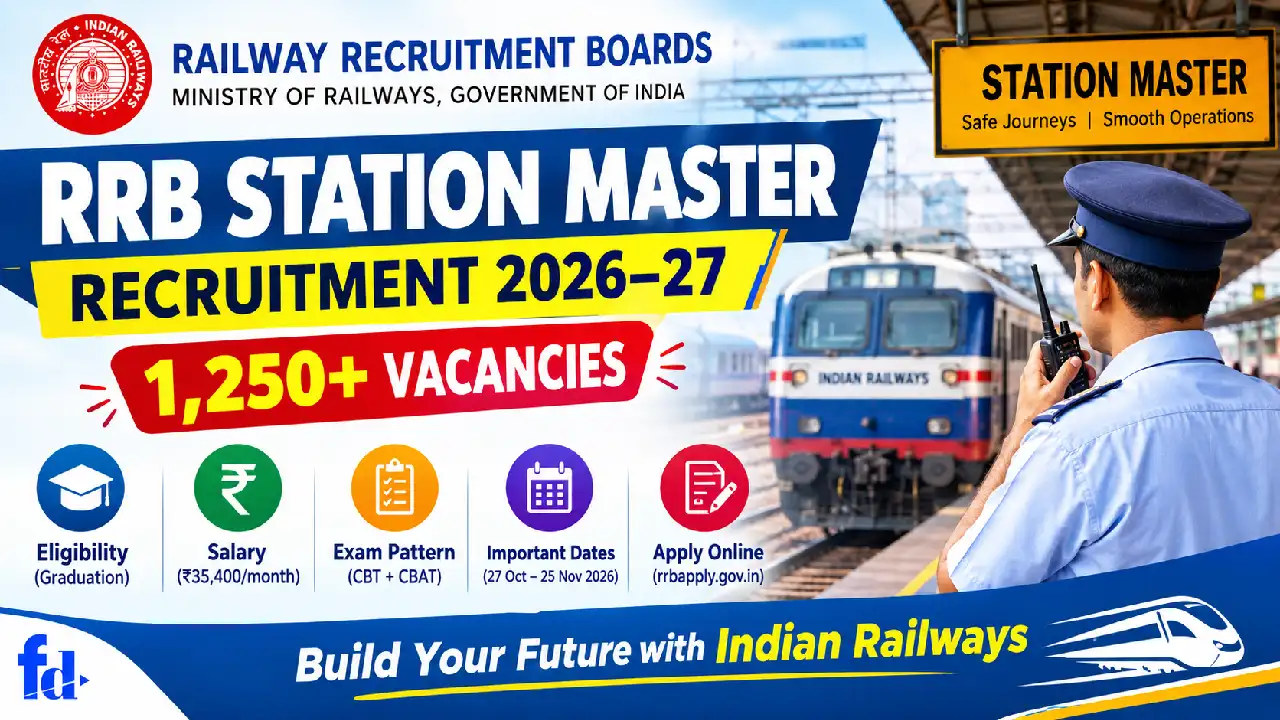
RRB Station Master Recruitment 2026–27: Check reported vacancies, eligibility, salary, exam pattern, syllabus, fees, important dates and official application links.
RRB Station Master Recruitment 2026–27
The Railway Recruitment Boards (RRBs), under the Ministry of Railways, Government of India, are the recruiting authorities associated with the reported Station Master recruitment drive under Centralised Employment Notification (CEN) 08/2026.
Station Master is an important operational position in Indian Railways. Station Masters help coordinate train movements, maintain safe railway operations, communicate with control offices and other railway staff, and respond to operational disruptions.
The position may appeal to graduates seeking a long-term government career with structured pay, allowances and opportunities for professional development.
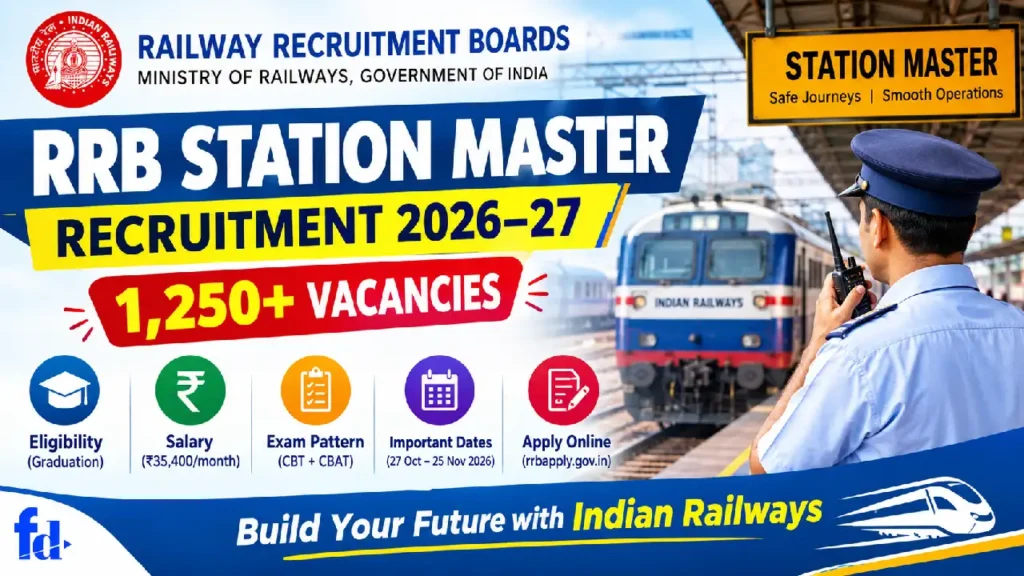
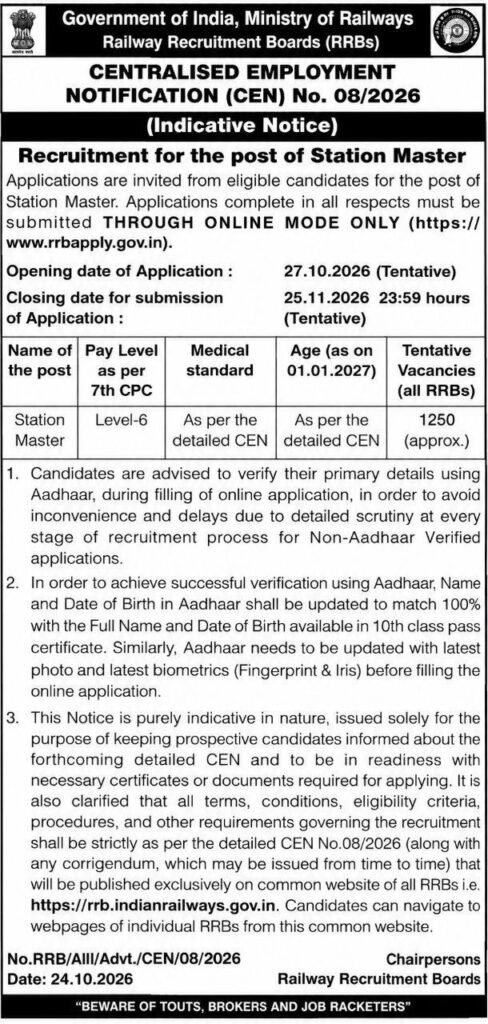
Recruitment-information websites have reported approximately 1,250 vacancies, an application window beginning on 27 October 2026, and a closing date of 25 November 2026. However, the final vacancy count, dates, category-wise allocation and examination rules must be checked against the detailed official notification before candidates rely on them.
Recruitment at a glance
Recruiting authority: Railway Recruitment Boards
Post: Station Master
Notification reference: CEN 08/2026
Reported vacancies: 1,250 (Approximately)
Reported application period: 27 Oct–25 Nov 2026
Reported basic pay: ₹35,400/month
Candidates should begin preparing for the relevant Railway Recruitment Board examination, organise their educational and identity documents, and monitor official announcements. They should not pay any person or intermediary claiming to guarantee selection.
Recruiting Organization | Indian Railways / Railway Recruitment Boards |
Post Name | Station Master |
Recruitment Cycle | 2026–27 |
Expected Vacancies | More than 1,200, tentative |
Recruitment Arrangement | Separate Centralised Employment Notice |
Educational Qualification | Graduation from a recognized university or equivalent |
Age Provision | 20–33 years, including the specified three-year relaxation |
Pay Level | Level 6 |
Initial Basic Pay | ₹35,400 per month |
Medical Standard | A-2 |
Selection | Single-stage CBT, CBAT, document verification and medical examination |
Application Status | Not yet open |
Expected Notification and Application Dates
Event | Expected Schedule |
Recruitment Guidelines Issued | October 7, 2026 |
Short Notification | Fourth week of October 2026 |
Online Applications | November 2026 |
Application Deadline | To be announced |
CBT | January 2027, tentative |
The projected notification, application and examination dates are subject to confirmation. Candidates cannot submit applications until the recruitment portal opens for the separate CEN.
Tentative Vacancy Details
Post | Expected Vacancies |
Station Master | More than 1,200 |
The final RRB-wise, railway-wise and category-wise distribution will be published with the recruitment advertisement. Zonal Railways must follow the prescribed reservation norms while submitting their vacancy requirements.
RRB Station Master Vacancy Trend (2024 to 2026)
Notification | Recruited through | Station Master vacancies | Upper age (UR) |
CEN 05/2024 | RRB NTPC Graduate | 994 | 36* |
CEN 06/2025 | RRB NTPC Graduate | 615 | 33 |
CEN 08/2026 | Separate Station Master CEN | 1250 (approx.) | As per detailed CEN |
* 36 in CEN 05/2024 included a one-time 3-year COVID relaxation. Sources: CEN 06/2025 page 4; indicative notice CEN 08/2026; CEN 05/2024 figures as on our NTPC Graduate vacancy trend table.
Station Master RRB-wise Vacancy, CEN 06/2025 (last year)
RRB | Zone | UR | SC | ST | OBC | EWS | Total | ExSM |
Ahmedabad | WR | 7 | 3 | 2 | 5 | 2 | 19 | 2 |
Ajmer | WCR | 8 | 16 | 0 | 24 | 5 | 53 | 5 |
Bengaluru | SWR | 17 | 4 | 3 | 4 | 8 | 36 | 4 |
Bhopal | WR | 3 | 2 | 0 | 1 | 0 | 6 | 1 |
Bhubaneswar | ECoR | 7 | 0 | 0 | 0 | 7 | 14 | 1 |
Bilaspur | CR | 2 | 0 | 1 | 1 | 1 | 5 | 1 |
Bilaspur | SECR | 9 | 5 | 3 | 10 | 3 | 30 | 3 |
Chennai | SR | 1 | 1 | 0 | 0 | 0 | 2 | 0 |
Guwahati | NFR | 7 | 2 | 1 | 4 | 2 | 16 | 2 |
Kolkata | ER | 56 | 20 | 10 | 36 | 13 | 135 | 14 |
Kolkata | SER | 10 | 4 | 2 | 6 | 2 | 24 | 2 |
Malda | ER | 15 | 6 | 2 | 9 | 3 | 35 | 4 |
Mumbai | CR | 17 | 7 | 5 | 11 | 5 | 45 | 5 |
Mumbai | SCR | 14 | 2 | 3 | 2 | 3 | 24 | 2 |
Mumbai | WR | 11 | 5 | 0 | 8 | 4 | 28 | 3 |
Ranchi | SER | 10 | 25 | 0 | 1 | 6 | 42 | 4 |
Secunderabad | ECoR | 5 | 3 | 2 | 1 | 1 | 12 | 1 |
Secunderabad | SCR | 28 | 9 | 4 | 15 | 6 | 62 | 6 |
Thiruvananthapuram | SR | 8 | 8 | 6 | 4 | 1 | 27 | 2 |
All RRBs | 235 | 122 | 44 | 142 | 72 | 615 | 62 |
Source: CEN 06/2025 Annexure B (pages 30 to 39), Station Master rows; ExSM is a horizontal reservation within the total. Most posts in 2025: RRB Kolkata 159, RRB Mumbai 97, RRB Secunderabad 74. No Station Master vacancy in 2025 at RRB Chandigarh, Gorakhpur, Jammu-Srinagar, Muzaffarpur, Patna, Prayagraj, Siliguri. The 2026 distribution can be very different.
About the hiring organisation: Indian Railways and RRBs
Indian Railways is one of the world’s largest railway networks and a major public-sector transportation organisation. It carries passengers and freight across an extensive network of routes, stations, terminals and operational facilities.
The Ministry of Railways oversees the railway system, while Railway Recruitment Boards conduct recruitment for designated railway positions according to published employment notifications and recruitment rules.
What do Railway Recruitment Boards do?
RRBs manage recruitment activities such as:
- Publishing employment notifications and vacancy information.
- Specifying eligibility requirements and reservation provisions.
- Accepting online applications through designated portals.
- Conducting or coordinating computer-based examinations and other prescribed assessments.
- Publishing results, shortlists and recruitment-related notices.
- Coordinating subsequent stages of the selection process with the relevant railway authorities.
Candidates should consult the official RRB website for authoritative recruitment updates rather than relying exclusively on coaching websites or job-alert aggregators.
Official website: Railway Recruitment Boards
Why is the Station Master role important?
A railway station is part of a larger operational system in which train movements, platform arrangements, signalling procedures, passenger services and communication must be coordinated safely.
Station Masters work within this system. Their duties require discipline, attention to detail, adherence to operating rules, and the ability to respond appropriately when normal operations are disrupted.
Unlike a conventional office job with predictable daytime hours, railway operations continue around the clock. Depending on the station and roster, the role may involve night shifts, weekends, public holidays and time-sensitive decisions.
Work culture and career considerations
A career in railway operations can offer structured employment, defined responsibilities, training and opportunities for progression. At the same time, it demands punctuality, procedural discipline and a strong commitment to safety.
Applicants should consider both the benefits and the practical realities before choosing this career. The role is particularly suited to people who can remain calm under pressure, communicate clearly and follow prescribed procedures even during busy or disrupted operations.
Employee experiences differ by posting, management, staffing levels and individual circumstances. Anonymous online reviews should therefore be treated as supplementary information rather than definitive evidence of the working conditions at every railway station.
Complete vacancy details and current recruitment status
The reported recruitment is associated with CEN 08/2026. The following table separates reported information from details that require confirmation.
Particular | Details |
Recruiting organisation | Railway Recruitment Boards |
Department | Ministry of Railways, Government of India |
Recruitment notification | CEN 08/2026, as reported |
Post name | Station Master |
Reported total vacancies | Approximately 1,250 |
Job location | Eligible railway zones and establishments specified in the notification |
Employment type | Central government railway employment |
Application mode | Online, subject to the official notification |
Reported opening date | 27 October 2026 |
Reported closing date | 25 November 2026 |
Detailed vacancy annexure | Requires confirmation from the official CEN |
Examination date | Not independently confirmed |
Final recruitment status | Check the official RRB notification and application portal |
Category-wise vacancy distribution
Reservation categories commonly relevant to Indian central-government recruitment include:
Category | Vacancy information |
UR / Unreserved | Exact count requires official confirmation |
OBC-NCL | Exact count requires official confirmation |
SC | Exact count requires official confirmation |
ST | Exact count requires official confirmation |
EWS | Exact count requires official confirmation |
PwBD and other applicable provisions | Requirements and allocations depend on the official notification |
The total reported vacancy count should not be divided among these categories using estimates. Reservation allocations, horizontal reservations, backlog vacancies and zone-wise distribution must be taken from the official vacancy annexure.
How to choose an RRB or railway zone
Applicants should carefully review the list of participating RRBs, the available vacancies and any restrictions on choosing a recruiting board or railway zone. Recruitment choices can affect the locations for which a candidate is considered.
Before submitting an application, candidates should check:
- Whether the desired RRB or zone is included.
- The number of vacancies advertised for the relevant post and category.
- The rules governing the choice of RRB, railway zone or posting.
- Whether the application permits changes after final submission.
- The consequences of selecting a particular recruitment preference.
Do not assume that selecting a nearby RRB guarantees a posting near home. Final placement is governed by the applicable recruitment and allocation rules.
RRB Station Master Vacancy 2026
As per CEN 08/20256, a total number of Railway Station Mater vacancy has been announced to be 1250. The Zone Wise Vacancy Distribution will be announced separately along with full notification.
Station Master Vacancy 2026 | |
Post | Vacancy |
Station Master (Level 6) | 1250 |
Railway Station Master Vacancy 2026 Zone Wise
The Railway Recruitment Board will be announced Station Master Vacancy for each RRB Zone (RRB Ahmedabad, RRB Ajmer, RRB Bengaluru, RRB Bhopal, RRB Bhubaneswar, RRB Bilaspur, RRB Chandigarh, RRB Chennai, RRB Gorakhpur, RRB Guwahati, RRB Jammu-Srinagar, RRB Kolkata, RRB Malda, RRB Mumbai, RRB Muzaffarpur, RRB Patna, RRB Prayagraj, RRB Ranchi, RRB Secunderabad, RRB Siliguri, and RRB Thiruvananthapuram). As soon as the announcement will made, we will update the same on the table below:
RRB Zone | Station Master Vacancy 2026 |
RRB Ahmedabad | To Be Announced |
RRB Ajmer | To Be Announced |
RRB Bengaluru | To Be Announced |
RRB Bhopal | To Be Announced |
RRB Bhubaneswar | To Be Announced |
RRB Bilaspur | To Be Announced |
RRB Chandigarh | To Be Announced |
RRB Chennai | To Be Announced |
RRB Gorakhpur | To Be Announced |
RRB Guwahati | To Be Announced |
RRB Jammu-Srinagar | To Be Announced |
RRB Kolkata | To Be Announced |
RRB Malda | To Be Announced |
RRB Mumbai | To Be Announced |
RRB Muzaffarpur | To Be Announced |
RRB Patna | To Be Announced |
RRB Prayagraj | To Be Announced |
RRB Ranchi | To Be Announced |
RRB Secunderabad | To Be Announced |
RRB Siliguri | To Be Announced |
RRB Thiruvananthapuram | To Be Announced |
Total | 1,250 |
Detailed job profile and key responsibilities
The Station Master is responsible for coordinating station-level railway operations within the authority and procedures prescribed by Indian Railways. The exact duties depend on the station’s operating arrangements, staffing and applicable railway rules.
Main responsibilities of a Station Master
- Train movement coordination
Station Masters help coordinate train arrivals, departures and movements through the station in accordance with prescribed operating procedures. They communicate with authorised railway personnel and follow the relevant signalling and movement protocols.
- Operational safety
Safety is central to the role. The Station Master must comply with applicable operating rules, ensure that required procedures are followed and respond appropriately to operational irregularities.
- Communication and coordination
Station operations require clear communication between the station, control office, adjoining stations and other railway staff. Accurate, timely communication helps maintain operational continuity and reduce the risk of misunderstandings.
- Platform and station coordination
Depending on the station and assigned duties, the Station Master may coordinate operational arrangements involving platforms, train services, station personnel and other railway departments.
- Records and documentation
Operational records, registers, reports and prescribed communications must be maintained according to the applicable procedures. Accuracy is important because records can support safety checks, investigations and operational reviews.
- Handling disruptions and emergencies
Train delays, equipment failures, unusual incidents and other disruptions require calm, rule-based responses. Station Masters must follow prescribed escalation procedures and communicate with the relevant railway authorities.
- Shift handovers
Railway stations may operate continuously, requiring effective handovers between staff. Important operational information must be communicated clearly so that the incoming personnel understand the current situation.
What does a typical working day look like?
The workday depends on the station and roster, but a typical sequence may involve:
- Reviewing operational information and the status of the station.
- Receiving a handover from the previous shift.
- Coordinating train movements and following operating procedures.
- Communicating with control offices and relevant railway staff.
- Responding to delays, changes and operational issues.
- Maintaining required records and completing a shift handover.
These duties should not be interpreted as a universal checklist for every station. The official railway operating rules and the employee’s assigned responsibilities take precedence.
Skills required for the role
Skill | Why it matters |
Situational awareness | Helps identify changing operational conditions |
Decision-making | Supports timely action within prescribed rules |
Communication | Reduces ambiguity during train operations |
Attention to detail | Helps prevent errors in operational procedures |
Emotional control | Supports effective responses during disruptions |
Rule compliance | Essential for railway safety |
Shift adaptability | Helps employees manage rotating rosters |
Applicants should understand that Station Master recruitment is not simply a test of academic knowledge. The position requires suitability for a safety-sensitive operational environment.
Eligibility criteria for RRB Station Master Recruitment 2026–27
Eligibility determines whether an applicant can be considered for the post. Candidates should verify each requirement in the detailed CEN before applying.
Educational qualification
Recruitment information generally identifies a bachelor’s degree from a recognised university or an equivalent qualification as the educational requirement for Station Master positions in the railway non-technical category.
Candidates should confirm:
- Whether their university and qualification meet the notification’s requirements.
- Whether the degree must have been completed by a specified cutoff date.
- What documentary evidence is accepted.
- Whether candidates awaiting final results are eligible.
Do not assume that appearing in a final-semester examination is equivalent to holding a completed degree. The official notification determines the relevant qualification date and documentation requirements.
Age limit
Secondary recruitment sources have reported different minimum ages for the 2026–27 recruitment. Some have described a range beginning at 18 years, while others have reported 20–30 years.
Because this discrepancy can affect eligibility, the applicable minimum and maximum age must be checked in the official notification. The age calculation date is equally important: eligibility is determined according to the date and rules specified in the CEN, not simply the candidate’s age on the day of application.
Age relaxation
Central-government recruitment commonly provides prescribed age relaxations for eligible reservation categories. The exact rules and supporting documents for this recruitment must be confirmed.
Candidate category | What to verify |
OBC-NCL | Applicable relaxation and valid non-creamy-layer certificate |
SC / ST | Applicable relaxation and category certificate |
PwBD | Applicable relaxation and disability eligibility requirements |
Ex-servicemen | Service-related conditions and applicable relaxation |
Other eligible groups | Specific conditions stated in the notification |
Candidates must not add relaxations from different categories together unless the recruitment rules expressly permit the combination.
Nationality
The nationality and citizenship provisions in the notification must be followed. Central-government recruitment can specify eligibility for Indian citizens and certain other legally defined categories under applicable rules.
Applicants should check the exact wording rather than relying on assumptions based on previous recruitment drives.
Medical fitness
Station Master duties involve railway operations and safety. Candidates should review the medical standards specified for the post, including any applicable vision requirements, medical classification and fitness assessment.
A candidate who satisfies the academic requirements may still be required to pass the prescribed medical examination.
Practical advice: Before paying the application fee, verify educational eligibility, age, category documentation, nationality requirements and medical suitability. These checks can prevent avoidable disqualification later.
Salary, allowances, perks and benefits
Station Master is commonly associated with Pay Level 6 of the 7th Central Pay Commission, with an entry basic pay of ₹35,400 per month. The applicable pay level and salary rules for CEN 08/2026 should be confirmed in the official notice.
Basic pay versus take-home salary
Basic pay is only one component of a railway employee’s compensation. The actual monthly salary may include applicable allowances and deductions.
Salary component | Explanation |
Basic pay | Reported entry-level basic pay of ₹35,400, subject to official confirmation |
Dearness Allowance (DA) | Allowance calculated according to applicable government orders |
House Rent Allowance (HRA) | Depends on applicable rules and accommodation circumstances |
Transport allowance | Payable according to the applicable eligibility and rules |
Other admissible allowances | Depend on duty, posting and relevant rules |
Retirement-related contributions | Determined by the applicable pension or contributory retirement framework |
Deductions | May include statutory contributions, taxes and other authorised deductions |
Illustrative salary calculation
The following is a simplified example, not an official salary quotation or a guaranteed in-hand amount.
Component | Illustrative amount |
Basic pay | ₹35,400 |
Example DA at 50% | ₹17,700 |
Example HRA at 10% | ₹3,540 |
Subtotal before other components and deductions | ₹56,640 |
The DA and HRA percentages above are hypothetical examples used to explain salary calculations. They are not claims about the actual rates applicable on the joining date. Transport allowance, other eligible components and deductions have not been included.
Actual compensation depends on the applicable DA rate, posting location, accommodation arrangements, admissible allowances, current government orders and individual deductions. Candidates should not treat the example subtotal as a verified salary or take-home figure.
Other benefits
Depending on applicable service rules and eligibility, railway employees may receive benefits associated with:
- Paid leave and public-sector employment conditions.
- Medical facilities under applicable railway rules.
- Retirement benefits under the governing scheme.
- Career progression and pay progression under relevant rules.
- Railway travel concessions or other employment-related facilities where permitted.
- Training and professional development.
The exact entitlements, restrictions and eligibility conditions should be checked in official service rules.
Is the salary attractive compared with private-sector jobs?
The position may be attractive to graduates who value structured pay, government employment conditions and a defined operational career path. However, comparing jobs solely on salary is misleading.
Candidates should also consider working hours, transfers, night shifts, location preferences, job responsibilities, advancement opportunities and personal suitability. Private-sector positions vary substantially by employer and industry, so there is no single reliable private-sector salary benchmark for comparison with every Station Master appointment.
Important dates and deadlines
Recruitment websites have reported an application period from 27 October to 25 November 2026. The detailed official notification and application portal should be treated as the final authority for dates and deadlines.
Event | Date or status |
Recruitment reference | CEN 08/2026, as reported |
Application opening | Reported: 27 October 2026 |
Application closing | Reported: 25 November 2026 |
Fee payment deadline | Confirm in the official schedule |
Application correction window | To be confirmed |
Exam city or travel-authority information | To be announced officially |
Admit card release | To be announced officially |
CBT examination | No independently verified official date |
CBAT | To be announced according to the recruitment schedule |
Document verification | After the relevant assessment stages |
Medical examination | According to the recruitment schedule |
How to avoid missing the deadline
- Check the recruitment portal for the actual application status.
- Register early rather than waiting until the final day.
- Complete payment before the official fee deadline.
- Save the application number and payment receipt.
- Download or save the submitted application.
- Monitor official notices for corrections, examination dates and admit-card information.
An application that has been started but not finally submitted may not count as a completed application. Candidates should verify the submission status on the portal.
Selection process and examination pattern
The Station Master selection process has historically involved a computer-based written examination and a computer-based aptitude assessment, followed by document verification and medical fitness assessment. The precise process, test structure, scoring and merit calculation for CEN 08/2026 must be confirmed against the applicable notification.
Candidates should be particularly careful about claims that a new recruitment cycle has introduced a single CBT or a revised syllabus. A change should be treated as official only when supported by the published recruitment rules.
Stage 1: Computer-Based Test (CBT)
The CBT assesses general academic aptitude and knowledge relevant to railway recruitment examinations. Preparation typically includes mathematics, reasoning, general awareness and other subjects specified in the applicable syllabus.
Stage 2: Computer-Based Aptitude Test (CBAT)
The aptitude test is designed to assess job-relevant mental abilities rather than simply recall of facts. Depending on the officially prescribed test format, candidates may need to practise tasks involving attention, information processing, decision-making and other cognitive abilities.
The exact modules, qualifying requirements and scoring rules must be taken from the official CEN and applicable instructions.
Stage 3: Document verification
Shortlisted candidates are required to establish that they satisfy the eligibility requirements. Documents may include educational certificates, proof of date of birth, identity documents and applicable category certificates.
Stage 4: Medical examination
Candidates must satisfy the medical standards prescribed for the post. The relevant railway medical authority determines fitness under the applicable rules.
Selection process summary
Stage | Purpose | Important consideration |
CBT | Assess knowledge and aptitude | Official subjects, marks and negative marking must be checked |
CBAT, if prescribed | Assess relevant cognitive abilities | Follow the official test and qualifying rules |
Document verification | Verify eligibility and claims | Keep original documents and valid certificates ready |
Medical examination | Assess fitness for the role | Review the prescribed medical classification |
Final selection | Establish merit and eligibility | Depends on official rules, vacancies and applicable criteria |
Railway Station Master Recruitment 2026: Old vs New Selection Process
The Railway has changed the recruitment method for Station Master from 2026 onwards. Earlier, the post was included in NTPC recruitment. The new process will have a separate CEN and a single-stage CBT.
Aspect | Old Rules | New Rules |
Notification | Included under NTPC CEN | Separate CEN for Station Master |
CBT Stages | CBT 1 + CBT 2 | Single-stage CBT |
CBT Marks | CBT 1: 100; CBT 2: 120 | 100 marks |
CBT Duration | 90 minutes for each CBT | 120 minutes |
Subjects | General Awareness, Maths, Reasoning | Science, Maths, Analytical, Logical and Mental Reasoning |
General Awareness | Included | Not included |
Data Analysis | Not a separate section | 30 marks |
Basic Science | Not included | 30 marks with Mathematics |
Reading Comprehension | Not a standard section | Included |
CBAT Shortlisting | 1:8 based on CBT 2 | 1:8 based on CBT |
Final Merit | 70% CBT 2 + 30% CBAT | 70% CBT + 30% CBAT |
Age Limit | 18–33 years | 20–30 years |
Education | Graduation | Graduation |
Pay Level | Level 6, ₹35,400 | Level 6, ₹35,400 |
Medical Standard | A-2 | A-2 |
DV & Medical | After CBAT | After CBAT |
CBT exam pattern: what candidates should know
Previous railway non-technical recruitment examinations have used structured objective tests. However, historical patterns should not automatically be treated as the final 2026–27 pattern.
The table below describes the conventional RRB NTPC graduate-level CBT format as a historical reference, not as a verified CEN 08/2026 examination scheme.
Subject | Historical CBT-1 questions | Historical CBT-1 marks |
General Awareness | 40 | 40 |
Mathematics | 30 | 30 |
General Intelligence and Reasoning | 30 | 30 |
Total | 100 | 100 |
The conventional NTPC CBT-1 format has used a duration of 90 minutes for most candidates, with prescribed adjustments for eligible candidates requiring a scribe. Historical NTPC examinations have also applied a penalty of one-third of the marks allotted to a question for each incorrect answer. These details must be rechecked against the 2026 notification before being used for exam-day planning.
Do not assume that CBT-1, CBT-2, CBAT or any particular weighting scheme applies unchanged to CEN 08/2026. If the official notice prescribes a single CBT or a different structure, that published scheme takes precedence.
How merit may be determined
Candidates should examine the notification for:
- Whether the CBT is a single-stage or multi-stage examination.
- Whether CBAT is compulsory for the Station Master post.
- The qualifying marks for each applicable stage.
- Whether aptitude-test scores contribute to final merit.
- How ties in marks are resolved.
- Whether reservation rules affect shortlisting or final selection.
- Whether any stage is qualifying only or contributes to the merit calculation.
These distinctions are essential because qualifying an assessment does not necessarily mean that a candidate will receive an appointment.
Comprehensive syllabus and preparation strategy
The syllabus is one of the most important parts of recruitment preparation. Candidates should use the official CEN syllabus as the definitive checklist. The subjects below reflect commonly used RRB NTPC preparation areas and should be cross-checked before being treated as the exact 2026–27 syllabus.
A. Mathematics
Topic | What to prepare |
Number system | Integers, divisibility and basic number properties |
Decimals and fractions | Operations, conversions and simplification |
LCM and HCF | Factors, multiples and applied problems |
Ratio and proportion | Direct and inverse relationships |
Percentages | Percentage changes and applications |
Profit and loss | Cost price, selling price, discount and profit percentage |
Simple and compound interest | Formula-based and practical questions |
Time and work | Work rates, efficiency and combined work |
Time, speed and distance | Relative speed, trains and travel calculations |
Mensuration | Common two-dimensional and three-dimensional shapes |
Algebra | Basic expressions, equations and identities |
Geometry | Lines, angles, triangles and other prescribed concepts |
Trigonometry | Fundamental ratios and standard identities where applicable |
Statistics | Mean, median, mode and interpretation |
Data interpretation | Tables, graphs and charts |
Preparation approach: Learn the underlying concepts before memorising shortcuts. Solve basic questions first, then progress to timed mixed sets. Maintain an error notebook for repeated mistakes involving percentages, arithmetic calculations and formula selection.
B. General Intelligence and Reasoning
Important preparation areas in conventional RRB examinations include:
- Analogies and classification.
- Number and alphabetical series.
- Coding and decoding.
- Mathematical operations.
- Relationships and family-based reasoning.
- Direction sense.
- Syllogisms.
- Venn diagrams.
- Statement-based reasoning.
- Conclusions and logical deductions.
- Puzzles and arrangements.
- Data sufficiency.
- Similarities and differences.
- Decision-making and analytical reasoning.
The exact topic list may differ in the official notification.
Preparation approach: Practise reasoning regularly rather than in occasional long sessions. Start with series, analogy and coding questions, then move to puzzles and multi-step problems. After every practice test, classify errors as conceptual mistakes, misreading, calculation errors or time-management problems.
C. General Awareness
General Awareness can cover a wide range of static and current topics.
Area | Preparation focus |
Current affairs | Important national and international developments |
Indian history | Major events, movements and historical periods |
Geography | Indian geography, physical features and world geography |
Indian polity | Constitution, government institutions and fundamental rights |
Economics | Basic economic concepts and major developments |
General science | Relevant physics, chemistry and biology fundamentals |
Environment | Ecology, conservation and environmental issues |
Computers | Basic terminology and digital concepts where prescribed |
Sports | Major events, achievements and awards |
Awards and honours | Important national and international recognitions |
Government programmes | Major schemes and policy developments |
Railway awareness | Relevant railway developments and organisational knowledge |
Preparation approach: Use a consistent daily current-affairs routine and revise static subjects separately. Avoid spending all study time collecting news; retention and revision are more important than the volume of notes.
D. General Science
Where included in the official syllabus, General Science preparation should focus on the specified level and topics.
- Physics: Motion, force, energy, electricity, heat, light and basic scientific principles.
- Chemistry: Matter, elements, compounds, acids, bases, metals, non-metals and everyday chemistry.
- Biology: Human body systems, nutrition, cells, diseases, plants and basic life processes.
Use concise topic notes and practise objective questions after each chapter. The official syllabus should determine how much time is allocated to science relative to the other subjects.
E. Computer-Based Aptitude Test preparation
If CBAT is part of the official selection process, candidates should begin familiarising themselves with the prescribed assessment format well before the test.
Useful preparation principles include:
- Understand the official instructions for each test module.
- Practise the relevant task types using legitimate practice materials.
- Develop accuracy before increasing speed.
- Learn to follow instructions carefully under time constraints.
- Avoid assuming that ordinary general-knowledge preparation can substitute for aptitude-test practice.
- Check the official qualifying requirements and any rules concerning score calculation.
Do not rely on unofficial claims that one specific practice app or paid course guarantees a qualifying score.
A practical 12-week preparation plan
The schedule below is a flexible study framework, not an official RRB timetable.
Weeks 1–4
Build the foundation
Study core mathematics and reasoning concepts, establish a daily current-affairs routine, and identify weak areas using a diagnostic mock test.
Weeks 5–8
Complete the syllabus
Cover remaining topics, solve chapter-wise questions, revise science and static general awareness, and start regular timed practice sets.
Weeks 9–10
Improve speed and accuracy
Attempt full-length mock tests based on the verified pattern, analyse every incorrect answer, and revise weak topics.
Weeks 11–12
Consolidate and revise
Review formulas, current-affairs notes and recurring mistakes. Practise the prescribed aptitude assessment if applicable, and confirm exam instructions.
Daily study timetable
Candidates with approximately four hours available each day can use the following illustrative allocation.
Activity | Suggested time |
Mathematics | 60 minutes |
Reasoning | 60 minutes |
General Awareness and current affairs | 60 minutes |
Science or weak-topic revision | 30 minutes |
Timed practice and error analysis | 30 minutes |
Total | 4 hours |
Adjust the timetable according to your current preparation level and the confirmed syllabus. Candidates with less time should prioritise the official syllabus, regular revision and careful mock-test analysis instead of attempting to study every topic superficially.
Common preparation mistakes to avoid
- Preparing from an outdated syllabus without checking the new notification.
- Memorising formulas without understanding when to use them.
- Ignoring current affairs until the final weeks.
- Taking mock tests without reviewing mistakes.
- Guessing answers indiscriminately in a test with negative marking.
- Neglecting CBAT preparation when the aptitude test is prescribed.
- Assuming that completing the syllabus guarantees selection.
The most effective preparation system combines concept learning, timed practice, revision and feedback.
Application fees and payment mode
The application fee must be checked against the official CEN 08/2026 notification. Secondary recruitment websites have reported fee amounts of ₹500 for some applicants and ₹250 for certain concession-eligible categories, but these figures and the applicable refund conditions require official verification.
Applicant category | Reported fee | What to verify |
General / other applicants in the applicable fee group | ₹500 | Exact fee category and refund rules |
Eligible concession categories | ₹250 | Eligible categories and conditions |
Other exempt or specially treated categories | To be confirmed | Applicable exemption rules |
These figures are indicative reports, not a verified final fee schedule.
Payment methods
If supported by the official application portal, payment may be made using approved online methods such as:
- Debit card or credit card.
- Net banking.
- UPI.
- Other payment methods expressly listed on the portal.
Use only the payment gateway linked through the official application process. Do not send money to an individual bank account or a third party promising to submit the form for you.
Important fee precautions
Before making payment:
- Check the fee applicable to your category.
- Confirm whether a refund is available and what conditions apply.
- Verify that the payment gateway belongs to the official application process.
- Save the payment receipt or transaction reference.
- Check that the application portal records the payment successfully.
A payment debit from your bank account does not necessarily prove that the recruitment portal has completed your application. Confirm the final application status.
Step-by-step guide to apply online
The reported application portal is https://www.rrbapply.gov.in/. Before entering personal information or paying a fee, confirm that the relevant recruitment notification is available there.
The following procedure describes a typical online recruitment workflow. The actual screen names, document requirements and sequence may differ from those specified in CEN 08/2026.
Step 1: Open the official recruitment portal
Visit the official RRB application portal or reach it through the official RRB website. Locate the Station Master recruitment notice and verify the CEN number.
Do not begin registration through an advertisement or an unfamiliar website that imitates an official recruitment portal.
Step 2: Read the notification
Download the detailed notification and read the sections covering:
- Eligibility and age calculation.
- Educational qualification and cutoff date.
- Vacancy distribution and reservation.
- Examination pattern and syllabus.
- Application fee and refund conditions.
- Photograph, signature and document requirements.
- Medical standards and selection stages.
Confirm that the application window is open before proceeding.
Step 3: Register your account
Enter the personal information requested by the portal. This may include your name, date of birth, contact information and other required details.
Use a valid mobile number and email address that you can access throughout the recruitment process. Keep your registration credentials secure.
Step 4: Complete the application form
Enter educational qualifications, category information, preferences and other required details.
Check spelling, dates and certificate information carefully. Inconsistent personal information may create difficulties during document verification.
Step 5: Upload the required files
Prepare the photograph, signature and other documents in the file formats, dimensions and sizes specified in the official notification.
Document | Preparation advice |
Photograph | Follow the prescribed image format, size and recency requirements |
Signature | Upload a clear image meeting the official specifications |
Educational certificates | Keep degree and marksheet details ready |
Proof of date of birth | Use the document accepted by the notification |
Category certificate | Ensure it meets the applicable format and validity requirements |
Disability or other applicable certificate | Upload only where relevant and as instructed |
Identity information | Ensure details match the application form |
Important: Exact image dimensions, pixel requirements, file-size limits and certificate templates have not been independently verified for this recruitment. Do not reuse specifications from an older examination unless the current notification confirms them.
Step 6: Pay the application fee
Review the fee applicable to your category and use one of the payment methods displayed by the official portal.
Save the receipt or transaction number and confirm that the payment status is updated successfully.
Step 7: Review the application
Before final submission, verify:
- Your name and date of birth.
- Contact details.
- Educational qualification.
- Category and supporting documentation.
- RRB or other preferences.
- Uploaded photograph and signature.
- Payment status.
- Any declaration or consent required by the portal.
Step 8: Submit and save the confirmation
Complete the final submission process. Download the submitted application and keep a copy of the confirmation page and payment receipt.
Retain your registration number and other credentials. They may be needed to check application status, download examination documents and access later recruitment notices.
Step 9: Monitor subsequent announcements
After applying, check the official portal periodically for corrections, examination-city information, admit cards, results and further instructions.
Never assume that a third-party website’s expected date is an official examination date.
Official links and useful recruitment resources
The following links are provided for candidates to check the recruitment and related information. Where a direct CEN PDF could not be independently authenticated, the link is identified as a destination for verification rather than a confirmed official document.
Official RRB website
Use this site to find official recruitment notices and RRB announcements.
https://rrb.indianrailways.gov.in/
Online application portal
Check whether the Station Master recruitment is available for registration and application.
Where is the official notification PDF?
A direct official PDF URL for CEN 08/2026 could not be independently authenticated in this research session. Candidates should locate the notification through the official RRB website or application portal and verify that the document explicitly relates to the Station Master recruitment.
Do not assume that a PDF hosted on a third-party website is an official notification merely because its filename contains “CEN 08/2026.” The issuing authority, document contents and applicable dates must be checked.
Final advice for candidates
RRB Station Master Recruitment 2026–27 could be an important opportunity for graduates seeking a career in railway operations. The reported vacancy count, government pay structure and potential for long-term professional development make it worth investigating carefully.
However, candidates should not make career or financial decisions based solely on recruitment summaries published by third-party websites. The age-limit discrepancy, unconfirmed vacancy distribution, reported changes in the exam pattern and unverified direct notification link make it especially important to consult the official CEN.
A sensible plan is to follow these priorities:
- Verify eligibility first. Check the official age limit, degree requirements, cutoff date and medical standards.
- Confirm the recruitment details. Establish the actual vacancy count, application dates, fee and selection stages.
- Prepare from the correct syllabus. Use previous RRB NTPC material as a study resource only where it matches the current official syllabus.
- Practise consistently. Build speed and accuracy through topic-wise questions, mock tests and error analysis.
- Prepare for every prescribed stage. If CBAT is included, do not postpone aptitude-test practice until after the CBT result.
- Apply through official channels. Save your application, payment receipt and registration details.
- Monitor official notices. Check for amendments, examination schedules, admit cards and further instructions.
A government recruitment examination rewards careful preparation, but success also depends on understanding the rules and avoiding preventable application errors. Start with the official notification, build a realistic study plan and keep every important document ready.
Final takeaway: Treat the reported recruitment figures as provisional until confirmed by the official CEN 08/2026. Once the eligibility criteria, exam pattern and dates are verified, use them to build a focused preparation strategy rather than relying on rumours or unconfirmed syllabus changes.
Frequently asked questions (FAQs)
Q1. How many vacancies are available for RRB Station Master Recruitment 2026–27?
Recruitment websites have reported approximately 1,250 vacancies. The final number, RRB-wise allocation and reservation-category distribution should be confirmed through the detailed official CEN.
Q2. What is the notification number?
The recruitment is reported under Centralised Employment Notification CEN 08/2026. Candidates should verify the reference number in the official document before applying.
Q3. What is the educational qualification for Station Master?
A bachelor’s degree from a recognised university is the commonly reported requirement for this type of graduate-level railway post. The applicable qualification, equivalence rules and degree-completion cutoff must be verified in the current notification.
Q4. What is the age limit for the recruitment?
Secondary sources have reported conflicting age ranges, including 18–30 and 20–30 years. The official CEN must be consulted for the applicable minimum age, maximum age, calculation date and relaxations.
Q5. What is the Station Master salary?
The post is commonly associated with Pay Level 6 and an entry basic pay of ₹35,400 per month. Actual gross and take-home salary depend on applicable allowances, posting, accommodation and deductions. Confirm the pay level in the official notice.
Q6. What are the application start and last dates?
Recruitment websites report 27 October 2026 as the opening date and 25 November 2026 as the closing date. Candidates should confirm these dates on the official application portal before submitting an application.
Q7. Is the examination conducted online?
Railway recruitment examinations of this type have used computer-based testing. The precise format, number of examination stages and any revised structure for CEN 08/2026 must be confirmed in the official notification.
Q8. Is a Computer-Based Aptitude Test required?
Station Master recruitment has historically included a CBAT stage. Candidates should verify whether it is prescribed for the current recruitment and check the applicable qualifying rules, assessment format and merit calculation.
Q9. Is there negative marking?
Historical RRB NTPC examinations have used negative marking, commonly one-third of the marks for an incorrect answer. However, candidates should verify the marking scheme in the current CEN before deciding how to approach questions.
Q10. What is the application fee?
Secondary sources have reported ₹500 for some applicants and ₹250 for certain concession-eligible categories. The official notification must establish the final fee categories, exemptions and refund conditions.
Q11. Can final-year graduation students apply?
That depends on the educational qualification and cutoff-date requirements specified in the notification. Candidates should not assume eligibility merely because their final examinations are scheduled or their results are expected before the recruitment process ends.
Q12. Where can I download the admit card?
Candidates should follow the official RRB recruitment website and application portal for examination-city information, admit-card announcements and instructions. They should not rely on unofficial links requesting payment or sensitive account details.
Q13. Can I apply through a private job website?
Candidates should submit their application through the designated official portal. Private recruitment websites may provide information or preparation resources, but they should not be treated as the authority for final application rules.
Q14. What documents should I keep ready?
Prepare educational certificates, proof of date of birth, identity information, photograph, signature and any applicable category or other supporting certificates. The official notification determines the exact document list, file requirements and prescribed formats.
Q15. Does submitting the application guarantee selection?
No. An application only enters the candidate into the recruitment process, subject to eligibility and successful submission. Selection depends on the prescribed assessments, merit rules, available vacancies, document verification and medical fitness requirements.

Hey, I am Sachin Ramdurg. I run and manage futuredecider.com website that helps students, graduates, and professionals, to find and decide on their future career with ultimate future career advices and future career guides. I have an overall 12+ years of career guidance experience in multiple domains which has helped multiple students, graduates, and professionals to find the best career path for their future.