
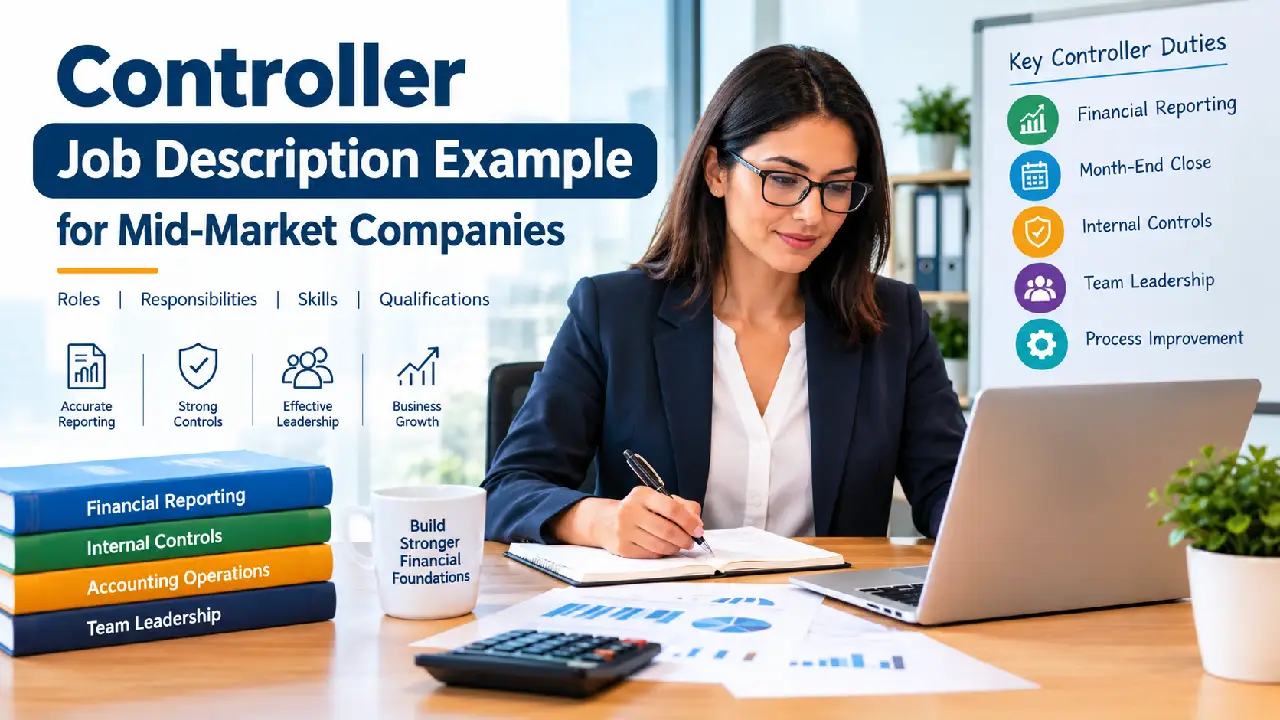
A well-written controller job description example should do more than list accounting tasks.
For a mid-market company, it should clearly explain how the Controller owns financial reporting, month-end close, internal controls, accounting operations, compliance, team leadership, and the financial information executives use to make decisions.
The role sits between day-to-day accounting and broader finance leadership, so a vague posting can attract candidates who are technically strong but not ready to manage the scale, systems, and business demands of a growing organization.
This guide explains what companies should include, what candidates should expect, and how HR teams can build a practical Controller job description for the U.S. market.
What Is a Controller in a Mid-Market Company?
A Controller is the senior accounting leader responsible for maintaining the accuracy, completeness, and integrity of a company’s financial records and reporting processes.
In a mid-market organization, the Controller commonly oversees areas such as:
- General ledger accounting
- Accounts payable
- Accounts receivable
- Payroll accounting
- Financial close
- Financial statements
- Cash and working capital reporting
- Budget and forecast support
- Internal controls
- Audit coordination
- Accounting policies
- Tax coordination
- Accounting systems and processes
- Finance team management
The exact scope varies by company size, ownership structure, industry, and reporting requirements. A Controller at a private manufacturing company may spend significant time on inventory and cost accounting, while a SaaS Controller may focus more heavily on revenue recognition, deferred revenue, billing, and subscription reporting.
Recent employer postings also show that modern Controller positions commonly combine accounting leadership with controls, reporting, audit coordination, systems improvement, and business partnering.
For context, the U.S. Bureau of Labor Statistics reports that accountants and auditors had 1.562 million jobs in 2023, with about 130,800 projected annual openings on average from 2023–2033. The broader accounting profession therefore remains a significant talent pool from which companies can develop or recruit future controllership leaders.
Why the Controller Role Matters More as a Company Grows
A small company can sometimes operate with an owner, bookkeeper, outside CPA, or accounting manager handling most financial activities.
That model becomes harder to manage as transaction volume, employees, customers, locations, financing arrangements, and regulatory requirements increase.
A mid-market company needs someone who can answer questions such as:
- Are the financial statements accurate?
- Can we close the books on time?
- Are balance sheet accounts properly reconciled?
- Are accounting policies being followed?
- Where are the largest financial risks?
- Are approval controls working?
- Can management trust the monthly numbers?
- Are auditors receiving complete support?
- Is the ERP producing reliable information?
- Can the accounting team scale with the business?
This is where the Controller becomes important.
The position is not simply about checking accounting entries. It creates a reliable financial foundation for management.
COSO notes that effective internal controls support reliable reporting, operational effectiveness, compliance, and the safeguarding of assets. Its framework centers on control environment, risk assessment, control activities, information and communication, and monitoring.
Where the Controller Fits in the Finance Organization
The reporting structure should be clearly defined before the position is advertised.
A common mid-market structure looks like this:
CEO / President
↓
CFO / VP Finance
↓
Controller
↓
Accounting Managers / Assistant Controller
↓
Accountants, AP, AR, Payroll and Other Accounting Staff
Not every organization has a CFO.
In some companies, the Controller reports directly to the CEO, President, or owner. In others, the Controller reports to a VP of Finance.
The distinction matters because candidates need to understand whether the position is primarily responsible for accounting and controllership or whether it also owns FP&A, treasury, tax strategy, investor reporting, and broader financial planning.
Controller vs. CFO
A Controller generally focuses on the accuracy and operation of the accounting function.
A CFO generally has a broader mandate covering areas such as:
- Corporate strategy
- Capital structure
- Financing
- Investor relations
- M&A
- FP&A
- Long-term planning
- Enterprise risk
- Executive decision support
There can be considerable overlap in smaller organizations.
VP Finance vs Controller
The difference between VP finance vs controller often depends on company design.
A VP Finance may own broader financial planning, business performance, treasury, and strategic finance. A Controller typically has deeper ownership of accounting operations, reporting, controls, close, compliance, and financial integrity.
Companies should define these boundaries in the job posting instead of assuming candidates will interpret the titles in the same way.
Controller Roles and Responsibilities
The core controller roles and responsibilities should be specific enough that a qualified candidate understands what success looks like.
A strong mid-market Controller typically owns or oversees the following areas.
1. Financial Reporting
The Controller oversees timely and accurate preparation of financial statements.
Typical responsibilities include:
- Monthly financial statements
- Quarterly reporting
- Annual reporting
- Balance sheet reviews
- Income statement reporting
- Cash flow reporting
- Management reporting
- Financial variance analysis
- Consolidation, where applicable
The Controller should also ensure that reporting is supported by appropriate reconciliations and documentation.
2. Month-End and Year-End Close
The close process is one of the clearest measures of controllership effectiveness.
The Controller may establish:
- Close calendars
- Account reconciliation deadlines
- Journal entry approval procedures
- Accrual processes
- Review controls
- Reporting deadlines
- Variance review procedures
For example, a company that currently takes 15 business days to close may expect its new Controller to reduce the close to 8–10 business days without sacrificing accuracy.
That is much more useful than simply saying, “Responsible for month-end close.”
3. General Ledger Management
The Controller is usually accountable for the integrity of the general ledger.
This can include:
- Chart of accounts
- Journal entries
- Accruals
- Prepaids
- Fixed assets
- Intercompany accounting
- Deferred revenue
- Account reconciliations
- Balance sheet substantiation
- Accounting estimates
The appropriate responsibilities depend heavily on the organization’s business model.
4. Internal Controls
Internal controls become increasingly important as a company grows.
The Controller may establish or strengthen controls covering:
- Payment approvals
- Journal entries
- User access
- Bank reconciliations
- Expense approvals
- Vendor setup
- Customer credit
- Cash handling
- Segregation of duties
- Financial reporting review
A good Controller does not create controls simply to add paperwork. The goal is to reduce risk while keeping processes practical.
COSO’s framework specifically emphasizes control activities, risk assessment, information and communication, and ongoing monitoring as parts of an effective internal control system.
Financial Controller Job Duties List
A practical financial controller job duties list for a mid-market organization can include:
Area | Typical Controller Responsibility |
Financial reporting | Prepare and review accurate monthly financial statements |
Month-end close | Lead timely and controlled close procedures |
General ledger | Maintain accurate accounting records |
Reconciliations | Review balance sheet reconciliations |
Internal controls | Design, document, and monitor controls |
Audit | Coordinate external and internal audit activities |
Budgeting | Support annual budgeting and forecasting |
Compliance | Maintain applicable accounting and reporting requirements |
Cash | Monitor accounting-related cash reporting and working capital |
Team leadership | Manage, coach, and develop accounting employees |
Systems | Improve ERP and accounting workflows |
Process improvement | Automate repetitive processes and reduce errors |
Management reporting | Provide useful financial information to leadership |
The responsibilities should be adjusted to the actual company rather than copied from a generic template.
For example, a distribution company may need strong inventory and cost accounting expertise. A professional services firm may place greater emphasis on project accounting, utilization, billing, and revenue recognition.
Corporate Controller Duties
Corporate controller duties can become broader when a company has multiple legal entities, locations, subsidiaries, or business units.
These responsibilities may include:
- Consolidated financial reporting
- Intercompany eliminations
- Accounting policy development
- Corporate close management
- Entity-level reporting
- Audit coordination
- Technical accounting research
- Financial control design
- Consolidation processes
- Corporate accounting governance
A corporate Controller may also work closely with legal, tax, FP&A, treasury, HR, operations, and external accounting advisers.
For example, if a company acquires another business, the Controller may be responsible for integrating the acquired entity’s chart of accounts, accounting processes, reporting calendar, and controls.
Controller Skills Required
The controller skills required should balance technical accounting expertise with leadership and business judgment.
Technical skills
A strong candidate may need experience with:
- U.S. GAAP
- Financial statement preparation
- General ledger accounting
- Account reconciliations
- Month-end close
- Revenue recognition
- Fixed assets
- Inventory accounting
- Cost accounting
- Internal controls
- Audit support
- Accounting systems
- Excel and financial analysis
The exact requirements should match the organization’s needs.
Leadership skills
A Controller is also a people leader.
Important qualities include:
- Team management
- Coaching
- Delegation
- Accountability
- Prioritization
- Communication
- Conflict resolution
- Process discipline
- Cross-functional collaboration
A technically excellent accountant may still struggle as a Controller if they cannot lead a team or explain financial issues to non-finance executives.
Business skills
Mid-market companies should also look for someone who understands how accounting connects to operations.
For example, a good Controller should be able to explain how:
Inventory → Cost of goods sold → Gross margin → Profitability
or:
Billing → Accounts receivable → Cash collection → Working capital
This business understanding helps the Controller move beyond transaction processing.
Controller Qualifications Sample
A useful controller qualifications sample might include:
Required qualifications
- Bachelor’s degree in accounting, finance, or a related field
- 7+ years of progressive accounting experience
- Experience managing month-end and year-end close
- Strong knowledge of U.S. GAAP
- Experience preparing and reviewing financial statements
- Experience leading accounting teams
- Strong understanding of internal controls
- Experience working with an ERP or accounting system
- Strong Excel and financial analysis skills
- Excellent written and verbal communication
Preferred qualifications
- CPA certification
- Public accounting experience
- Experience in a mid-market company
- Multi-entity accounting experience
- M&A or integration experience
- ERP implementation experience
- Industry-specific accounting experience
Do not make every preferred qualification mandatory.
For example, requiring a CPA for a private company Controller may be appropriate in some situations but unnecessary in others. The requirement should reflect the actual work the employee will perform.
Indeed’s current guidance similarly describes Controllers as financial leaders who oversee accounting activities, reporting, compliance, financial statements, budgets, and related accounting operations.
How to Decide Whether You Need a Controller
A company may be ready for a Controller when accounting complexity has outgrown the capabilities of a bookkeeper or accounting manager.
Common warning signs include:
- The monthly close is consistently late.
- Financial reports require extensive manual corrections.
- Nobody clearly owns accounting controls.
- Balance sheet reconciliations are incomplete.
- The CFO spends too much time fixing accounting issues.
- Audit preparation is disorganized.
- The company has multiple entities.
- Accounting staff lack clear management.
- Management questions the reliability of financial reports.
- The ERP is not being used effectively.
The decision should be based on complexity and risk, not simply revenue.
Two companies with identical annual revenue may need very different finance structures.
A software company with complex revenue recognition and international subsidiaries may require a Controller sooner than a simpler local business with fewer transactions.
Assistant Controller Job Description vs Controller
An assistant controller job description usually focuses on supporting the Controller rather than owning the entire accounting function.
An Assistant Controller may:
- Supervise accounting staff
- Manage portions of the close
- Review reconciliations
- Prepare management reports
- Support audits
- Improve accounting processes
- Assist with internal controls
- Handle technical accounting projects
The Controller normally carries broader accountability.
A company might promote an Assistant Controller into the Controller position when the employee demonstrates the ability to own the complete close, lead the team, manage auditors, strengthen controls, and communicate effectively with executives.
Entry-Level Controller Role: Is It Realistic?
The phrase entry level controller role can be misleading.
In most mid-market organizations, a true Controller position is not an entry-level accounting job. It generally requires several years of progressive accounting responsibility and leadership experience.
A graduate may instead begin as:
- Staff Accountant
- Junior Accountant
- Accounts Payable Specialist
- Accounts Receivable Specialist
- Financial Analyst
- Audit Associate
A common progression is:
Staff Accountant → Senior Accountant → Accounting Manager → Assistant Controller → Controller
The exact path varies.
The BLS reports that accountants and auditors typically enter the occupation with a bachelor’s degree, while employers may add experience and professional credentials for more senior positions.
A Strong Controller Job Posting Example
Before publishing a vacancy, employers should turn the role into a clear controller job posting example rather than a long list of generic accounting duties.
A strong posting should answer five questions:
- What does the Controller own?
- Who does the Controller report to?
- How large is the accounting team?
- What systems and accounting environment will they manage?
- What will success look like after 6–12 months?
For example:
Controller — Mid-Market Manufacturing Company
We are seeking an experienced Controller to lead our accounting function and ensure accurate, timely financial reporting. This position will oversee month-end close, general ledger accounting, financial reporting, internal controls, audit coordination, and accounting team development. The Controller will partner with the CFO and operational leaders to improve reporting quality, strengthen financial processes, and support profitable growth.
That opening gives candidates considerably more context than “Responsible for accounting operations.”
What Should Come Next?
The next section of the article should turn this framework into a complete, ready-to-use Controller job description, including the job summary, reporting structure, detailed duties, qualifications, skills, KPIs, experience requirements, compensation considerations, interview criteria, and hiring checklist.
For accounting teams evaluating technology, the accounting system should also match the company’s complexity. For example, it is positioned for small businesses, while larger organizations may use more robust ERP environments. Oracle’s NetSuite documentation, for example, describes Controller functionality covering financial statements, general ledger, payroll, budgeting, taxes, analysis, risk management, and reporting.
Controller Job Description Template for a Mid-Market Company
The following template can be adapted by HR teams, hiring managers, CFOs, and business owners. The goal is to describe the position accurately without creating unrealistic requirements or mixing the Controller role with responsibilities that belong to the CFO, VP Finance, or FP&A leader.
Job Title
Controller
Department
Finance & Accounting
Reports To
Chief Financial Officer, VP of Finance, President, or CEO, depending on the organization’s structure.
Employment Type
Full-time
Location
U.S.-based; onsite, hybrid, or remote depending on company policy
Role Summary
The Controller leads the company’s accounting function and is accountable for accurate financial records, timely financial reporting, effective internal controls, and an efficient month-end and year-end close process.
The position manages accounting operations while serving as a key partner to the CFO and senior leadership team. The Controller may oversee general accounting, accounts payable, accounts receivable, payroll accounting, fixed assets, inventory accounting, financial reporting, audit support, and accounting systems.
In a mid-market company, the Controller is also expected to improve processes as the organization grows. This may involve reducing manual work, strengthening controls, improving reconciliations, developing accounting staff, and helping management understand the financial results.
Key Responsibilities
The Controller will typically be responsible for:
- Lead the monthly, quarterly, and annual close process.
- Prepare and review financial statements.
- Maintain the integrity of the general ledger.
- Review account reconciliations and supporting documentation.
- Establish and maintain accounting policies and procedures.
- Monitor internal controls and recommend improvements.
- Coordinate external audits and provide required documentation.
- Support tax compliance activities in partnership with internal or external tax professionals.
- Oversee accounts payable and accounts receivable processes.
- Monitor cash-related accounting activities.
- Manage fixed assets and depreciation accounting.
- Oversee inventory accounting where applicable.
- Review journal entries and accruals.
- Manage intercompany accounting and eliminations when applicable.
- Support budgeting and forecasting activities.
- Provide financial information to senior management.
- Lead and develop accounting employees.
- Improve accounting systems and workflows.
- Ensure compliance with applicable accounting standards.
- Partner with operations and other departments to resolve financial issues.
Controller KPIs and Performance Expectations
A strong job description should explain how success will be measured.
Without measurable expectations, a Controller can complete hundreds of accounting tasks while management still struggles with late or unreliable information.
Useful KPIs include:
KPI | Example Target |
Month-end close | 5–10 business days |
Account reconciliations | 100% completed and reviewed |
Material reconciliation issues | Resolved within defined timeline |
Audit adjustments | Minimized through stronger controls |
Financial reporting | Delivered according to reporting calendar |
Control deficiencies | Tracked and remediated |
Staff turnover | Monitored and addressed |
Process improvements | Defined number of improvements per year |
Reporting accuracy | Minimal post-close corrections |
These numbers are examples, not universal standards.
A company should establish targets based on its industry, transaction volume, ERP system, accounting team size, and reporting requirements.
Example of a 90-Day Performance Goal
A newly hired Controller might be expected to:
First 30 days
- Learn the business model.
- Meet the accounting team.
- Understand the close process.
- Review major reconciliations.
- Identify significant control gaps.
- Understand the ERP and reporting structure.
Days 31–60
- Document major accounting processes.
- Identify close bottlenecks.
- Improve reconciliation review.
- Establish clearer ownership of accounting tasks.
- Begin implementing priority process improvements.
Days 61–90
- Present a controllership improvement plan.
- Improve close timelines where practical.
- Establish stronger reporting routines.
- Address priority control weaknesses.
- Create development goals for accounting employees.
This approach gives the new employee a practical roadmap rather than expecting immediate transformation.
Controller Responsibilities by Business Size
The title Controller can mean very different things depending on company size.
Small Business
The controller responsibilities small business leaders often need may be broader because there are fewer employees.
A Controller in a smaller organization might personally review journal entries, oversee AP and AR, work with the CPA, manage payroll accounting, prepare financial statements, and assist with budgeting.
The position may be highly hands-on.
Mid-Market Company
A mid-market Controller is more likely to manage a team and establish scalable processes.
The role may include:
- Accounting leadership
- Financial reporting
- Close management
- Internal controls
- Audit management
- ERP oversight
- Process improvement
- Team development
- Technical accounting
- Cross-functional partnership
The Controller may perform less transaction-level work than a small-company accounting manager.
Larger Enterprise
In a larger company, the Controller may lead multiple accounting functions or regional Controllers.
Responsibilities can include:
- Consolidation
- Global accounting
- Corporate accounting
- Technical accounting
- Shared services
- Internal controls
- SEC reporting support
- Acquisition integration
The job description should therefore reflect the actual operating model.
Controller Experience Requirements
Experience requirements should be realistic and directly connected to the position.
A mid-market company may request:
- 7–12 years of progressive accounting experience
- Experience managing accounting teams
- Strong month-end and year-end close experience
- Financial reporting experience
- U.S. GAAP knowledge
- Internal-control experience
- Audit experience
- ERP experience
- Experience working with senior leadership
Some companies may prefer public accounting experience, while others may prioritize industry experience.
Public Accounting vs Industry Experience
Public accounting experience can provide strong exposure to:
- Financial statements
- Audits
- Accounting standards
- Internal controls
- Multiple industries
- Technical accounting
Industry experience can provide stronger exposure to:
- Operational accounting
- ERP systems
- Business processes
- Budgeting
- Management reporting
- Team leadership
- Long-term process ownership
Neither background should automatically be considered superior.
The better choice depends on what the organization needs.
CPA Requirement: Should It Be Mandatory?
A CPA can be valuable for a Controller, particularly when the company has complex reporting, external audits, investors, lenders, or regulatory requirements.
However, employers should consider whether the credential is genuinely necessary.
For example, a private company seeking a hands-on accounting leader may find a highly experienced non-CPA Controller who has managed a similar organization more valuable than a CPA without relevant operational leadership experience.
A practical job description can state:
CPA certification is preferred but not required; equivalent accounting leadership experience may be considered.
Alternatively, where the role genuinely requires it:
CPA certification is required due to the technical accounting and financial reporting responsibilities of the position.
The requirement should have a business reason behind it.
Controller Compensation Considerations
Compensation should be determined using factors such as:
- Company revenue
- Industry
- Geographic market
- Number of employees
- Accounting team size
- Reporting complexity
- Public vs private ownership
- PE-backed vs founder-owned structure
- Multi-entity complexity
- Required technical expertise
- ERP experience
- CPA requirement
Salary data changes frequently, so employers should use current market sources rather than relying on old salary articles.
The U.S. Bureau of Labor Statistics reported a $81,680 median annual wage for accountants and auditors in May 2024, but a Controller is generally a more senior leadership position, meaning employers should not use the accountant median as a direct Controller salary benchmark. Compensation should instead be benchmarked against comparable Controller positions in the same market and company size. (bls.gov)
Accounting Controller Hiring Checklist
An effective accounting controller hiring checklist can help HR and finance leaders evaluate candidates consistently.
Before Posting
- [ ] Define reporting relationship.
- [ ] Determine team size.
- [ ] Document accounting systems.
- [ ] Identify major accounting challenges.
- [ ] Define required technical expertise.
- [ ] Determine CPA requirement.
- [ ] Establish compensation range.
- [ ] Define hybrid/remote expectations.
- [ ] Establish first-year objectives.
- [ ] Identify required industry experience.
During Resume Screening
Look for:
- [ ] Progressive accounting responsibility.
- [ ] Controller or Assistant Controller experience.
- [ ] Financial reporting experience.
- [ ] Month-end close ownership.
- [ ] Team leadership.
- [ ] ERP experience.
- [ ] Internal-control experience.
- [ ] Audit experience.
- [ ] Relevant industry exposure.
- [ ] Evidence of process improvement.
During Interviews
Ask candidates to explain:
- [ ] Their month-end close process.
- [ ] How they handle reconciliation problems.
- [ ] How they identify control weaknesses.
- [ ] How they manage an accounting team.
- [ ] How they handle audit requests.
- [ ] How they improve accounting processes.
- [ ] How they communicate bad financial news.
- [ ] How they work with a CFO.
- [ ] How they handle competing deadlines.
Controller Interview Questions
A Controller interview should test more than accounting knowledge.
Technical Accounting Questions
- Walk us through your month-end close process.
Look for an organized response covering:
- Close calendar
- Accruals
- Reconciliations
- Review
- Adjustments
- Financial statements
- Management review
- What are the most important balance sheet controls?
A strong candidate should be able to discuss reconciliation, supporting documentation, review, access controls, and appropriate segregation of duties.
- How would you investigate a material account reconciliation difference?
Look for a structured approach rather than immediate adjustment.
- Tell us about a time you identified an accounting error.
The best responses explain the root cause, correction, communication, and preventive action.
Leadership Questions
- How do you manage an accounting employee who repeatedly misses deadlines?
Look for coaching, clear expectations, accountability, and documentation rather than simply replacing the employee.
- How do you prioritize during a difficult close?
A strong candidate should distinguish between material issues, deadlines, dependencies, and tasks that can wait.
Business Questions
- How do you explain financial results to a non-finance executive?
The Controller should be able to translate accounting information into business language.
For example, instead of saying:
“The accrued liability increased by $500,000.”
A strong business explanation might be:
“The increase reflects services already received but not yet invoiced. We therefore recognized the expense this month even though payment will occur later.”
That difference matters.
Controller Hiring Scorecard
A structured scorecard can make interviews more consistent.
Competency | Weight |
Technical accounting | 20% |
Financial reporting | 15% |
Close management | 15% |
Internal controls | 10% |
Leadership | 15% |
ERP and systems | 10% |
Business partnership | 10% |
Communication | 5% |
The weights can be changed according to the company.
For example, a PE-backed company preparing for a transaction may place more weight on reporting, controls, and transaction readiness.
A fast-growing technology company may place more emphasis on systems scalability and revenue accounting.
Common Mistakes When Hiring a Controller
Many hiring problems happen because organizations write the position around a title rather than the actual work.
Mistake 1: Making the Description Too Generic
“Manage accounting operations” is not enough.
Candidates should understand what accounting operations actually include.
Mistake 2: Turning the Controller Into a CFO
Some job postings ask the Controller to handle:
- Accounting
- FP&A
- Treasury
- Fundraising
- M&A
- Investor relations
- Corporate strategy
- Tax
- Legal
- HR
That may describe a CFO, not a Controller.
Mistake 3: Requiring Too Many Certifications
Do not use certifications as substitutes for relevant experience.
Mistake 4: Ignoring Leadership
The Controller may manage experienced accounting professionals. Technical knowledge alone does not guarantee effective leadership.
Mistake 5: Failing to Explain the Company
Candidates need context.
A strong posting should explain:
- What the company does
- Approximate organization size
- Accounting team size
- Reporting structure
- Business complexity
- Work environment
- Why the position is being hired
How HR and Finance Should Work Together
Controller hiring is strongest when HR and finance share responsibility.
HR should typically own:
- Job architecture
- Compensation process
- Recruiting workflow
- Candidate experience
- Interview coordination
- Employment requirements
Finance leadership should typically own:
- Technical requirements
- Accounting competencies
- Reporting expectations
- Team structure
- Accounting systems
- First-year goals
The hiring manager and HR should agree on the difference between must-have and nice-to-have qualifications before recruiting begins.
This can reduce unnecessary screening barriers and keep the candidate pool focused on genuine business requirements.
How to Write a Better Controller Job Advertisement
The first few lines of a job advertisement should communicate the opportunity clearly.
Instead of:
“A leading company is seeking an experienced Controller to join its growing team.”
Consider:
“We are seeking a Controller to lead accounting operations for a growing U.S. mid-market company. The position will oversee month-end close, financial reporting, internal controls, audit coordination, and a team of accounting professionals while partnering with the CFO to improve financial processes.”
The second version gives candidates immediate information about the job.
It also makes the position easier for search engines and job platforms to understand because the description contains meaningful information about the actual role.
Example: Controller Job Description for a Mid-Market Company
Position Overview
We are seeking an experienced Controller to lead our accounting organization and ensure accurate, timely, and reliable financial reporting. The Controller will oversee the monthly close, general ledger, reconciliations, financial statements, internal controls, audit activities, and accounting team development.
The successful candidate will bring strong technical accounting knowledge, practical leadership skills, and the ability to improve processes as the company grows.
Primary Responsibilities
- Lead monthly, quarterly, and annual financial close.
- Review financial statements and management reporting.
- Maintain accurate general ledger records.
- Review balance sheet reconciliations.
- Establish and maintain accounting policies.
- Strengthen internal controls.
- Coordinate external audit activities.
- Support tax and compliance requirements.
- Manage accounting staff and develop team capabilities.
- Oversee AP, AR, payroll accounting, and related processes.
- Partner with FP&A and operational leaders.
- Improve accounting systems and processes.
- Support budgeting and forecasting.
- Identify accounting risks and recommend corrective actions.
- Provide financial insight to the CFO and executive leadership.
Required Qualifications
- Bachelor’s degree in accounting, finance, or related discipline.
- Progressive accounting experience.
- Experience managing accounting teams.
- Strong knowledge of U.S. GAAP.
- Financial statement and close experience.
- Strong reconciliation and internal-control knowledge.
- Experience with ERP/accounting systems.
- Strong Excel skills.
- Excellent communication and organizational skills.
Preferred Qualifications
- CPA certification.
- Public accounting experience.
- Multi-entity accounting experience.
- Experience in a mid-market organization.
- ERP implementation or improvement experience.
- M&A integration experience.
- Relevant industry experience.
Success in This Position
Within the first year, the successful Controller should be able to demonstrate:
- Reliable and timely financial reporting.
- A well-controlled close process.
- Strong balance sheet reconciliation discipline.
- Improved accounting processes.
- Clear accountability across the accounting team.
- Effective audit preparation.
- Better visibility into accounting risks.
- Strong working relationships with finance and operational leaders.
How Candidates Can Prepare for a Controller Position
Professionals preparing for this career should focus on more than technical accounting.
Build experience in:
Financial reporting
Learn how financial statements connect and how accounting decisions affect them.
Close management
Learn how to manage deadlines, dependencies, reconciliations, accruals, reviews, and reporting.
Internal controls
Understand why controls exist and how to identify weaknesses.
Technology
Develop strong skills in Excel and gain experience with ERP and accounting platforms.
Leadership
Learn how to delegate, coach, review, and develop accounting professionals.
Communication
Practice explaining financial information to people who do not work in accounting.
A Controller must often move between detailed accounting questions and executive-level business discussions during the same day.
What a Strong Controller Looks Like After One Year
By the end of the first year, a successful Controller should not simply have completed a large number of accounting tasks.
The organization should feel a measurable difference.
For example:
- The close is more predictable.
- Financial statements are more reliable.
- Reconciliations are better documented.
- Accounting responsibilities are clearer.
- Audit requests are handled more efficiently.
- Control weaknesses are being addressed.
- Accounting employees understand expectations.
- Manual processes have been reduced.
- Management has greater confidence in financial information.
That is the real value of controllership.
Key Takeaways for Employers
Before publishing a Controller vacancy, use this checklist:
- Define the role clearly.
- Explain the reporting structure.
- Separate Controller duties from CFO responsibilities.
- List actual accounting responsibilities.
- Specify the accounting environment.
- Describe team size and leadership expectations.
- Identify required technical skills.
- Separate required and preferred qualifications.
- Define measurable first-year objectives.
- Use realistic experience requirements.
- Explain company size and complexity.
- Include the ERP or accounting technology environment.
- Build a structured interview scorecard.
- Use consistent candidate evaluation criteria.
- Review compensation against current market data.
Key Takeaways for Job Seekers
If you are considering a Controller position, evaluate more than the salary and title.
Ask:
- Who will I report to?
- How large is the accounting team?
- What functions will I own?
- How long does the company take to close?
- What ERP does the company use?
- Are there multiple legal entities?
- Is the company audited?
- What internal-control challenges exist?
- What happened to the previous Controller?
- What are the first 90-day priorities?
- How will performance be measured?
- Does the company expect Controller-level work or CFO-level work under a Controller title?
These questions can reveal whether the opportunity is appropriately structured.
How to Evaluate Controller Candidates Effectively
Writing a strong Controller job description is only the first step. The next challenge is identifying a candidate who can actually perform the work described in the posting.
For a mid-market company, hiring teams should evaluate technical accounting ability, leadership experience, business judgment, communication, systems knowledge, and process improvement skills together. A candidate may have excellent accounting credentials but still struggle if they cannot manage people, improve a weak close process, or communicate financial issues to executives.
The interview process should therefore test how the candidate has handled real situations rather than relying only on questions about accounting theory.
Look for Evidence, Not Just Claims
Instead of asking a candidate whether they are “good at financial reporting,” ask:
“Tell us about the most challenging financial reporting issue you handled. What was the problem, what did you do, and what was the outcome?”
The answer can reveal several things at once.
You can assess:
- Technical knowledge
- Ownership
- Judgment
- Communication
- Problem-solving
- Leadership
- Results
Strong candidates usually provide specific examples rather than general statements.
For example, a candidate might explain that they inherited a 14-day close, mapped the process, identified duplicated reviews, automated several reconciliations, reassigned responsibilities, and reduced the close to eight business days.
That is much stronger evidence than simply saying, “I have extensive month-end close experience.”
A Practical Controller Interview Framework
A structured interview can make hiring decisions more consistent.
Consider dividing the interview into six areas:
Competency | What to Evaluate |
Technical accounting | U.S. GAAP, journal entries, financial statements |
Financial reporting | Close, reporting accuracy, reconciliations |
Controls | Risk identification and control design |
Leadership | Team management and employee development |
Systems | ERP, automation, reporting technology |
Business partnership | Communication and decision support |
Each interviewer should score candidates against the same criteria.
This reduces the risk of hiring based on personality alone.
Controller Interview Questions for HR
HR interviewers do not need to test advanced accounting theory.
Instead, they can focus on behavioral and leadership questions.
Question 1: Tell us about your accounting leadership experience.
Listen for:
- Team size
- Reporting structure
- Scope of responsibility
- Management experience
- Career progression
Question 2: Tell us about a process you improved.
A strong response should describe the original problem, the action taken, and the measurable result.
Question 3: How do you handle competing deadlines?
Controllers regularly deal with close deadlines, audit requests, executive questions, and operational issues at the same time.
Look for evidence of prioritization and delegation.
Question 4: How do you handle an employee who repeatedly makes accounting errors?
A good leader should discuss coaching, root-cause analysis, training, documentation, accountability, and follow-up.
Question 5: How do you communicate financial information to non-finance leaders?
This question helps determine whether the candidate can act as a business partner rather than functioning only as a technical accountant.
Technical Controller Interview Questions
The CFO, VP Finance, or senior accounting leader should normally handle deeper technical questions.
Examples include:
- Walk us through your month-end close process.
- How do you review balance sheet reconciliations?
- What controls do you consider essential in a mid-market accounting organization?
- How do you identify an unusual accounting balance?
- How have you handled a material audit adjustment?
- How do you approach revenue recognition questions?
- How do you manage intercompany accounting?
- What is your approach to accounting policy documentation?
- How have you improved financial reporting?
- What accounting processes would you automate first?
The objective is not to create a difficult accounting exam.
The objective is to understand whether the candidate can make sound decisions in the company’s actual environment.
A Controller Candidate Evaluation Scorecard
A simple scorecard can help the hiring team compare candidates objectively.
Category | Suggested Weight |
Technical accounting | 20% |
Financial reporting | 15% |
Month-end close | 15% |
Leadership | 15% |
Internal controls | 10% |
ERP and technology | 10% |
Business partnership | 10% |
Communication | 5% |
The weighting should change according to the position.
For example, a company preparing for an acquisition may give greater weight to consolidation, controls, transaction accounting, and integration experience.
A rapidly growing technology company may place greater emphasis on ERP scalability and revenue accounting.
Controller KPIs to Track After Hiring
A Controller should have measurable objectives.
Without clear KPIs, the company may struggle to determine whether the accounting function is improving.
Useful metrics include:
Month-End Close Time
Track the number of business days required to complete the close.
The goal is not simply to close faster.
Speed must not come at the expense of accuracy.
Reconciliation Completion
Measure whether required balance sheet reconciliations are completed and reviewed according to schedule.
Reporting Accuracy
Track the number and significance of post-close corrections.
Audit Adjustments
Monitor material adjustments identified during external or internal audits.
A reduction may indicate stronger processes, although this metric should be interpreted carefully.
Control Issues
Track identified control deficiencies and how quickly corrective actions are completed.
Process Improvement
Measure meaningful improvements rather than counting minor administrative changes.
For example:
- Automated bank reconciliations
- Reduced manual journal entries
- Improved invoice approval
- Faster reporting
- Better documentation
Team Development
Consider:
- Employee retention
- Training completion
- Internal promotions
- Cross-training
- Performance management
The Controller’s performance should not be measured only by accounting output. People leadership is part of the job.
First 30-60-90 Day Plan for a New Controller
A structured onboarding plan can help a new Controller understand the business before making major changes.
First 30 Days: Learn
The first month should focus on understanding.
The Controller should review:
- Organizational structure
- Accounting team
- Chart of accounts
- ERP
- Close calendar
- Financial statements
- Reconciliations
- Audit history
- Accounting policies
- Internal controls
- Major contracts
- Reporting expectations
The Controller should also meet leaders from operations, sales, HR, procurement, FP&A, IT, tax, and treasury where applicable.
The objective is to understand how the business makes money and how transactions flow through accounting.
Days 31–60: Diagnose
The second phase should focus on identifying problems.
The Controller can evaluate:
- Close bottlenecks
- Manual processes
- Control weaknesses
- Reporting delays
- Reconciliation issues
- Staffing gaps
- Technology limitations
- Documentation gaps
Not every issue needs immediate correction.
The Controller should prioritize problems based on risk, financial impact, effort, and business importance.
Days 61–90: Improve
The third phase should focus on execution.
The Controller can begin implementing high-priority improvements.
Examples include:
- Revised close calendar
- Better reconciliation standards
- Updated approval procedures
- Improved reporting packages
- Clearer team responsibilities
- Automated accounting processes
- Improved audit documentation
The Controller should present leadership with a practical roadmap for the next six to twelve months.
How a Controller Should Work With the CFO
The Controller and CFO should have clearly defined responsibilities.
The Controller generally owns the integrity and operation of accounting.
The CFO generally focuses more heavily on financial strategy and enterprise-level decisions.
However, the two roles must work closely.
For example:
Controller: “Gross margin declined by 3 percentage points.”
CFO: “Why did it decline, and what does it mean for our forecast?”
The Controller should be able to explain the accounting facts.
The CFO may then use those facts to evaluate pricing, costs, strategy, cash flow, and profitability.
This relationship works best when neither role operates in isolation.
Controller vs CFO: A Practical Comparison
Responsibility | Controller | CFO |
General ledger | Primary owner | Oversight |
Month-end close | Primary owner | Review |
Financial statements | Primary owner | Executive review |
Internal controls | Primary owner | Oversight |
Audit coordination | Primary owner | Executive support |
Accounting policies | Primary owner | Oversight |
FP&A | Partnership | Often primary owner |
Treasury | Support/partnership | Often primary owner |
Capital strategy | Usually limited | Primary owner |
M&A strategy | Accounting support | Often primary owner |
Investor relations | Usually limited | Often primary owner |
Business strategy | Input | Major responsibility |
This is a general framework rather than a universal organizational rule.
Controller vs Assistant Controller
An Assistant Controller typically operates one level below the Controller.
The Assistant Controller may manage:
- Close activities
- Reconciliations
- Accounting staff
- Financial reporting
- Audit schedules
- Accounting projects
- Process improvements
The Controller normally carries broader accountability for the entire accounting function.
For organizations with a large accounting department, an Assistant Controller can provide valuable management depth.
For example:
Controller
↓
Assistant Controller
↓
Accounting Managers
↓
Senior Accountants / Accountants
This structure can allow the Controller to focus more heavily on financial reporting, controls, executive communication, and strategic accounting matters.
When Should a Company Hire an Assistant Controller?
A company may benefit from an Assistant Controller when the Controller has too many direct reports or too broad an operational workload.
Common signals include:
- Large accounting team
- Multiple entities
- Complex close process
- High transaction volume
- Multiple locations
- Frequent acquisitions
- Significant audit requirements
- Extensive process improvement projects
The Assistant Controller can provide operational leadership while the Controller maintains overall accountability.
Controller Role in a Growing Company
Growth changes the accounting function.
A company that starts with five accounting employees may eventually have:
- Multiple business units
- Several legal entities
- Multiple locations
- International transactions
- Larger customer contracts
- Complex revenue arrangements
- More employees
- Greater reporting expectations
The Controller should anticipate these changes.
Instead of asking:
“How do we handle today’s accounting volume?”
the Controller should also ask:
“Will this process still work when the company is twice as large?”
That forward-looking mindset is important in mid-market organizations.
Controller Role in Multi-Entity Accounting
Multi-entity businesses require additional discipline.
The Controller may oversee:
- Entity-level accounting
- Intercompany transactions
- Intercompany eliminations
- Consolidated reporting
- Due-to/due-from accounts
- Entity reconciliations
- Shared expenses
- Consolidated financial statements
For example, if three subsidiaries transact with one another, the Controller needs processes that prevent intercompany balances from creating inaccurate consolidated results.
The accounting system, chart of accounts, policies, and reporting structure should support this complexity.
Controller Role in Cash Flow Management
Although treasury strategy may belong to the CFO, the Controller plays an important role in providing reliable accounting information related to cash.
The Controller may oversee or support:
- Bank reconciliations
- Accounts receivable reporting
- Accounts payable timing
- Accruals
- Working capital reporting
- Cash-related reconciliations
- Debt accounting
For example, a profitable company can still experience cash pressure if customers pay slowly while vendors require faster payment.
The Controller should ensure the accounting information used to analyze these issues is accurate.
Controller Role in Working Capital
Working capital often requires cooperation between accounting and operations.
Important areas include:
- Accounts receivable
- Inventory
- Accounts payable
- Accrued liabilities
Consider a distributor with increasing sales but rapidly growing inventory.
The Controller should help management understand whether the additional inventory is supporting growth or unnecessarily tying up cash.
The Controller may not own the operational decision, but reliable financial information allows leaders to make better decisions.
How Controllers Support Better Decision-Making
Controllers are sometimes viewed as backward-looking because accounting records past transactions.
That view is incomplete.
Reliable accounting information can help management make forward-looking decisions.
For example, management may ask:
- Which product lines have the highest margins?
- Which customers are paying slowly?
- Why did expenses increase?
- Which locations are profitable?
- What caused the variance from budget?
- Are inventory levels increasing too quickly?
- Which costs are recurring?
The Controller can help provide the financial foundation for answering these questions.
Controller and Data Quality
Good financial analysis starts with reliable data.
A Controller should be concerned about:
Completeness
Are all transactions recorded?
Accuracy
Are transactions recorded correctly?
Timeliness
Are transactions recorded within the appropriate period?
Consistency
Are accounting policies applied consistently?
Documentation
Can another qualified person understand how the number was calculated?
Poor data quality can undermine even sophisticated financial reporting systems.
How to Improve a Controller Job Description
HR teams should review the job description before publication and remove unnecessary language.
Avoid statements such as:
“Must be a highly motivated self-starter who thrives in a fast-paced environment.”
This type of language is common but provides little information.
Instead, describe the actual expectation:
“The Controller will manage monthly close deadlines, coordinate accounting team deliverables, and work with department leaders to resolve reporting issues.”
The second version tells candidates what they will actually do.
Use Specific Responsibilities
Instead of:
“Manage accounting.”
Use:
“Lead monthly and annual close activities, review account reconciliations, oversee general ledger activity, and ensure timely financial reporting.”
Instead of:
“Improve processes.”
Use:
“Identify manual accounting activities and implement practical process improvements that improve accuracy, reduce rework, or shorten reporting timelines.”
Specific language improves candidate understanding.
Make the Job Description Inclusive
A good job description should avoid unnecessarily restrictive requirements.
For example, do not automatically require:
- A particular degree when equivalent experience is acceptable.
- CPA certification when it is not necessary.
- Experience with one exact software platform when comparable ERP experience would work.
- An arbitrary number of years if demonstrated capability matters more.
A qualification should have a clear connection to the job.
This can broaden the candidate pool without lowering the actual standard.
Employers should also ensure their hiring practices comply with applicable federal, state, and local employment laws. The U.S. Equal Employment Opportunity Commission provides guidance on federal employment discrimination laws and employer responsibilities. (eeoc.gov)
Controller Job Description: Compensation and Benefits Section
The job posting should provide enough information for qualified candidates to understand the opportunity.
Where company policy and applicable law permit or require it, employers should consider including:
- Salary range
- Bonus opportunity
- Health benefits
- Retirement plan
- Paid time off
- Professional development
- Flexible work options
- Other relevant benefits
Compensation transparency requirements vary by location, so employers should review the applicable state and local rules before publishing a posting.
For example, California, New York, Colorado, and other jurisdictions have specific requirements relating to pay transparency and job advertisements.
Controller Job Posting Example
A concise career-site introduction could read:
Controller — Mid-Market Company
We are seeking an experienced Controller to lead our accounting function and provide accurate, timely financial reporting to executive leadership. This role will oversee month-end close, general ledger accounting, financial reporting, internal controls, audit coordination, accounting systems, and accounting team development.
The Controller will report to the CFO and work closely with finance and operational leaders to strengthen processes, improve reporting, and support the company’s continued growth. The ideal candidate combines strong U.S. GAAP knowledge with hands-on leadership experience and a practical approach to process improvement.
This format provides enough information to attract relevant candidates without turning the opening into a wall of text.
Controller Job Description Template: Complete Version
The following template can be copied into an internal hiring document and customized.
Here is the Complete Controller Job Description Template for Mid-Market Companies Controller:
Job Summary
We are seeking an experienced Controller to lead the accounting function for our growing organization. The Controller will be responsible for accurate financial reporting, monthly and annual close processes, general ledger management, internal controls, audit coordination, accounting policies, and accounting team leadership.
This position will partner closely with the CFO and other business leaders to improve accounting processes, strengthen financial controls, provide reliable financial information, and support the company’s continued growth.
Reporting Relationship
Reports to: Chief Financial Officer / VP of Finance / President
Direct reports may include:
- Accounting Manager
- Assistant Controller
- Senior Accountants
- Staff Accountants
- Accounts Payable staff
- Accounts Receivable staff
- Other accounting professionals
Essential Responsibilities
Financial Reporting
- Lead monthly, quarterly, and annual financial reporting.
- Review financial statements for accuracy and completeness.
- Maintain reliable general ledger information.
- Prepare management reporting and supporting schedules.
- Investigate significant financial variances.
- Ensure financial information is delivered according to established deadlines.
Month-End Close
- Lead the monthly close process.
- Establish and maintain a close calendar.
- Review journal entries and accruals.
- Oversee account reconciliations.
- Resolve unusual or unsupported balances.
- Improve close efficiency without compromising accuracy.
Internal Controls
- Develop and maintain effective accounting controls.
- Review existing processes for financial risk.
- Strengthen approval and reconciliation procedures.
- Monitor segregation of duties.
- Document accounting policies and procedures.
- Track and resolve identified control deficiencies.
Accounting Operations
- Oversee general accounting activities.
- Provide leadership for accounts payable and accounts receivable.
- Oversee fixed assets and depreciation.
- Manage inventory accounting where applicable.
- Review intercompany accounting where applicable.
- Support payroll accounting.
- Maintain accurate accounting records.
Audit and Compliance
- Coordinate external audit activities.
- Prepare audit schedules and supporting documentation.
- Work with external accounting and tax advisers.
- Support tax compliance activities.
- Maintain appropriate accounting documentation.
- Monitor applicable accounting requirements.
Team Leadership
- Lead and develop accounting employees.
- Establish clear responsibilities and performance expectations.
- Provide coaching and feedback.
- Support professional development.
- Identify staffing and training needs.
- Build a culture of accuracy, accountability, and continuous improvement.
Systems and Process Improvement
- Improve accounting workflows and procedures.
- Evaluate opportunities for automation.
- Improve ERP utilization.
- Reduce unnecessary manual processes.
- Strengthen reporting processes.
- Support accounting system implementations and upgrades.
Business Partnership
- Partner with the CFO and finance leadership.
- Work with operational departments to resolve financial issues.
- Explain financial information to non-finance leaders.
- Support budgeting and forecasting activities.
- Provide accounting insight for business decisions.
- Support acquisitions and other strategic projects when required.
Required Qualifications
- Bachelor’s degree in accounting, finance, or a related field.
- Progressive accounting experience.
- Experience leading accounting teams.
- Strong knowledge of U.S. GAAP.
- Strong financial reporting experience.
- Experience managing month-end and year-end close.
- Experience with reconciliations and internal controls.
- Experience with ERP or accounting systems.
- Strong analytical and problem-solving skills.
- Strong written and verbal communication skills.
Preferred Qualifications
- CPA certification.
- Public accounting experience.
- Mid-market company experience.
- Multi-entity accounting experience.
- Experience with acquisitions or integrations.
- ERP implementation experience.
- Industry-specific accounting experience.
- Experience improving accounting processes.
Key Performance Indicators
Success may be measured using:
- Timeliness of financial reporting.
- Month-end close cycle time.
- Reconciliation completion and quality.
- Accuracy of financial statements.
- Audit readiness.
- Control issue resolution.
- Accounting process improvements.
- Accounting team performance.
- Quality of management reporting.
- Stakeholder satisfaction.
First-Year Expectations
During the first year, the successful Controller is expected to:
- Build strong relationships with the accounting team and executive leadership.
- Understand the company’s accounting environment.
- Improve the close and reporting process.
- Strengthen key accounting controls.
- Improve reconciliation discipline.
- Identify meaningful automation opportunities.
- Develop accounting team capabilities.
- Establish sustainable accounting processes.
- Provide reliable financial information to management.
Work Environment
The position may be structured as onsite, hybrid, or remote depending on company requirements.
Travel requirements, working hours, and other conditions should be clearly communicated in the final job posting.
Compensation and Benefits
Compensation should be based on the organization’s internal pay structure, market data, candidate experience, geographic location, and role scope.
Benefits may include health insurance, retirement benefits, paid time off, professional development, bonus opportunities, and other company-sponsored programs.
Equal Employment Opportunity
[Company Name] is committed to providing equal employment opportunities to qualified individuals and maintaining a workplace that respects applicable federal, state, and local employment laws.
Final Hiring Checklist for HR
Before publishing the final version, HR should confirm:
- [ ] The job title accurately reflects the level.
- [ ] The reporting manager is identified.
- [ ] The accounting team structure is clear.
- [ ] Responsibilities reflect the actual position.
- [ ] CFO and Controller duties are separated.
- [ ] Required qualifications are genuinely necessary.
- [ ] Preferred qualifications are clearly identified.
- [ ] CPA expectations are explained.
- [ ] ERP requirements are realistic.
- [ ] Compensation has been reviewed.
- [ ] Work location is accurate.
- [ ] Interview criteria are established.
- [ ] First-year expectations are measurable.
- [ ] Applicable employment laws have been considered.
- [ ] The posting has been reviewed by the hiring manager.
- [ ] The final description uses clear, candidate-friendly language.
Frequently Asked Questions About Controller Hiring
What is the main purpose of a Controller?
The main purpose of a Controller is to lead the accounting function and ensure that financial information is accurate, timely, properly controlled, and useful to management.
What are the most important Controller responsibilities?
The most common responsibilities include financial reporting, month-end close, general ledger management, reconciliations, internal controls, audit coordination, accounting policies, team leadership, and process improvement.
What qualifications should a mid-market Controller have?
Most organizations look for a bachelor’s degree and significant progressive accounting experience. Strong financial reporting, close management, U.S. GAAP, internal controls, ERP experience, and leadership skills are commonly important.
Is a CPA required for a Controller?
Not necessarily. The requirement depends on the company’s accounting complexity, reporting obligations, audit environment, and internal hiring strategy.
Should a Controller manage the FP&A team?
It depends on the company’s structure. In some mid-market organizations, FP&A reports to the CFO while the Controller leads accounting. In smaller companies, the Controller may have a broader finance role.
What is the difference between a Controller and VP Finance?
A Controller typically focuses on accounting operations, financial reporting, controls, and accounting compliance. A VP Finance generally has broader responsibility for financial planning, business performance, treasury, and strategic finance, although structures vary.
Can an Accounting Manager become a Controller?
Yes. An Accounting Manager can progress into controllership by developing broader financial reporting, internal-control, audit, team leadership, technical accounting, and business-partnership experience.
What makes a Controller successful?
A successful Controller combines technical accounting knowledge, leadership, strong controls, process discipline, business judgment, and communication skills.
Final Hiring Perspective
A Controller is one of the most important accounting leadership positions in a growing mid-market organization. The right person does more than produce financial statements. They create discipline, reliability, accountability, and visibility across the accounting function.
For employers, the strongest job description connects responsibilities to business needs and measurable outcomes. For candidates, the strongest opportunity is one where the authority, resources, reporting relationship, and expectations match the title.
The best Controller job descriptions therefore avoid vague language and explain the real work: close the books, protect financial integrity, strengthen controls, lead people, improve processes, and provide management with information it can trust.
Conclusion: Building a Controller Role That Works
A Controller position should be designed around the company’s actual accounting environment rather than copied from a generic job board template.
For a mid-market organization, the role should create clear ownership over financial reporting, month-end close, accounting operations, internal controls, audit readiness, accounting systems, and team performance. At the same time, the Controller should have a clearly defined relationship with the CFO or VP Finance so that accounting leadership and broader financial strategy complement each other rather than overlap unnecessarily.
For HR teams, the strongest approach is to combine a detailed job description with a structured hiring scorecard, realistic qualifications, measurable performance expectations, and a defined 30-60-90 day plan.
For hiring managers, the key question should not simply be, “Can this candidate do accounting?”
The better question is:
“Can this person build and lead an accounting function that management can trust as the company grows?”
That distinction is critical.
A strong Controller can shorten an inefficient close, improve financial reporting, strengthen internal controls, develop accounting talent, reduce unnecessary manual work, improve audit readiness, and give executives greater confidence in the numbers.
For candidates, the right Controller opportunity should offer clear authority, appropriate resources, realistic expectations, and meaningful access to leadership. If the company expects Controller-level accountability but provides neither decision-making authority nor adequate accounting resources, the position may be difficult to succeed in regardless of the candidate’s experience.
Ultimately, the best Controller job description is one that creates clarity for HR, accountability for the hiring manager, transparency for candidates, and measurable expectations for the person who ultimately takes the role.

Hey, I am Sachin Ramdurg. I run and manage futuredecider.com website that helps students, graduates, and professionals, to find and decide on their future career with ultimate future career advices and future career guides. I have an overall 12+ years of career guidance experience in multiple domains which has helped multiple students, graduates, and professionals to find the best career path for their future.