
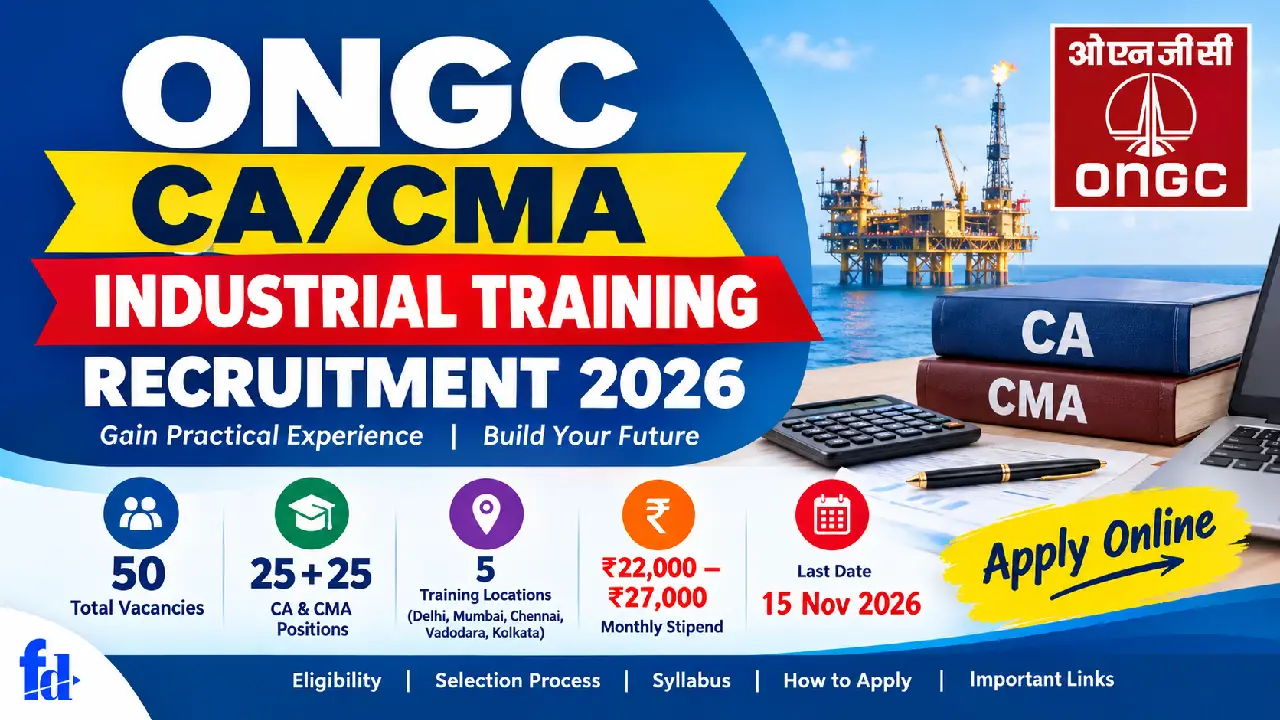
Apply Online
ONGC CA/CMA Industrial Training Recruitment 2026 offers 50 training positions with stipends up to ₹27,000 monthly. Check eligibility, vacancies, stipend, selection and apply by 15 November 2026.
ONGC CA/CMA Industrial Training Recruitment 2026
Oil and Natural Gas Corporation Limited (ONGC), one of India’s leading Maharatna public sector enterprises, has announced an excellent professional training opportunity for students pursuing Chartered Accountancy (CA) and Cost and Management Accountancy (CMA).
Under Advertisement No. ONGC/Industrial Trainee/1/2026, the corporation has invited applications for 50 industrial training positions, comprising 25 CA Industrial Trainees and 25 CMA Industrial Trainees.
The notification, dated 23 October 2026, offers eligible candidates an opportunity to gain practical exposure to the financial and accounting operations of a major public sector undertaking.
Selected trainees will be placed at five important business locations: Delhi, Mumbai, Chennai, Vadodara and Kolkata. Depending on the location and training year, the monthly stipend ranges from ₹22,000 to ₹27,000.
Candidates who have passed the relevant CA or CMA Intermediate examination, secured at least 60% aggregate marks in Class 12 and were born on or after 1 January 2000 can apply, subject to the remaining notification conditions.
The application process is being conducted online through the Google Form specified in the official advertisement. The last date for submitting applications is 15 November 2026.
This opportunity is particularly valuable for students seeking practical experience in corporate finance, accounting, cost management, auditing and financial reporting before completing their professional qualifications. However, applicants must understand that this is an industrial training engagement and not a permanent ONGC employment opportunity.
ONGC CA/CMA Industrial Training Recruitment 2026: Executive Summary
The following table presents the major details of the recruitment drive.
Particulars | Details |
Organisation | Oil and Natural Gas Corporation Limited |
Organisation Type | Maharatna Central Public Sector Enterprise |
Advertisement Number | ONGC/Industrial Trainee/1/2026 |
Training Programme | CA/CMA Industrial Training |
Total Vacancies | 50 |
CA Industrial Trainees | 25 |
CMA Industrial Trainees | 25 |
Notification Date | 23 October 2026 |
Application Mode | Online Google Form |
Educational Qualification | CA/CMA Intermediate Pass |
Class 12 Requirement | Minimum 60% aggregate |
Date of Birth Requirement | On or after 01 January 2000 |
Monthly Stipend | ₹22,000–₹27,000 |
Training Locations | Delhi, Mumbai, Chennai, Vadodara and Kolkata |
CA Training Duration | 9–12 months |
CMA Training Duration | 15–18 months |
Application Fee | No fee specified |
Last Date to Apply | 15 November 2026 |
Selection Process | Eligibility assessment and interview, if conducted |
Official Website |
Current recruitment status: Applications are open as of 31 October 2026. Eligible candidates should complete the prescribed application process before the deadline.
It is important to note that the recruitment is intended for students registered with the respective professional institutes who have completed the relevant Intermediate examination. Candidates should also verify their eligibility for industrial training under the applicable ICAI or ICMAI regulations.
About Oil and Natural Gas Corporation Limited (ONGC)
Oil and Natural Gas Corporation Limited is one of India’s most important energy-sector public enterprises. Headquartered in New Delhi, ONGC is engaged primarily in the exploration and production of crude oil and natural gas, supporting the country’s energy requirements and contributing to its economic development.
The organisation traces its origins to 1956, when the Government of India established the Oil and Natural Gas Directorate to develop the country’s petroleum resources. It subsequently became a statutory commission in 1959 and was converted into a limited company in 1993.
ONGC received Navratna status in 1997 and Maharatna status in 2010, reflecting its importance and operational capabilities within India’s public sector enterprise framework.
ONGC’s core business activities
The organisation’s activities extend across several important areas:
- Exploration: Identifying and evaluating potential oil and natural gas reserves.
- Production: Extracting crude oil and natural gas from onshore and offshore fields.
- Reservoir management: Monitoring production performance and managing hydrocarbon resources.
- Project development: Developing infrastructure and facilities for exploration and production.
- Financial management: Managing large capital expenditure programmes, operating costs and financial resources.
- Corporate governance: Maintaining regulatory compliance, accountability and transparent reporting.
Why ONGC industrial training is valuable
For CA and CMA students, industrial training at ONGC can provide exposure to the financial processes of a large, asset-intensive organisation.
Unlike a small commercial business, an integrated energy enterprise deals with significant capital investments, complex procurement arrangements, operating expenditure, project accounting and financial controls.
Trainees may gain exposure to professional working environments involving:
- Corporate accounting and financial reporting.
- Budget preparation and expenditure monitoring.
- Cost analysis and management accounting.
- Internal audit and control procedures.
- Taxation and statutory compliance.
- Financial planning and performance analysis.
Actual assignments will depend on the department, location and work allocation made by ONGC. These learning areas should not be interpreted as a guarantee of placement in a particular department.
ONGC Industrial Trainee Vacancy Details 2026
ONGC has announced 50 industrial training positions, divided equally between CA and CMA candidates.
Training Position | Number of Vacancies |
CA Industrial Trainee | 25 |
CMA Industrial Trainee | 25 |
Total | 50 |
The available positions are distributed across five training locations.
A. CA Industrial Trainee vacancies
Location | OBC | SC | ST | PwBD | Unreserved | Total |
Delhi | 3 | 1 | 1 | 0 | 6 | 11 |
Mumbai | 2 | 1 | 0 | 1 | 4 | 7 |
Chennai | 1 | 1 | 0 | 0 | 1 | 3 |
Vadodara | 1 | 0 | 0 | 0 | 1 | 2 |
Kolkata | 0 | 1 | 0 | 0 | 1 | 2 |
Total | 7 | 4 | 1 | 1 | 13 | 25 |
B. CMA Industrial Trainee vacancies
Location | OBC | SC | ST | PwBD | Unreserved | Total |
Delhi | 2 | 1 | 1 | 0 | 5 | 9 |
Mumbai | 2 | 1 | 1 | 1 | 3 | 7 |
Chennai | 1 | 0 | 0 | 0 | 2 | 3 |
Vadodara | 0 | 1 | 0 | 0 | 2 | 3 |
Kolkata | 1 | 0 | 0 | 0 | 2 | 3 |
Total | 6 | 3 | 2 | 1 | 14 | 25 |
Important reservation information:
- The CA category has 25 positions, including 13 unreserved positions.
- The CMA category also has 25 positions, including 14 unreserved positions.
- One PwBD position is identified in each training category.
- Unfilled reserved vacancies may be filled by unreserved-category candidates, as specified in the recruitment information.
- Candidates claiming reservation must provide valid supporting certificates.
Which training location should candidates prefer?
The five locations offer different professional and practical considerations.
Delhi: The highest number of CA and CMA training positions is available in Delhi. It is particularly relevant for candidates interested in corporate and administrative exposure.
Mumbai: Mumbai is an important financial and commercial centre, offering an environment with substantial corporate and financial activity.
Chennai: Candidates interested in working in a major industrial and commercial city may consider Chennai.
Vadodara: This location offers a lower stipend than the four Category X cities, but living expenses may also differ.
Kolkata: Kolkata provides another opportunity to gain experience within ONGC’s organisational environment.
Candidates should consider accommodation costs, travel expenses and personal circumstances before making their location preference.
Detailed Job Profile and Key Responsibilities
The ONGC CA/CMA Industrial Training programme is designed to provide professional students with exposure to the financial and accounting functions of a large public sector organisation.
The actual work allocation will depend on the department and the requirements of the concerned office. Although the advertisement does not prescribe an exhaustive job description, the following areas explain the type of professional exposure candidates may encounter.
A. Financial accounting and reporting
CA and CMA trainees may receive exposure to financial accounting processes, including:
- Understanding financial statements and accounting records.
- Assisting with financial reporting documentation.
- Reviewing accounting entries and supporting schedules.
- Understanding reconciliation procedures.
- Learning the application of relevant accounting standards.
- Supporting documentation required for periodic financial reporting.
Working in an organisation such as ONGC can help trainees understand how accounting principles are applied in a large corporate environment.
B. Cost accounting and management accounting
Cost management is particularly important in the petroleum and natural gas industry because exploration, production, transportation and infrastructure operations involve substantial expenditure.
Potential learning areas include:
- Cost classification and allocation.
- Budgetary control.
- Variance analysis.
- Cost-centre reporting.
- Project expenditure monitoring.
- Management information systems.
- Cost efficiency and performance measurement.
CMA trainees may find these areas particularly relevant to their professional studies.
C. Auditing and internal controls
Industrial trainees may also gain exposure to the importance of financial controls and audit documentation.
Potential activities include:
- Understanding internal audit procedures.
- Reviewing supporting financial documents.
- Learning audit-trail requirements.
- Understanding compliance controls.
- Studying expenditure approval procedures.
- Assisting with documentation and verification exercises.
D. Taxation and statutory compliance
Large public sector organisations operate under extensive regulatory and taxation requirements.
Relevant learning areas may include:
- Goods and Services Tax (GST).
- Income-tax provisions.
- Tax deduction at source.
- Tax-related documentation.
- Statutory reporting requirements.
- Corporate compliance procedures.
E. Reporting structure and working environment
Trainees will work within the office or department to which ONGC assigns them. Their reporting arrangements and responsibilities will depend on the designated supervisory officers.
The industrial training environment is expected to emphasise professional conduct, confidentiality, accuracy, documentation and adherence to organisational procedures.
Important: These are potential professional learning areas, not an officially guaranteed list of duties. The notification does not specify particular software, ERP platforms, department names or individual reporting officers.
ONGC CA/CMA Industrial Training Eligibility Criteria 2026
Candidates must satisfy the educational, age and other conditions prescribed in the advertisement.
A. Educational qualification
Candidate Category | Required Qualification |
CA Industrial Trainee | Passed CA Intermediate examination conducted by ICAI |
CMA Industrial Trainee | Passed CMA Intermediate examination conducted by ICMAI |
Class 12 | Minimum 60% aggregate marks |
Candidates applying for the CA training category must possess the required CA Intermediate qualification. Similarly, applicants for CMA training must have passed CMA Intermediate.
Simply appearing in the Intermediate examination or awaiting results should not be treated as equivalent to passing the examination.
B. Class 12 percentage requirement
Candidates must have secured at least 60% aggregate marks in their Class 12 examination.
Applicants should calculate their aggregate percentage carefully using their recognised board’s marksheet and ensure that the percentage meets the notification requirement.
C. Age limit
The notification specifies that applicants must have been born on or after 1 January 2000.
This is a date-of-birth eligibility condition rather than a conventional maximum-age calculation.
Candidates should verify their date of birth using their Class 10 certificate, which is among the documents required for submission.
D. Preference in selection
ONGC has indicated preference for:
- Wards of ONGC employees.
- Candidates who passed the relevant Intermediate examination in their first attempt.
These are preference conditions and should not be confused with the essential educational eligibility criteria.
Candidates who have passed after multiple attempts should not automatically assume that they are ineligible. They should disclose their examination history accurately and upload the required marksheets.
E. Nationality and domicile
The programme is intended for eligible students of ICAI and ICMAI under the Indian professional training framework.
The advertisement does not establish a separate state domicile quota. Candidates should follow the nationality and documentation conditions applicable under the official advertisement and relevant institute regulations.
F. Physical standards
No separate height, weight, eyesight, endurance or physical efficiency test is prescribed for this financial and accounting industrial training opportunity.
G. Training regulations
Candidates should independently confirm that their professional training arrangements comply with the applicable ICAI or ICMAI requirements.
An ONGC selection does not automatically replace any registration, approval or documentation procedure required by the respective professional institute.
ONGC Industrial Trainee Stipend, Perks and Benefits 2026
One of the biggest attractions of the ONGC CA/CMA Industrial Training programme is its monthly stipend.
The stipend differs according to the training location and year.
Monthly stipend structure
Training Location | Year 1 | Year 2 |
Delhi | ₹25,000 | ₹27,000 |
Mumbai | ₹25,000 | ₹27,000 |
Chennai | ₹25,000 | ₹27,000 |
Kolkata | ₹25,000 | ₹27,000 |
Vadodara | ₹22,000 | ₹25,000 |
The figures represent monthly stipends, not permanent employee salaries.
Estimated annual stipend
For comparison, the annualised amounts are:
Location Category | Year 1 Annualised | Year 2 Annualised |
Category X cities | ₹3,00,000 | ₹3,24,000 |
Category Y city | ₹2,64,000 | ₹3,00,000 |
These are calculations based on 12 months at the applicable monthly rate. They should not be interpreted as guaranteed total payments where the actual training period is shorter.
Other benefits and facilities
Candidates should understand the following conditions:
- Professional experience: Exposure to a major public sector enterprise.
- Learning opportunities: Potential exposure to accounting, financial reporting, costing and audit-related work.
- Leave: Leave will be governed by the respective ICAI/ICMAI rules and regulations.
- Boarding and lodging: Selected candidates must arrange their own accommodation.
- Travel expenses: Candidates are responsible for their own travel arrangements.
- Interview expenses: Candidates must bear the expenses of attending an interview, if conducted.
The notification does not promise company accommodation, medical insurance, gratuity, provident fund, pension or regular employee allowances. These benefits should not be assumed.
Is ONGC industrial training better than private-sector training?
The value of industrial training depends on the quality of work exposure, supervision and professional learning.
ONGC offers the potential advantage of understanding the financial operations of a major energy-sector PSU. Private-sector organisations may provide different opportunities, including exposure to consulting, financial services, manufacturing, technology or multinational corporate environments.
Candidates should compare actual responsibilities, professional recognition, location, stipend and training duration rather than selecting an organisation solely because of its brand name.
Important Dates and Deadlines
Candidates should keep the following dates in mind.
Event | Date |
Notification release | 23 October 2026 |
Online application commencement | 23 October 2026 |
Last date for application submission | 15 November 2026 |
Interview date | To be communicated, if applicable |
Result/selection announcement | To be communicated by ONGC |
Training commencement | As notified by ONGC |
There is no separate examination date because the recruitment notification does not prescribe a written competitive examination. It is not required as a separate examination date because the recruitment notification does not prescribe a written competitive examination.
Candidates should submit their forms well before the closing date to avoid document-upload problems or last-minute technical issues.
ONGC Selection Process and Interview Pattern 2026
The ONGC CA/CMA Industrial Training selection process is different from conventional government job recruitment.
There is no advertised competitive written examination, preliminary examination, mains examination or physical efficiency test.
The selection procedure is based on eligibility and the organisation’s selection requirements.
Stage 1: Eligibility verification
ONGC will assess whether applicants satisfy the essential requirements, including:
- CA/CMA Intermediate qualification.
- Minimum 60% marks in Class 12.
- Date of birth on or after 1 January 2000.
- Required supporting documents.
- Applicable industrial training eligibility.
Stage 2: Preference considerations
Preference will be given to ONGC wards and candidates who passed the relevant examination in their first attempt.
Candidates should provide accurate information regarding their examination attempts and any applicable ONGC employee relationship.
Stage 3: Interview
An interview may be conducted through:
- Online mode.
- Offline mode.
- Telephone.
The organisation will communicate the interview arrangements to shortlisted candidates, if an interview is required.
Candidates must attend at their own expense.
Stage 4: Final selection
ONGC reserves the right to make the final selection.
Meeting the minimum eligibility conditions does not guarantee selection because the number of available training positions is limited.
Is there a written examination?
No written examination is specified in the advertisement.
Examination Parameter | Details |
Written examination | Not prescribed |
Preliminary examination | Not prescribed |
Main examination | Not prescribed |
Total written marks | Not applicable |
Examination duration | Not applicable |
Negative marking | Not applicable |
Interview | May be conducted |
Document verification | Required |
This distinction is important because candidates should not waste time preparing for an imaginary ONGC recruitment examination.
Comprehensive Preparation Strategy for the ONGC Interview
Although ONGC has not announced a written examination syllabus, candidates should prepare for a possible professional interview.
A strong candidate should demonstrate a clear understanding of accounting concepts, financial management, costing and the energy sector.
A. Financial accounting
Revise the following topics:
- Journal entries and ledger accounting.
- Trial balance and financial statements.
- Depreciation and fixed assets.
- Inventory valuation.
- Revenue recognition.
- Accounting standards.
- Cash flow statements.
- Bank reconciliation.
Interview preparation tip: Practise explaining the preparation and interpretation of financial statements rather than memorising definitions alone.
B. Cost accounting
CMA candidates should particularly focus on:
- Material, labour and overhead costing.
- Cost sheets.
- Marginal costing.
- Break-even analysis.
- Standard costing.
- Variance analysis.
- Activity-based costing.
- Budgetary control.
- Process costing.
Interview preparation tip: Practise numerical problems involving contribution, break-even points and cost variances.
C. Financial management
Important areas include:
- Working capital management.
- Capital budgeting.
- Net present value.
- Internal rate of return.
- Cost of capital.
- Capital structure.
- Financial ratios.
- Cash management.
Candidates should understand how these concepts influence investment and expenditure decisions in large organisations.
D. Taxation
Prepare the fundamentals of:
- GST.
- Input tax credit.
- Income-tax basics.
- Tax deducted at source.
- Tax compliance.
- Corporate taxation.
- Relevant statutory documentation.
E. Auditing
Revise:
- Internal auditing.
- Statutory auditing.
- Audit evidence.
- Internal financial controls.
- Vouching and verification.
- Audit risk.
- Compliance procedures.
F. ONGC and the energy sector
This is particularly important for demonstrating genuine interest in the organisation.
Candidates should research:
- ONGC’s history and business operations.
- Exploration and production activities.
- India’s crude oil and natural gas requirements.
- Energy security.
- Capital-intensive projects.
- Financial management in the petroleum industry.
- Corporate governance and sustainability.
G. Common interview questions
Prepare answers to questions such as:
- Why do you want to pursue industrial training at ONGC?
- What is the difference between financial accounting and cost accounting?
- Explain working capital management.
- What is the difference between marginal costing and absorption costing?
- How is depreciation calculated?
- What are internal financial controls?
- Explain the importance of budgetary control.
- What do you know about ONGC’s core business?
- How can cost accounting improve operational efficiency?
- What are your professional goals after completing your training?
Recommended preparation schedule
Preparation Period | Recommended Activity |
Day 1–2 | Financial accounting and accounting standards |
Day 3–4 | Cost accounting and variance analysis |
Day 5 | Financial management |
Day 6 | GST and taxation |
Day 7 | Auditing and internal controls |
Day 8 | ONGC company research |
Day 9 | Practical accounting and costing questions |
Day 10 | Mock interview and revision |
The objective is not to prepare for a competitive examination but to demonstrate professional understanding and readiness to learn in a corporate environment.
Application Fees and Payment Mode
The ONGC CA/CMA Industrial Training advertisement does not specify an application fee.
Category | Application Fee |
General/Unreserved | No fee specified |
OBC | No fee specified |
SC | No fee specified |
ST | No fee specified |
PwBD | No fee specified |
Candidates are required to submit their applications using the prescribed online Google Form.
There is no separate examination fee or online payment procedure specified in the notification.
Applicants should not transfer money to unofficial agents or individuals claiming to guarantee selection.
How to Apply for ONGC CA/CMA Industrial Training 2026
Eligible candidates can follow these steps to complete the application.
Step 1: Visit the official notification
Open the official ONGC recruitment advertisement and read the eligibility conditions, vacancy details, stipend structure and document requirements.
Step 2: Open the online application form
Use the Google Form link provided in the official notification.
Verify that you are using the correct form before entering personal information.
Step 3: Enter personal details
Fill in the requested information carefully, including:
- Full name.
- Date of birth.
- Contact number.
- Email address.
- Educational qualifications.
- CA/CMA Intermediate examination details.
- Relevant examination attempt information.
- Category and other applicable details.
- ONGC ward information, if applicable.
Ensure that your name and date of birth match the supporting documents.
Step 4: Upload the required documents
The notification specifies the following document requirements.
Document | File Format |
Recent photograph | JPG |
Class 10 marksheet/certificate | |
Aadhaar card | |
Class 12 marksheet | |
Caste certificate, if applicable | |
PwBD certificate, if applicable | |
CA Intermediate Group 1 marksheets | |
CA Intermediate Group 2 marksheets | |
CMA Intermediate Group 1 marksheets | |
CMA Intermediate Group 2 marksheets | |
ONGC employee ID, for ONGC ward candidates |
Candidates should upload only the documents relevant to their application category.
Step 5: Follow the document naming instructions
All uploaded documents must be self-attested.
The advertisement also specifies a file-naming convention based on the candidate’s name appearing in the Class 10 certificate.
Candidates should follow the exact naming instructions in the notification rather than using random filenames.
Step 6: Include all Intermediate examination attempts
An important instruction concerns Intermediate examination marksheets.
Candidates must upload the relevant Group 1 and Group 2 marksheets separately, including marksheets relating to failed attempts, as specified in the advertisement.
Do not upload only the final passing marksheet if the notification requires the complete attempt history.
Step 7: ONGC ward documentation
Candidates applying under the ONGC ward preference should provide the relevant ONGC employee identification document and CPF number as required.
Ensure that the employee details are accurate.
Step 8: Review the complete application
Before submission, check:
- Correct personal information.
- Accurate examination details.
- Correct category selection.
- Appropriate document uploads.
- Clear and readable scanned documents.
- Correct file formats and filenames.
The advertisement does not provide separate photograph pixel dimensions or a universal file-size limit. Follow the actual upload restrictions displayed in the application form.
Step 9: Submit the application
Submit the completed Google Form before the deadline of 15 November 2026.
Keep a copy or screenshot of the submission confirmation for future reference.
Step 10: Contact ONGC for technical assistance
For issues related to the application submission process, candidates can contact:
Email: cacmatrainees@ongc.co.in
Applicants should avoid waiting until the final day to report technical problems.
Official Links for ONGC Recruitment 2026
Candidates should use the official links below to access the notification and application form.
Description | Official Link |
Official Notification PDF | |
Direct Apply Online | |
Official Website | |
Recruitment Notices | |
Application Assistance | cacmatrainees@ongc.co.in |
Important: The official notification should always be treated as the final authority for eligibility, selection and application requirements. Candidates should verify that the Google Form is still accepting submissions before applying.
Conclusion and Final Advice
The ONGC CA/CMA Industrial Training Recruitment 2026 is a valuable opportunity for professional accounting students who want to gain practical experience in a major Maharatna public sector enterprise.
With 50 training positions across Delhi, Mumbai, Chennai, Vadodara and Kolkata, the programme offers exposure to the financial and accounting environment of one of India’s most important energy organisations.
The monthly stipend of ₹22,000 to ₹27,000 makes the opportunity financially attractive, while the potential professional exposure can help candidates understand how financial management, costing, auditing and corporate reporting operate in a large organisation.
However, candidates should carefully consider the training duration, location, accommodation expenses and professional institute requirements before applying.
The most important eligibility conditions are passing the relevant CA/CMA Intermediate examination, securing at least 60% aggregate marks in Class 12 and being born on or after 1 January 2000.
Applicants should also remember that ONGC gives preference to its wards and candidates who passed the relevant Intermediate examination in their first attempt.
The application deadline is 15 November 2026. Interested candidates should read the official notification, prepare their documents and submit the application well before the closing date.
For CA and CMA students looking to strengthen their professional journey with meaningful corporate exposure, ONGC’s industrial training programme deserves serious consideration.
Frequently Asked Questions (FAQs)
Q1. How many vacancies are available in ONGC CA/CMA Industrial Training Recruitment 2026?
ONGC has announced 50 industrial training positions. These include 25 positions for CA Intermediate-qualified candidates and 25 positions for CMA Intermediate-qualified candidates.
Q2. What is the last date to apply for ONGC Industrial Training 2026?
The last date for receipt of applications is 15 November 2026. Candidates must submit their applications through the prescribed online Google Form before the deadline.
Q3. What is the educational qualification required for ONGC CA/CMA Industrial Training?
Candidates must have passed the CA Intermediate examination conducted by ICAI or the CMA Intermediate examination conducted by ICMAI, depending on the training category. Applicants must also have secured at least 60% aggregate marks in Class 12.
Q4. What is the age limit for ONGC CA/CMA Industrial Trainees?
Candidates must have been born on or after 1 January 2000. The date of birth should be supported by the relevant educational certificate.
Q5. What is the monthly stipend offered by ONGC?
The monthly stipend is ₹25,000 in the first year and ₹27,000 in the second year for Delhi, Mumbai, Chennai and Kolkata. For Vadodara, it is ₹22,000 in the first year and ₹25,000 in the second year.
Q6. What is the training duration for CA and CMA candidates?
The specified training duration is 9–12 months for CA candidates and 15–18 months for CMA candidates. Candidates should also ensure that their training arrangements comply with the applicable professional institute regulations.
Q7. Is there any written examination for ONGC Industrial Training Recruitment 2026?
No written competitive examination is specified in the notification. Selection is based on eligibility, applicable preferences and an interview that may be conducted online, offline or telephonically.
Q8. Are ONGC employees’ children given preference?
Yes. Preference is given to ONGC wards. Candidates who have passed their relevant Intermediate examination in the first attempt are also given preference, as stated in the recruitment information.
Q9. Can candidates who passed CA/CMA Intermediate after multiple attempts apply?
Candidates should not assume that multiple attempts automatically disqualify them. First-attempt qualification is a preference criterion, while passing the relevant Intermediate examination is an essential educational requirement. Applicants must provide the required marksheets, including failed attempts.
Q10. Is there any application fee for ONGC CA/CMA Industrial Training?
The notification does not specify an application fee. Applications are submitted through the prescribed online Google Form without a separate examination-fee payment procedure.
Q11. Does ONGC provide accommodation to selected industrial trainees?
Candidates are required to arrange their own boarding, lodging and travel. The advertisement does not promise company accommodation or reimbursement of these expenses.
Q12. Is this a permanent ONGC government job?
No. This is an industrial training engagement for eligible CA and CMA students. It is not a regular permanent appointment, and selection does not guarantee future employment with ONGC.

Hey, I am Sachin Ramdurg. I run and manage futuredecider.com website that helps students, graduates, and professionals, to find and decide on their future career with ultimate future career advices and future career guides. I have an overall 12+ years of career guidance experience in multiple domains which has helped multiple students, graduates, and professionals to find the best career path for their future.