
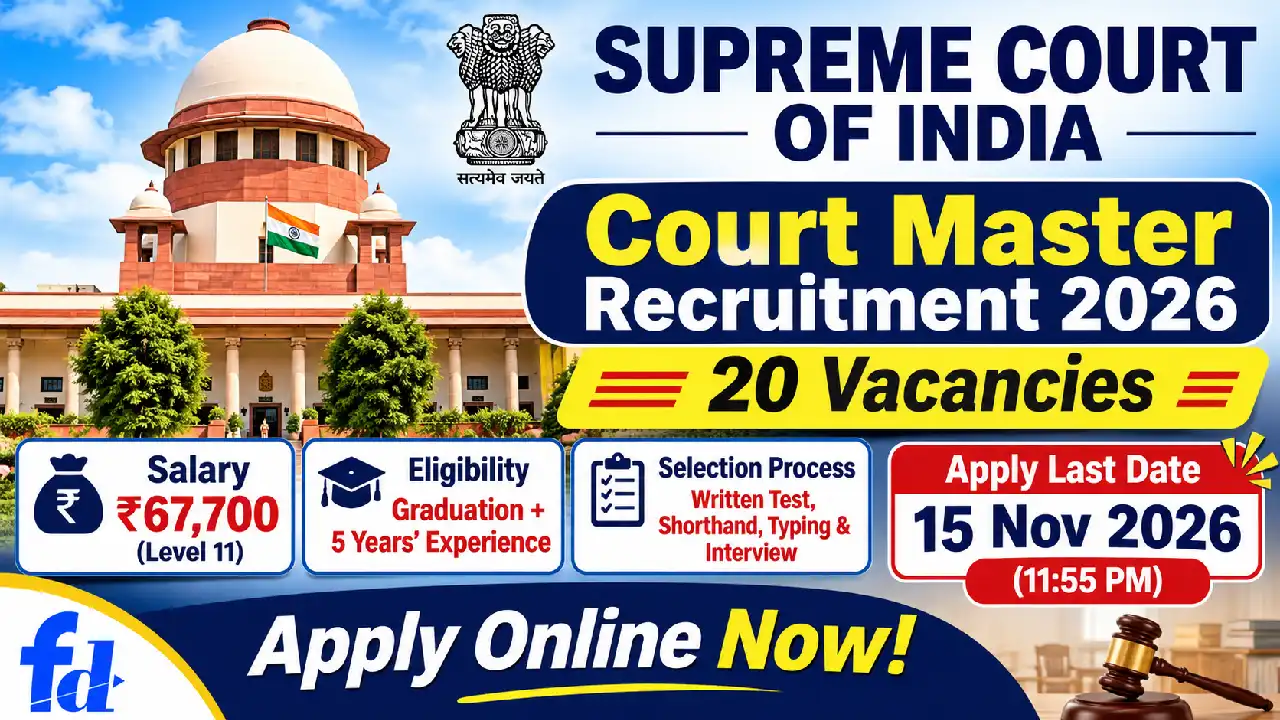
Supreme Court Court Master Recruitment 2026 offers 20 vacancies with ₹67,700 basic pay. Check eligibility, age limit, syllabus, exam pattern and apply online by November 15.
Supreme Court Court Master Recruitment 2026
The Supreme Court of India has announced the Court Master (Shorthand) Recruitment 2026, offering an important career opportunity for experienced stenography and personal-assistant professionals seeking a prestigious position in the country’s highest judicial institution.
Under the recruitment advertisement dated 15 October 2026, the Supreme Court intends to fill 20 tentative vacancies through direct recruitment. Selected candidates will work in the Supreme Court Registry in New Delhi and receive remuneration under Pay Level 11 of the government pay matrix, with an initial basic salary of ₹67,700 per month.
Unlike ordinary stenographer recruitment examinations, this opportunity is specifically intended for experienced professionals who already possess substantial shorthand, typing and administrative experience.
Applicants must hold a bachelor’s degree, demonstrate English shorthand proficiency of 120 words per minute, possess computer typing speed of at least 40 words per minute and satisfy the prescribed five-year regular-service requirement.
The online application process commenced on 25 October 2026. Eligible candidates can submit their applications until 15 November 2026, 11:55 PM.
The selection process includes an objective written examination, an English shorthand skill test, a computer typing speed test and an interview. Consequently, candidates must prepare for both conventional competitive examinations and practical stenography assessments.
The objective examination is tentatively scheduled for 7 December 2026. Candidates should regularly monitor the official recruitment portal for subsequent examination notices, admit cards and changes to the recruitment schedule.
This recruitment is particularly attractive to experienced Private Secretaries, Senior Personal Assistants, Personal Assistants and Senior Stenographers working in eligible government organisations, public-sector undertakings and statutory bodies.
Recruitment at a glance
Particular | Details |
Recruiting organisation | Supreme Court of India |
Recruitment year | 2026 |
Post name | Court Master (Shorthand) |
Total vacancies | 20 (tentative) |
Advertisement date | 15 October 2026 |
Recruitment type | Direct recruitment |
Job category | Gazetted Group A |
Job location | New Delhi |
Pay level | Level 11 |
Initial basic salary | ₹67,700 |
Application mode | Online |
Application start date | 25 October 2026 |
Last date | 15 November 2026 |
Written examination | 7 December 2026 (tentative) |
Official website |
India+2
About the Supreme Court of India
The Supreme Court of India is the apex judicial institution of the country. It occupies a central position in India’s constitutional framework and serves as the final court of appeal in the Indian judicial system.
The Supreme Court was established on 26 January 1950, when the Constitution of India came into force. It was formally inaugurated on 28 January 1950, replacing the Federal Court of India.
Located on Tilak Marg in New Delhi, the institution exercises extensive constitutional, appellate and advisory jurisdiction.
Its principal responsibilities include:
- Interpreting and protecting the Constitution of India.
- Hearing appeals against judgments of High Courts and other courts.
- Resolving constitutional disputes involving governments.
- Protecting fundamental rights through appropriate judicial remedies.
- Maintaining consistency in the interpretation of laws.
- Exercising judicial review over legislative and executive actions.
- Providing advisory opinions to the President under Article 143.
The Supreme Court functions through judges, judicial officers, Registry officials, administrative departments and supporting personnel.
Understanding the Supreme Court Registry
The Supreme Court Registry plays an essential role in ensuring that judicial and administrative processes operate efficiently.
Its responsibilities include managing case filings, maintaining judicial records, coordinating court proceedings, processing administrative documentation and facilitating communication between different branches of the institution.
A Court Master is an important part of this administrative and judicial-support ecosystem.
Working in the Supreme Court offers a professional environment where accuracy, confidentiality, discipline and a strong understanding of court procedures are particularly important.
For an experienced stenography professional, the Court Master position represents an opportunity to apply established administrative and shorthand skills within one of India’s most significant constitutional institutions.
Official website: Supreme Court of India.
Complete Vacancy Details – Supreme Court Court Master Recruitment 2026
The Supreme Court has announced 20 tentative vacancies for the Court Master (Shorthand) position.
The recruitment is being conducted through direct recruitment, and the successful candidates will be placed in a panel for consideration for appointment.
Vacancy distribution
Vacancy detail | Information |
Name of post | Court Master (Shorthand) |
Total vacancies | 20 (tentative) |
Recruitment method | Direct recruitment |
Post classification | Gazetted |
Pay level | Level 11 |
Department | Supreme Court Registry |
Posting location | New Delhi |
Reservation categories | SC, ST and OBC-NCL, as applicable under rules |
Category-wise reservation: The notification does not publish a numerical SC/ST/OBC-NCL vacancy breakup. Reservation benefits are governed by Rule 4A of the Supreme Court Officers and Servants (Conditions of Service and Conduct) Rules, 1961. Candidates should not assume that all 20 posts are unreserved or that a particular category has a fixed number of vacancies.
Current recruitment status
Online applications active
As of 31 October 2026:
- Recruitment notification has been published.
- Online registration has commenced.
- The application portal is accepting applications.
- The deadline is 15 November 2026.
- The objective examination is tentatively scheduled for 7 December 2026.
- Later skill-test and interview dates are awaited.
The Supreme Court reserves the right to modify the number of vacancies or selection arrangements according to administrative requirements. Moreover, inclusion in the final panel does not automatically establish a right to appointment.
Detailed Job Profile and Key Responsibilities
The Court Master (Shorthand) position is a specialised judicial-administration role requiring excellent shorthand skills, computer proficiency, accuracy and professional discipline.
The official advertisement specifies the qualifications and selection requirements rather than providing a detailed daily-duty manual. The following describes the professional functions generally associated with this type of position.
A. Recording judicial proceedings
A Court Master may be required to support the recording and documentation of court proceedings. This requires the ability to understand spoken English quickly and accurately.
The professional must be comfortable handling legal terminology, names of parties, case references and judicial expressions.
B. Shorthand transcription
One of the most important professional capabilities is English shorthand at 120 words per minute.
The employee must be able to:
- Record spoken dictation accurately.
- Maintain consistency during lengthy dictation.
- Convert shorthand notes into readable English.
- Correct transcription errors.
- Maintain proper formatting and punctuation.
C. Court and Registry coordination
Court administration involves coordination among judicial officers, Registry personnel and other authorised staff.
A Court Master may assist with documentation and administrative communication connected with judicial work.
D. Document management
Accuracy is essential when dealing with official documents. Responsibilities associated with this work can include maintaining records, organising documents, preparing typed material and ensuring that sensitive information is handled appropriately.
E. Computer-based administrative work
The position requires computer operation and a minimum typing speed of 40 words per minute.
Practical familiarity with word processing, document formatting, electronic records and office applications is therefore valuable.
F. Confidentiality and professional conduct
Employees working in a judicial institution must exercise discretion and maintain confidentiality.
Information relating to cases, court proceedings and internal administration must be handled according to applicable rules and instructions.
Working hours and professional environment
One particularly important condition appears in the recruitment notification: selected candidates may have to work at odd hours and on holidays.
Applicants must submit an undertaking agreeing to this requirement.
This makes the position more demanding than an ordinary fixed-hour administrative job. Candidates should consider their willingness to work according to court and Registry requirements before applying.
Eligibility Criteria for Supreme Court Court Master Recruitment 2026
Eligibility is one of the most important aspects of this recruitment because the post is not intended for fresh graduates without relevant professional experience.
Candidates must satisfy the educational, technical, experience and age requirements as of 1 October 2026.
A. Educational qualification
Applicants must possess:
– A bachelor’s degree from a recognised university in India.
The advertisement does not restrict the degree to a particular academic stream. Therefore, candidates with recognised undergraduate qualifications in arts, science, commerce or other disciplines may be eligible, provided they satisfy all remaining requirements.
B. Shorthand qualification
Candidates must demonstrate:
– English shorthand proficiency of at least 120 words per minute.
This is a mandatory skill requirement. Merely possessing a shorthand certificate without the required speed and practical proficiency will not be sufficient.
C. Computer typing qualification
Applicants must have:
- Computer operation knowledge.
- English typing speed of at least 40 words per minute.
Candidates should practise typing under timed conditions and maintain accuracy because the typing examination has a separate qualifying requirement.
D. Required work experience
The notification requires a minimum of five years of regular service in any of the following cadres:
- Private Secretary.
- Senior Personal Assistant.
- Personal Assistant.
- Senior Stenographer.
The qualifying service must be in Government, Public Sector Undertakings or statutory bodies.
This requirement is particularly important.
A candidate who has five years of experience in an unrelated private-sector administrative position cannot automatically claim eligibility. Similarly, freelance shorthand work or informal office experience should not be treated as equivalent to the prescribed regular service.
Applicants should verify that their service certificate clearly establishes their cadre, organisation and qualifying period.
E. Age limit
Category | Age requirement |
Minimum age | 30 years |
Maximum age | 45 years |
Age calculation date | 1 October 2026 |
Candidates must be at least 30 years old and must not exceed 45 years on the prescribed calculation date, subject to applicable relaxations.
F. Age relaxation
The notification provides the following provisions:
Category | Age relaxation |
SC | As per Government of India rules |
ST | As per Government of India rules |
OBC-NCL | As per Government of India rules |
Ex-Servicemen | As per applicable Government rules |
Dependants of Freedom Fighters | Up to 5 years |
Supreme Court Registry departmental candidates | No upper age limit |
Important: Candidates working in other Government departments, PSUs, statutory bodies and nationalised banks are specifically not entitled to age relaxation merely because of their employment.
G. Nationality requirement
The official advertisement invites applications from Indian citizens.
The recruitment is not an international hiring exercise, and foreign nationals cannot apply under this advertisement.
H. Reservation provisions
Reservation benefits are available to eligible SC, ST and OBC-NCL candidates under the applicable Supreme Court service rules.
Candidates claiming reservation must possess valid certificates issued by the competent authority.
OBC candidates should ensure that their certificate satisfies the Non-Creamy Layer requirement.
I. Physical standards
The advertisement does not specify a separate physical measurement, height, chest or endurance test for this post.
The selection focuses on educational qualifications, professional experience, written knowledge, shorthand, typing and interview performance.
S3WaaS+1
Salary, Perks and Benefits
Initial Basic Pay: ₹67,700
The Court Master (Shorthand) position is placed under Level 11 of the Pay Matrix.
Salary component | Details |
Pay level | Level 11 |
Pay matrix | ₹67,700–₹2,08,700 |
Initial basic pay | ₹67,700 |
Dearness Allowance | As admissible under applicable rules |
House Rent Allowance | As admissible under applicable rules |
Other allowances | As admissible under applicable rules |
Gross salary | Depends on applicable allowances and deductions |
Understanding the basic salary
The initial basic salary of ₹67,700 is the foundation of the employee’s monthly remuneration.
It is not the same as the final take-home salary.
The actual monthly gross amount may include applicable Dearness Allowance, House Rent Allowance and other admissible components.
The final in-hand salary will depend on posting-related entitlements, deductions, tax liability and applicable service regulations.
Additional benefits
Depending on the applicable service rules, eligible employees may receive:
- Dearness Allowance.
- House Rent Allowance or applicable accommodation-related benefits.
- Medical and healthcare facilities.
- Leave benefits.
- Retirement-related benefits under the applicable government framework.
- Other admissible service allowances.
The precise benefits should be confirmed through the applicable Supreme Court service regulations and appointment terms.
Is this salary attractive?
The initial basic pay of ₹67,700 places the position in a comparatively high government pay level.
It is especially attractive for experienced stenography professionals because the role combines a substantial pay matrix with employment in the country’s apex judicial institution.
However, candidates should evaluate the position as a specialised career opportunity rather than considering salary alone. The responsibilities, work schedule, professional experience requirement and Delhi posting are equally important factors.
Important Dates and Deadlines
Candidates should carefully follow the recruitment calendar.
Recruitment event | Important date |
Official notification | 15 October 2026 |
Application portal notice | 24 October 2026 |
Online registration begins | 25 October 2026, 10:00 AM |
Last date to apply | 15 November 2026, 11:55 PM |
Objective examination | 7 December 2026 (tentative) |
Tentative answer-key publication | 8 December 2026 |
Answer-key objection deadline | 9 December 2026, 11:55 PM |
Shorthand test | To be announced |
Typing test | To be announced |
Interview | To be announced |
The notification also specifies a fee of ₹100 per answer-key objection. This amount is refundable if the objection is found valid.
The shorthand and typing tests will be held in Delhi/NCR. The interview may be conducted online or physically in Delhi, depending on the competent authority’s directions.
The objective examination has multiple centres across India.
Selection Process and Examination Pattern
The Supreme Court Court Master Recruitment 2026 selection process consists of four stages.
- Objective Type Written Examination
100 questions, 100 marks, 90 minutes. - English Shorthand Skill Test
120 words per minute, seven-minute dictation and 45-minute transcription. - Computer Typing Speed Test
Minimum 40 words per minute, 10 minutes. - Interview
30 marks, with a minimum qualifying score of 15.
A. Objective written examination
The written examination consists of 100 objective-type questions carrying 100 marks.
Subject | Questions | Marks |
General English | 25 | 25 |
General Knowledge | 25 | 25 |
Judiciary-related constitutional provisions | 25 | 25 |
Supreme Court Rules, 2013 | 15 | 15 |
Computer Operation | 10 | 10 |
Total | 100 | 100 |
Examination feature | Details |
Question type | Objective |
Total questions | 100 |
Maximum marks | 100 |
Duration | 90 minutes |
Minimum qualifying marks | 50 |
Negative marking | No |
The examination tests a combination of language ability, general awareness, constitutional knowledge, judicial procedures and computer proficiency.
B. English shorthand skill test
This is a major stage of the recruitment.
Particular | Requirement |
Language | English |
Dictation speed | 120 WPM |
Dictation duration | 7 minutes |
Transcription time | 45 minutes |
Maximum marks | 100 |
Minimum qualifying marks | 50 |
Maximum permissible mistakes | 5% |
The notification specifies the following gradation:
Shorthand errors | Marks |
No mistake | 100 |
Up to 1% | 90 |
Up to 2% | 80 |
Up to 3% | 70 |
Up to 4% | 60 |
Up to 5% | 50 |
The full stop is treated as half a mistake. Certain capitalisation errors are also treated as half mistakes under the prescribed rules.
C. Computer typing test
Particular | Requirement |
Language | English |
Minimum typing speed | 40 WPM |
Duration | 10 minutes |
Maximum marks | 20 |
Minimum qualifying marks | 10 |
Permissible errors | 2% |
Candidates should focus on both speed and accuracy.
E. Interview
The interview carries 30 marks, and candidates must secure at least 15 marks.
The interview may evaluate:
- Professional experience.
- Communication skills.
- Understanding of court administration.
- Professional conduct.
- Familiarity with judicial terminology.
- Practical experience in shorthand and administrative work.
F. Shortlisting criteria
The notification provides specific shortlisting ratios:
- Candidates may be shortlisted for the shorthand and typing stages in a ratio of 1:10 against the tentative vacancies.
- Candidates who qualify in the first three tests may be shortlisted for the interview in a ratio of 1:3.
These ratios apply according to the notification’s prescribed merit-based conditions.
Final selection: Candidates will be empanelled in merit order. Being included in the panel does not automatically guarantee appointment.
Comprehensive Syllabus and Preparation Strategy
The Supreme Court notification specifies the subjects and their question distribution. Candidates should use this official structure as the foundation of their preparation.
The detailed topic breakdown below is a practical study guide, not a claim that every individual topic has been separately prescribed in the notification.
A. General English – 25 Marks
General English is important because the job requires excellent written and spoken English.
Topics to prepare:
- English grammar.
- Parts of speech.
- Tenses.
- Subject-verb agreement.
- Articles and prepositions.
- Active and passive voice.
- Direct and indirect speech.
- Synonyms and antonyms.
- Idioms and phrases.
- One-word substitutions.
- Sentence correction.
- Error detection.
- Reading comprehension.
- Vocabulary and spelling.
- Sentence rearrangement.
- Fill in the blanks.
Preparation strategy:
Start with grammar fundamentals and practise objective questions regularly. Read English newspapers and editorials to improve vocabulary and comprehension.
Because the post requires professional English shorthand, candidates should also practise listening to formal English speeches and accurately converting spoken language into written text.
B. General Knowledge – 25 Marks
The General Knowledge section tests awareness of India and important national and international developments.
Important topics:
Subject | Topics |
Indian History | Ancient, medieval and modern history |
Indian Geography | Physical geography, rivers, climate and resources |
Indian Polity | Constitution, Parliament, President and governance |
Economy | Banking, inflation, budget and economic terminology |
General Science | Basic physics, chemistry and biology |
Current Affairs | National and international developments |
Awards | Important national and international awards |
Sports | Major tournaments and achievements |
Important Organisations | UN, WHO and other international institutions |
Important Days | National and international observances |
Preparation strategy:
Maintain a current-affairs notebook and revise important developments regularly.
Give additional attention to constitutional developments, important judicial appointments, major Supreme Court judgments and legal developments in India.
C. Constitutional Provisions Relating to the Judiciary – 25 Marks
This section is particularly important because the job is connected with the Supreme Court.
Candidates should understand the constitutional framework governing the judiciary.
Important constitutional provisions:
Article | Subject |
Article 124 | Establishment and constitution of the Supreme Court |
Article 125 | Salaries of Supreme Court judges |
Article 126 | Appointment of Acting Chief Justice |
Article 127 | Appointment of ad hoc judges |
Article 128 | Attendance of retired judges |
Article 129 | Supreme Court as a Court of Record |
Article 130 | Seat of the Supreme Court |
Article 131 | Original jurisdiction |
Article 132 | Appellate jurisdiction in constitutional matters |
Article 133 | Civil appellate jurisdiction |
Article 134 | Criminal appellate jurisdiction |
Article 134A | Certificate for appeal |
Article 136 | Special Leave Petition |
Article 137 | Review jurisdiction |
Article 141 | Law declared by Supreme Court binding on all courts |
Article 142 | Enforcement of decrees and orders |
Article 143 | Advisory jurisdiction |
Article 145 | Rules of Court |
Article 146 | Officers and servants of the Supreme Court |
Article 147 | Interpretation |
Additional topics:
- Structure of the Indian judicial system.
- Independence of the judiciary.
- Appointment and removal of judges.
- Judicial review.
- Public Interest Litigation.
- Original and appellate jurisdiction.
- Contempt of court.
- Fundamental rights and judicial remedies.
- Writ jurisdiction.
- Separation of powers.
- Judicial accountability.
Preparation strategy:
Read the relevant constitutional articles directly rather than relying entirely on short notes.
Prepare comparison tables for original jurisdiction, appellate jurisdiction, advisory jurisdiction and review powers.
Understand the difference between Articles 32, 136, 137, 141 and 142 because these provisions are central to the Supreme Court’s constitutional role.
9.4 Supreme Court Rules, 2013 – 15 Marks
This subject is particularly relevant to the Court Master position.
Candidates should study the Supreme Court Rules, 2013, with attention to procedural and administrative provisions.
Suggested preparation topics:
- General court procedures.
- Registry functions.
- Filing of cases.
- Presentation of petitions.
- Preparation and maintenance of records.
- Court hearings and procedural requirements.
- Applications and interlocutory matters.
- Appeals and special leave petitions.
- Court fees and related procedural provisions.
- Rules governing advocates and appearances.
- Orders, judgments and judicial documentation.
- Procedural responsibilities of Registry officials.
Preparation strategy:
Use the official Supreme Court Rules rather than relying solely on coaching notes.
Read the rules systematically, create short summaries and practise objective questions based on definitions, procedures and important provisions.
Official resource: Supreme Court Rules.
E. Computer Operation – 10 Marks
Candidates should have practical familiarity with computers and common office applications.
Important topics:
- Computer fundamentals.
- Hardware and software.
- Operating systems.
- Input and output devices.
- Keyboard shortcuts.
- MS Word.
- MS Excel.
- MS PowerPoint.
- File management.
- Internet and email.
- Basic networking.
- Cybersecurity fundamentals.
- Data storage.
- Word processing.
- Document formatting.
Preparation strategy:
Practise using a computer rather than depending entirely on theoretical material.
Focus on MS Word formatting, keyboard shortcuts, document editing, typing accuracy and basic spreadsheet operations.
F. Shorthand preparation strategy – 120 WPM
The shorthand test deserves substantial preparation time because the required speed is demanding.
A seven-minute dictation at 120 words per minute represents approximately 840 dictated words.
Candidates should follow a structured routine:
- Practise dictation at 100 WPM until accuracy becomes consistent.
- Increase speed to 110 WPM.
- Move to 120 WPM.
- Practise seven-minute continuous dictation.
- Transcribe within 45 minutes.
- Review mistakes after every exercise.
- Maintain a record of recurring errors.
Do not focus exclusively on speed. A fast dictation with excessive transcription mistakes can damage the final score.
G. Computer typing preparation – 40 WPM
Candidates should practise typing for 10-minute sessions.
Recommended practice:
- Maintain a minimum speed of 45–50 WPM during preparation.
- Practise legal and formal English passages.
- Improve punctuation accuracy.
- Avoid repeated spelling mistakes.
- Practise capitalisation and numerical entries.
- Complete timed typing tests every day.
A preparation speed above the prescribed minimum provides a useful safety margin during the actual examination.
Suggested 30-day preparation timetable
Study activity | Daily time |
General English | 45 minutes |
General Knowledge | 45 minutes |
Constitution and Judiciary | 60 minutes |
Supreme Court Rules | 45 minutes |
Computer knowledge | 30 minutes |
Shorthand practice | 90 minutes |
Typing practice | 30 minutes |
Revision and mock tests | 45 minutes |
Total | 6 hours 30 minutes |
Candidates who already possess strong shorthand and typing skills should devote more time to constitutional provisions, Supreme Court Rules and objective examination practice.
Application Fees and Payment Mode
The Supreme Court has prescribed different application fees for unreserved and specified reserved categories.
Category | Application fee |
General / Unreserved | ₹1,500 |
SC | ₹750 |
ST | ₹750 |
OBC-NCL | ₹750 |
Ex-Servicemen | ₹750 |
Additional charges: Bank charges will be payable separately.
Payment method
The application fee must be paid online through the payment gateway provided by UCO Bank.
The notification does not permit payment through postal orders, demand drafts or other offline methods.
Important fee conditions
- The application fee is non-refundable.
- Bank charges are additional.
- Incorrect category selection may affect the application.
- Candidates should preserve the payment confirmation.
- An unsigned application will be summarily rejected.
Candidates should carefully check the application preview before completing the submission process.
Step-by-Step Guide to Apply Online
Applications must be submitted through the official online application portal.
Online application available
Application deadline: 15 November 2026, 11:55 PM.
Step 1: Visit the official website
Open the Supreme Court of India website:
Navigate to the Recruitment section and locate the detailed advertisement for Court Master (Shorthand) dated 15 October 2026.
Step 2: Open the application link
Visit the direct application portal:
https://cdn3.digialm.com/EForms/configuredHtml/32912/103070/3vdM5J33Gl951
Check that the page displays the correct recruitment and post name before proceeding.
Step 3: Read the eligibility conditions
Before registration, verify:
- Educational qualification.
- Five years of qualifying regular service.
- Shorthand speed.
- Computer typing speed.
- Age eligibility.
- Reservation eligibility, where applicable.
Step 4: Complete personal details
Enter the required information accurately.
Typical details include:
- Candidate’s full name.
- Father’s name.
- Mother’s name.
- Date of birth.
- Gender.
- Category.
- Contact information.
- Email address.
- Correspondence details.
The name and date of birth should match the Class 10 certificate.
Step 5: Enter educational qualifications
Provide the details of your educational qualifications, including graduation.
Ensure that the university and qualification information matches your certificates.
Step 6: Enter professional experience
This is a particularly important step.
Candidates must accurately enter their qualifying employment details, including:
- Organisation name.
- Designation.
- Employment period.
- Nature of service.
- Relevant cadre.
The experience information must establish the prescribed five years of regular service.
Step 7: Upload the required documents
The notification requires scanned copies of the following:
Document | Requirement |
Recent photograph | Required |
Candidate’s signature | Required |
Class 10 certificate | Required |
Class 12 certificate | Required |
Graduation certificate | Required |
Experience certificate | Required |
Caste/community certificate | If applicable |
Non-Creamy Layer certificate | If applicable |
The exact dimensions, file formats and maximum upload sizes must be followed according to the instructions displayed on the application portal.
Do not use assumed photograph or signature dimensions.
Step 8: Pay the application fee
Select the applicable category and proceed to the online payment gateway.
Pay using the payment methods made available by the portal.
After successful payment, retain the transaction details.
Step 9: Review the application
Check all personal, educational, employment and category information.
Verify that the uploaded documents are correct and readable.
Important: The notification states that once the application is submitted, it cannot be withdrawn or modified.
Step 10: Submit and save the application
Complete the final submission and download or print the application form.
Retain:
- Application number.
- Submitted application copy.
- Payment confirmation.
- Uploaded-document copies.
The application printout does not need to be sent to the Registry by post.
Important application precautions
- Do not submit incorrect employment information.
- Do not claim an experience period that cannot be supported by documents.
- Ensure that the category certificate is valid.
- Keep the registered mobile number and email address active.
- Avoid submitting multiple forms unless necessary, because only the last submitted application will be considered.
- Download the admit card from the official website when released.
Examination Centres and Test Locations
The Supreme Court has provided examination centres in several states and Union Territories for the objective written examination.
The shorthand and typing tests, however, will be conducted in Delhi/NCR.
Some of the important objective examination locations include:
State / UT | Examination cities |
Karnataka | Bengaluru, Belagavi, Mysuru |
Andhra Pradesh | Guntur, Visakhapatnam |
Telangana | Hyderabad, Warangal |
Kerala | Ernakulam, Thiruvananthapuram |
Tamil Nadu | Chennai, Coimbatore |
Maharashtra | Mumbai, Pune, Nagpur |
Uttar Pradesh | Lucknow, Kanpur, Agra, Varanasi and others |
Delhi/NCR | Delhi/NCR |
Rajasthan | Jaipur, Jodhpur, Ajmer and others |
West Bengal | Kolkata, Siliguri |
Bihar | Patna, Bhagalpur, Muzaffarpur |
Odisha | Bhubaneswar/Cuttack, Dhenkanal, Rourkela |
Gujarat | Ahmedabad/Gandhinagar, Rajkot |
Madhya Pradesh | Bhopal, Indore, Jabalpur, Gwalior |
The complete list also includes centres in Assam, Jharkhand, Punjab, Haryana, Uttarakhand, Himachal Pradesh, Jammu and Kashmir, Ladakh and Chhattisgarh.
Candidates must select their preferred examination cities in the order requested by the application form.
Important: The Registry reserves the right to change or reallocate examination centres for administrative reasons. No request for changing the allotted examination city or test date will be entertained.
Official Links – Supreme Court Court Master Recruitment 2026
Candidates should use the official Supreme Court website and application portal rather than relying on unofficial websites for registration or fee payment.
Important resource | Direct link |
Official notification PDF | |
Direct online application | |
Supreme Court recruitment portal | |
Supreme Court main website | |
Supreme Court Rules |
Application reminder: The final application deadline is 15 November 2026 at 11:55 PM. Candidates should complete the process well before the closing date to avoid technical problems.
Conclusion – Is Supreme Court Court Master Recruitment 2026 Worth Applying For?
The Supreme Court Court Master Recruitment 2026 is an excellent opportunity for experienced stenography and personal-assistant professionals who want to advance their careers in the judicial administration sector.
With 20 tentative vacancies, an initial basic salary of ₹67,700, Level 11 pay benefits and the opportunity to work in India’s highest judicial institution, the position offers a valuable professional career path.
However, candidates should understand that this is not an entry-level stenographer vacancy.
The five-year regular-service requirement, 120 WPM English shorthand standard, 40 WPM computer typing requirement and age criteria make this recruitment particularly suitable for experienced administrative professionals.
Candidates should pay special attention to the written examination’s constitutional and judicial components. Knowledge of the Supreme Court Rules, 2013, is also important because it is directly relevant to the institution’s functioning.
The practical shorthand and typing tests should not be ignored. Candidates who qualify in the written examination must still demonstrate the required professional skills.
Final advice for applicants
- Read the official notification carefully before applying.
- Confirm that your five years of qualifying service are properly documented.
- Check your age eligibility as of 1 October 2026.
- Begin practising shorthand at 120 WPM.
- Improve computer typing accuracy beyond the minimum requirement.
- Study the Constitution and Supreme Court Rules systematically.
- Keep your application number and payment receipt safe.
- Monitor the official recruitment portal for admit cards and examination updates.
Important application reminder
15 November 2026
Last date to submit the online application
Application closing time: 11:55 PM
Click here to apply: Apply Through Official Portal
Check the official eligibility conditions before submitting your application.
For eligible candidates, this recruitment deserves serious consideration. Start preparing early, verify every document and approach the selection process with a combination of subject knowledge, shorthand accuracy and professional confidence.
Best wishes to all candidates applying for Supreme Court Court Master Recruitment 2026!
Official information verification: This article is based primarily on Supreme Court of India Advertisement No. F.6/11/CM(S)/2026-SC (RC), dated 15 October 2026, and the subsequent official online application notice dated 24 October 2026. Examination dates other than the application schedule are subject to official confirmation.
Frequently Asked Questions (FAQs)
Q1. How many vacancies are available in Supreme Court Court Master Recruitment 2026?
The Supreme Court has announced 20 tentative vacancies for the Court Master (Shorthand) post. The final number may change depending on administrative requirements.
Q2. What is the last date to apply for Supreme Court Court Master Recruitment 2026?
The last date for online registration and submission is 15 November 2026, at 11:55 PM.
Candidates should complete their application and fee payment before the deadline.
Q3. What is the educational qualification required?
Applicants must possess a bachelor’s degree from a recognised university in India.
They must also satisfy the prescribed shorthand, computer typing and work-experience requirements.
Q4. Is five years of work experience compulsory?
Yes. Candidates must have at least five years of regular service in the cadre of Private Secretary, Senior PA, PA or Senior Stenographer in Government, PSUs or statutory bodies.
Candidates should ensure that their employment certificates establish the required qualifying service.
Q5. Can private-sector employees apply?
The advertisement specifically prescribes five years of regular service in the eligible cadres in Government, Public Sector Undertakings or statutory bodies.
Therefore, ordinary private-sector employment cannot automatically be considered equivalent to the required experience.
Q6. What is the age limit for this recruitment?
The minimum age is 30 years, and the maximum age is 45 years as of 1 October 2026.
Applicable relaxations are available for specified categories, including SC, ST, OBC-NCL and ex-servicemen.
Q7. What is the salary of a Supreme Court Court Master?
The post is placed in Pay Level 11, with a pay matrix of ₹67,700–₹2,08,700.
The initial basic pay is ₹67,700 per month, plus applicable allowances.
Q8. Is there negative marking in the written examination?
No. The official notification explicitly states that there will be no negative marking in the objective examination.
The examination contains 100 questions for 100 marks and lasts 90 minutes.
Q9. What shorthand speed is required?
Candidates must possess English shorthand proficiency of 120 words per minute.
The practical test involves seven minutes of dictation and 45 minutes for transcription.
Q10. What is the minimum typing speed required?
Candidates must demonstrate a minimum English computer typing speed of 40 words per minute.
The typing examination lasts 10 minutes and carries 20 marks.
Q11. Can candidates from Karnataka apply?
Yes. Indian citizens who satisfy the prescribed eligibility requirements can apply.
The official examination-centre list includes Bengaluru, Belagavi and Mysuru in Karnataka.
However, candidates should remember that the shorthand and typing tests will be conducted in Delhi/NCR.
Q12. What is the application fee?
The fee is ₹1,500 for General/Unreserved candidates and ₹750 for SC, ST, OBC-NCL and Ex-Servicemen candidates, plus applicable bank charges.
Payment must be completed online through the UCO Bank payment gateway.
Q13. What is the date of the written examination?
The objective examination is tentatively scheduled for 7 December 2026.
The dates for shorthand, typing and interview will be announced separately.
Q14. Will candidates receive travel allowances for examinations?
No. The notification states that no TA/DA will be payable to candidates appearing in the tests or interview.
Q15. Does selection in the panel guarantee appointment?
No. The Supreme Court will prepare an empanelled list in merit order.
Mere inclusion in the panel does not create an automatic right to appointment.

Hey, I am Sachin Ramdurg. I run and manage futuredecider.com website that helps students, graduates, and professionals, to find and decide on their future career with ultimate future career advices and future career guides. I have an overall 12+ years of career guidance experience in multiple domains which has helped multiple students, graduates, and professionals to find the best career path for their future.