
UCO Bank Apprentice Recruitment 2026 offers 530 seats with ₹16,650 monthly stipend. Check eligibility, vacancies, syllabus, exam pattern and official notification.
UCO Bank Apprentice Recruitment 2026
UCO Bank has announced its Apprentice Engagement Programme for the financial year 2026–27, inviting applications from eligible graduates for 530 apprenticeship training positions across different States and Union Territories in India.
The recruitment notification, issued under Advertisement No. HO/HRM/RECR/2026-27/COM-02, was published on 13 October 2026 by the bank’s Human Resources Management Department.
This recruitment is an opportunity for graduates who want to gain practical exposure to banking operations, customer service, financial products, digital banking and branch-level administrative activities.
The apprenticeship is conducted under the Apprentices Act, 1961, and is designed to help young graduates understand the functioning of a public sector bank through structured workplace training.
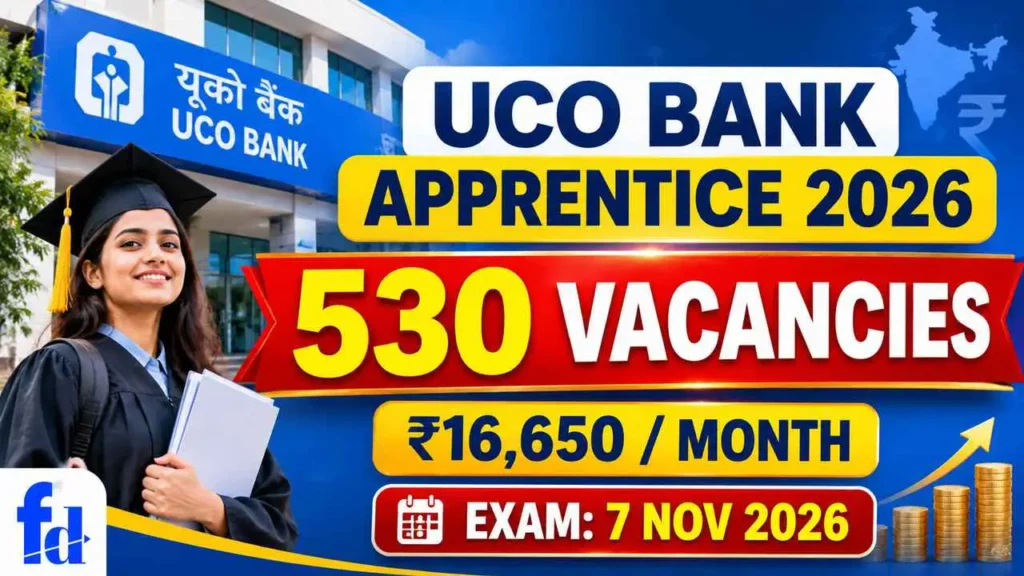
The application process commenced on 14 October 2026 and closed on 29 October 2026. The online entrance examination is scheduled for 7 November 2026 at 11:00 AM.
Candidates selected through the prescribed process will undergo one year of apprenticeship training and receive a combined monthly stipend of ₹16,650, comprising the bank’s contribution and the government’s Direct Benefit Transfer contribution.
An important distinction must be understood: this is not a regular clerical, probationary officer or permanent banking recruitment. Apprentices are engaged for training and do not automatically become employees of UCO Bank after completing the apprenticeship.
UCO Bank Apprentice Recruitment 2026 – Key Highlights
Total vacancies; 530
Monthly stipend: ₹16,650
Training period: 1 year
Minimum qualification: Graduation
Age limit: 20–28 years
Examination: 7 November 2026
Advertisement: HO/HRM/RECR/2026-27/COM-02 | Notification date: 13 October 2026
The recruitment is particularly relevant to fresh graduates who want to gain exposure to India’s banking industry before pursuing further competitive examinations or other financial-sector opportunities.
The official recruitment listing is available on the UCO Bank Job Opportunities page.
About UCO Bank – Hiring Organization Profile
UCO Bank
United Commercial Bank | Public Sector Bank | Headquarters: Kolkata, West Bengal
Established: 1943
Website: uco.bank.in
UCO Bank, originally established as United Commercial Bank, is one of India’s established public sector banking institutions. It was founded in 1943 and subsequently nationalised in 1969 as part of the Government of India’s banking nationalisation programme.
Headquartered in Kolkata, West Bengal, the bank has developed a substantial presence across India’s banking and financial services sector. Its operations include retail banking, corporate banking, agricultural finance, MSME lending, international banking and digital financial services.
Mission and banking operations
UCO Bank’s activities cover several important areas:
- Retail banking: Savings accounts, current accounts, deposits, loans and personal banking services.
- Corporate banking: Financial services for businesses, companies and institutional customers.
- Agricultural banking: Credit facilities and financial assistance for farmers and agricultural enterprises.
- MSME financing: Banking support for micro, small and medium-sized enterprises.
- Digital banking: Internet banking, mobile banking, electronic payments and other technology-enabled services.
- Financial inclusion: Banking access for underserved communities through various government-supported financial initiatives.
Why does UCO Bank recruit apprentices?
Apprenticeship programmes help banks develop a pipeline of trained individuals who understand the practical functioning of banking institutions.
The programme offers graduates an opportunity to observe and participate in supervised banking activities, understand customer requirements, become familiar with financial products and learn how banking technology supports daily operations.
For graduates considering a future in banking, this experience can provide valuable industry exposure. However, candidates must remember that apprenticeship training does not guarantee subsequent regular employment.
Complete Vacancy Details – UCO Bank Apprentice 2026
UCO Bank has announced 530 provisional apprentice training seats across 31 States and Union Territories.
The recruitment is conducted on a State/UT basis. Candidates must carefully choose their preferred State because the bank permits an application for only one State/UT.
Category-wise vacancy distribution
Category | Vacancies |
General / Unreserved (UR) | 205 |
Other Backward Classes (OBC-NCL) | 147 |
Scheduled Caste (SC) | 106 |
Scheduled Tribe (ST) | 49 |
Economically Weaker Section (EWS) | 23 |
Total | 530 |
■ EWS
■ OBC-NCL
■ SC
■ ST
■ UR
The category distribution shows that the largest allocation is under the unreserved category, followed by OBC-NCL and SC.
Reservation is governed by the applicable Government of India guidelines and the conditions mentioned in the recruitment advertisement. Candidates claiming reserved-category benefits must possess valid supporting certificates.
State-wise vacancy highlights
Some of the major State/UT allocations are:
State | Vacancies |
West Bengal | 86 |
Uttar Pradesh | 45 |
Odisha | 41 |
Rajasthan | 37 |
Bihar | 34 |
Maharashtra | 32 |
Madhya Pradesh | 27 |
Himachal Pradesh | 25 |
Assam | 24 |
Punjab | 24 |
Tamil Nadu | 21 |
Karnataka | 11 |
These figures are useful for understanding the geographical distribution of the recruitment. Candidates should refer to the official notification for the complete State-wise and category-wise vacancy matrix.
Important vacancy conditions:
- Vacancies are provisional and may be modified by the bank.
- Candidates can apply for only one State/UT.
- The bank may allot a district within the selected State/UT.
- Reservation benefits are subject to the applicable eligibility and documentation requirements.
- PwBD reservation and suitability are governed by the official advertisement.
Apply Online for 530 Posts+2
Detailed Job Profile and Key Responsibilities
The position offered under this recruitment is Apprentice. Unlike a regular bank clerk or officer, an apprentice is primarily engaged for structured training and practical learning.
The objective is to familiarise graduates with banking procedures and customer-facing activities.
A. Customer service and assistance
Apprentices may receive supervised exposure to customer service activities, including:
- Helping customers understand basic banking services.
- Guiding visitors regarding account-related procedures.
- Explaining general banking products and services.
- Assisting with customer enquiries.
- Understanding how banks handle service requests and complaints.
- Familiarising themselves with customer identification and KYC procedures.
B. Account opening and documentation
Another important area of learning is documentation.
Under supervision, apprentices may become familiar with:
- Savings and current account opening procedures.
- Customer identification documents.
- PAN and Aadhaar-related documentation requirements.
- KYC and customer due diligence procedures.
- Account maintenance processes.
- Basic documentation verification.
C. Digital banking operations
Digital banking is increasingly important in India’s financial services industry.
Apprentices may learn about:
- Mobile banking applications.
- Internet banking facilities.
- UPI transactions.
- NEFT and RTGS payment systems.
- IMPS transfers.
- Debit card services.
- Digital payment security.
- Basic precautions against online banking fraud.
D. Administrative and branch operations
Branch operations require accuracy, documentation and coordination.
The training may provide exposure to:
- Maintaining banking records.
- Organising customer documentation.
- Understanding deposit-related processes.
- Learning basic operational procedures.
- Observing transaction processing.
- Assisting authorised employees with routine administrative activities.
E. Financial literacy and banking products
Apprentices may also gain exposure to financial literacy initiatives and common banking products, including:
- Fixed deposits.
- Recurring deposits.
- Savings schemes.
- Personal loans.
- Housing loans.
- Education loans.
- Agricultural credit.
- Government-sponsored financial inclusion schemes.
Reporting structure and work environment
Apprentices generally undertake training under the supervision of designated bank officials at their assigned branch or training location.
The bank’s authorised employees supervise activities, provide instructions and evaluate learning progress.
The work environment can involve direct interaction with customers, documentation, computer-based activities and observation of banking operations.
Important: These responsibilities describe the likely learning areas associated with branch banking apprenticeship. They should not be interpreted as an independent authority to approve transactions, sanction loans or perform restricted banking functions.
Eligibility Criteria for UCO Bank Apprentice Recruitment 2026
Candidates must satisfy the educational, age, nationality and other conditions specified in the recruitment notification.
A. Educational qualification
The minimum educational requirement is a graduate degree from a recognised university or institution.
Candidates from different academic disciplines may apply, provided they meet the prescribed graduation requirements.
The important conditions include:
- Graduation must be from a recognised university.
- The candidate must possess the required graduation documents.
- Mark sheets and the degree certificate must establish completion of graduation on or after 1 April 2022.
- The qualification must be completed by the prescribed eligibility reference date.
A candidate who has completed graduation before the specified cut-off may not qualify, even if the candidate otherwise satisfies the age requirement.
B. Age limit
The prescribed age limit is 20–28 years as on 1 October 2026.
Category | Age relaxation |
General / UR | No relaxation |
EWS | No relaxation |
OBC-NCL | 3 years |
SC | 5 years |
ST | 5 years |
PwBD | Up to 10–15 years, according to category |
Eligible widows/divorced/separated women | As specified in the notification |
Candidates should calculate their age using 1 October 2026 as the reference date, not the date of application or examination.
C. Nationality
The notification provides eligibility for Indian citizens and specified other nationality categories under the applicable Government of India rules.
Candidates falling under non-Indian citizenship categories must satisfy the conditions and documentary requirements mentioned in the official advertisement.
D. Local language proficiency
Local language proficiency is an important eligibility consideration.
Candidates must be proficient in the local language of the State/UT for which they have applied.
This requirement may involve reading, writing, speaking and understanding the relevant language.
Candidates who have studied the specified language as part of their educational qualification may be able to establish proficiency through their academic records, subject to the notification’s conditions.
Others may have to appear for a local language assessment during document verification.
E. Apprenticeship and work experience restrictions
The notification also specifies restrictions concerning previous apprenticeship training and work experience.
Candidates who have already undergone apprenticeship training or have one year or more of relevant post-qualification training/job experience may be ineligible under the prescribed conditions.
This is especially important for candidates who have previously worked in a bank, financial institution or another organisation after graduation.
F. Physical standards
There is no conventional physical efficiency test involving running, height or chest measurements for this banking apprenticeship.
However, medical fitness is required as part of the engagement process. Candidates must satisfy the bank’s prescribed medical requirements.
G. One-State application restriction
Candidates should not submit multiple applications for different States/UTs.
The recruitment permits candidates to apply for only one State/UT, and the bank may allot a district within that selected region.
Click here to apply: Apply Online for 530 Posts
Salary, Stipend, Perks and Benefits
TOTAL MONTHLY APPRENTICESHIP STIPEND = ₹16,650
For the prescribed one-year apprenticeship period
Bank contribution = ₹10,500
Government DBT contribution = ₹6,150
Total monthly stipend = ₹16,650
A. Monthly stipend
The apprenticeship stipend consists of two components:
Component | Amount |
UCO Bank contribution | ₹10,500 |
Government contribution through DBT | ₹6,150 |
Total | ₹16,650 |
The government’s contribution is transferred through Direct Benefit Transfer, subject to the applicable scheme conditions.
B. Estimated annual stipend
For a full 12-month training period, the combined monthly stipend amounts to:
₹16,650 × 12 = ₹1,99,800
This is an arithmetic estimate of the combined stipend over 12 months, assuming all 12 monthly payments are payable.
C. Other benefits
The main benefit is practical exposure to banking operations.
Candidates can expect learning opportunities in:
- Customer relationship management.
- Financial products and services.
- Digital banking systems.
- Banking documentation.
- Branch administration.
- Financial literacy and customer support.
D. Is this a permanent UCO Bank job?
No.
This is one of the most important points candidates must understand.
An apprentice is engaged under the Apprentices Act, 1961, for a specified training period. Apprentices are not regular bank employees merely because they complete the training.
The notification does not promise:
- Permanent employment.
- Automatic appointment as a clerk.
- Automatic appointment as a probationary officer.
- Regular employee salary scales.
- Guaranteed absorption after training.
The apprenticeship should therefore be viewed as a professional learning opportunity rather than a permanent government job.
E. Comparison with regular banking employment
Regular public sector bank clerks and officers receive salary structures and service benefits governed by applicable banking service rules and settlements.
UCO Bank apprentices, on the other hand, receive the prescribed apprenticeship stipend.
Candidates should not compare ₹16,650 directly with the gross salary of a regular bank employee because the employment status, responsibilities, service conditions and benefits are fundamentally different.
Important Dates and Deadlines
Candidates should carefully note the following schedule.
Event | Date |
Official notification | 13 October 2026 |
Online registration begins | 14 October 2026 |
Last date for registration | 29 October 2026 |
Last date for fee payment | 29 October 2026 |
Eligibility reference date | 1 October 2026 |
Online entrance examination | 7 November 2026 |
Examination time | 11:00 AM |
Result declaration | Not confirmed |
Application window closed
As of 3 November 2026, the online application deadline has passed. Candidates who successfully completed the application process should focus on examination preparation and monitoring official communications.
Candidates should not assume that merely registering on NATS completed the UCO Bank application. The additional BFSI SSC application formalities and fee payment were also required.
Selection Process and Exam Pattern
The selection process includes multiple stages to assess candidates’ general aptitude and suitability for apprenticeship training.
Stage 1: Online entrance examination
Eligible applicants must appear for an online objective examination conducted through the designated examination arrangements.
The examination carries 100 questions for 100 marks and is scheduled for 60 minutes.
Detailed examination pattern
Subject | Questions | Marks |
General/Financial Awareness | 25 | 25 |
General English | 25 | 25 |
Reasoning Ability & Computer Aptitude | 25 | 25 |
Quantitative Aptitude | 25 | 25 |
Total | 100 | 100 |
Examination duration: 60 minutes.
Examination type: Objective multiple-choice questions.
Qualifying marks
Category | Minimum qualifying marks |
General / EWS | 40 |
SC / ST / OBC / PwBD | 35 |
These are qualifying thresholds, not a guarantee of selection. Final shortlisting also depends on the applicable merit and other selection conditions.
Negative marking
The notification reviewed does not specify a negative-marking penalty. Candidates should not assume a particular deduction for incorrect answers unless it is explicitly stated in the examination instructions.
Stage 2: State-wise merit list
Candidates who satisfy the examination requirements are considered for the relevant State/UT and category-wise merit list.
Merit preparation is subject to the bank’s selection conditions and applicable reservation provisions.
Stage 3: Document verification
Shortlisted candidates must produce original documents and supporting certificates.
Important documents include:
- Graduation certificate.
- Graduation mark sheets.
- Date-of-birth proof.
- Identity proof.
- Category certificate, wherever applicable.
- PwBD certificate, wherever applicable.
- NATS registration details.
- Local language qualification evidence.
- Other documents requested by the bank.
Stage 4: Local language assessment
Candidates must demonstrate proficiency in the applicable local language.
This is important because banking work frequently involves communication with customers in the language commonly used in the selected region.
Stage 5: Medical fitness
Candidates must satisfy the medical fitness conditions prescribed for engagement.
Only candidates who complete the applicable selection and verification requirements can proceed to apprenticeship engagement.
StudentUpdate.in+2
9. Comprehensive Syllabus and Preparation Strategy
The UCO Bank Apprentice examination tests four broad areas: banking and general awareness, English language, reasoning and computer aptitude, and quantitative aptitude.
Although the recruitment notification provides the examination structure, candidates should treat the following topic-wise breakdown as a comprehensive preparation guide rather than a verbatim official chapter-wise syllabus.
A. General and Financial Awareness – 25 Marks
This section evaluates candidates’ knowledge of current affairs, the Indian economy, banking institutions and financial developments.
Topic | Important areas to prepare |
Banking Awareness | Types of banks, banking functions, deposits, loans |
RBI | Functions, monetary policy, repo rate, CRR, SLR |
Financial Awareness | Inflation, GDP, fiscal deficit, financial inclusion |
Government Schemes | PMJDY, PMJJBY, PMSBY, APY, MUDRA |
Banking Institutions | NABARD, SIDBI, SEBI, IRDAI |
Digital Banking | UPI, NEFT, RTGS, IMPS, digital payments |
Current Affairs | National and international developments |
Economy | Union Budget, taxation, economic indicators |
Static GK | Important days, headquarters, currencies and capitals |
Preparation strategy:
- Read daily current affairs and revise important developments.
- Focus on RBI announcements and banking-sector news.
- Understand the differences between NEFT, RTGS, IMPS and UPI.
- Study important financial inclusion schemes.
- Prepare monthly current affairs notes, especially for the months immediately preceding the examination.
A candidate should not restrict preparation to general knowledge alone. Financial awareness is particularly relevant to a banking apprenticeship examination.
B. General English – 25 Marks
The English section evaluates grammar, vocabulary, comprehension and the ability to understand written communication.
Topic | Preparation areas |
Reading Comprehension | Main idea, inference, vocabulary |
Error Detection | Subject-verb agreement, grammar |
Cloze Test | Contextual vocabulary and grammar |
Fill in the Blanks | Vocabulary and sentence structure |
Para Jumbles | Sentence arrangement |
Sentence Improvement | Grammar and usage |
Synonyms and Antonyms | Vocabulary |
Idioms and Phrases | Common expressions |
Active and Passive Voice | Sentence transformation |
Direct and Indirect Speech | Reported speech |
Preparation strategy:
- Practise one reading comprehension passage daily.
- Revise essential grammar rules.
- Learn 10–15 useful vocabulary words every day.
- Solve cloze tests and error-detection questions.
- Attempt timed English sectional tests.
Candidates with weaker English skills should prioritise reading comprehension and basic grammar because these areas can improve through consistent practice.
C. Reasoning Ability and Computer Aptitude – 25 Marks
This section combines logical reasoning with basic computer knowledge.
Logical reasoning syllabus
Topic | Important concepts |
Seating Arrangement | Linear and circular arrangements |
Puzzles | Floor, box and scheduling puzzles |
Coding-Decoding | Letter and number patterns |
Blood Relations | Family relationship problems |
Direction Sense | Directions and distance |
Syllogism | Logical conclusions |
Inequalities | Mathematical and coded inequalities |
Series | Alphabet and number series |
Ranking | Position and order |
Alphanumeric Series | Mixed character arrangements |
Computer aptitude syllabus
- Computer fundamentals.
- Hardware and software.
- Input and output devices.
- Operating systems.
- MS Office fundamentals.
- Internet and networking basics.
- Computer memory.
- Database concepts.
- Cybersecurity awareness.
- Digital payments and online banking security.
Preparation strategy:
Begin with simpler reasoning topics such as inequalities, syllogisms and coding-decoding.
Once comfortable with the fundamentals, practise puzzles and seating arrangements.
For computer aptitude, focus on conceptual understanding rather than advanced programming or software development.
D. Quantitative Aptitude – 25 Marks
This section tests numerical ability, calculation speed and mathematical problem-solving.
Topic | Important concepts |
Simplification | BODMAS, basic calculations |
Number Series | Missing and incorrect numbers |
Percentage | Percentage change and applications |
Profit and Loss | Cost price, selling price, discount |
Ratio and Proportion | Direct and inverse proportion |
Average | Basic and weighted averages |
Simple Interest | Principal, rate and time |
Compound Interest | Annual and periodic compounding |
Time and Work | Efficiency and work completion |
Time, Speed and Distance | Relative speed and travel |
Data Interpretation | Tables, charts and graphs |
Mixture and Allegation | Concentration and ratios |
Preparation strategy:
- Memorise multiplication tables up to 20.
- Learn common squares and cubes.
- Practise percentage-to-fraction conversions.
- Improve calculation speed.
- Solve at least two data interpretation sets regularly.
- Practise questions under a time limit.
Suggested 7-day revision timetable
Since the examination is scheduled for 7 November 2026, candidates who have already registered should prioritise revision, mock examinations and accuracy.
Day | Main preparation focus |
Day 1 | Banking awareness and current affairs |
Day 2 | Quantitative aptitude fundamentals |
Day 3 | Reasoning and puzzles |
Day 4 | English grammar and comprehension |
Day 5 | Computer aptitude and financial awareness |
Day 6 | Full-length mock examination and analysis |
Day 7 | Formula revision, current affairs and examination readiness |
Examination time-management strategy
The examination contains 100 questions for 60 minutes. This means candidates have an average of only 36 seconds per question.
A possible time allocation is:
Section | Suggested time |
English | 12 minutes |
Reasoning and Computer Aptitude | 16 minutes |
Quantitative Aptitude | 17 minutes |
General/Financial Awareness | 10 minutes |
Final review | 5 minutes |
Total | 60 minutes |
This is a suggested strategy, not an officially prescribed sectional time limit.
Most important preparation advice: Avoid spending too much time on one difficult puzzle or calculation. Attempt familiar questions first and maintain a balance between speed and accuracy.
Application Fees and Payment Mode
The application fee varies according to the candidate’s category and gender as specified in the recruitment advertisement.
Category | Examination fee |
SC | ₹200 + GST |
ST | ₹200 + GST |
PwBD | ₹200 + GST |
General / EWS / OBC Male | ₹800 + GST |
General / EWS / OBC Female | ₹600 + GST |
Transgender candidates | ₹600 + GST |
Payment mode
The prescribed payment process is online through the designated BFSI SSC application system.
Candidates were required to:
- Complete the relevant registration formalities.
- Proceed to the BFSI SSC application process.
- Enter the requested information.
- Select the applicable fee category.
- Pay using the available online payment facility.
- Save the payment acknowledgement.
Important fee instructions
- The application fee is non-refundable.
- Bank transaction charges or applicable taxes may be additional.
- Candidates must verify their category before payment.
- An incomplete payment does not constitute a successfully completed application.
- Applicants should retain their transaction reference and payment confirmation.
The fee payment deadline was 29 October 2026.
Step-by-Step Guide: How to Apply for UCO Bank Apprentice Recruitment 2026
The original recruitment application involved the NATS portal and the BFSI SSC application process.
Although the application window is now closed, the following instructions explain the procedure followed during the recruitment period.
Step 1: Visit the NATS portal
Open the National Apprenticeship Training Scheme portal:
https://nats.education.gov.in/
Candidates were required to register or access their existing NATS account.
Step 2: Complete candidate registration
Enter the required personal and educational information, including:
- Full name.
- Date of birth.
- Contact number.
- Email address.
- Educational qualification.
- Graduation details.
- Other requested information.
Ensure that the details match the supporting documents.
Step 3: Obtain the NATS enrolment ID
After completing registration, candidates receive an enrolment identification number.
This number is important for subsequent apprenticeship application formalities.
Step 4: Locate the UCO Bank apprenticeship opportunity
Search for the relevant UCO Bank Apprentice engagement for FY 2026–27.
Verify the advertisement number:
HO/HRM/RECR/2026-27/COM-02
Step 5: Complete the additional BFSI SSC application
Candidates were required to follow the communication and instructions provided for the next stage of application through BFSI SSC.
Official portal:
The candidate had to complete the additional information and payment formalities within the prescribed deadline.
Step 6: Select the preferred State/UT
Candidates should select their preferred State/UT carefully.
Only one State/UT application was permitted under the recruitment conditions.
Step 7: Upload or provide the required documents
Candidates should keep the following documents ready:
- Recent passport-size photograph.
- Signature.
- Graduation mark sheets.
- Graduation certificate.
- Aadhaar or other accepted identity proof.
- Category certificate, if applicable.
- PwBD certificate, if applicable.
- NATS enrolment details.
- Other documents specified by the portal.
Photograph and signature dimensions: Candidates should follow the specifications displayed in the relevant application portal. The notification information reviewed does not establish a separate verified universal pixel-size or file-size requirement. Therefore, candidates should not rely on unofficial dimensions.
Step 8: Pay the application fee
Pay the applicable examination fee through the online payment facility.
Check the amount and category before proceeding.
Step 9: Verify application details
Before final submission, review:
- Personal details.
- Graduation information.
- State/UT selection.
- Category information.
- Contact details.
- Payment status.
Step 10: Save the application acknowledgement
Download or save the submitted application details and payment receipt.
These documents may be useful during subsequent communication and verification.
Application status reminder
Closed
The application window ended on 29 October 2026. The above procedure is for reference and does not indicate that fresh applications are currently being accepted.
12. Official Links – UCO Bank Apprentice Recruitment 2026
Candidates should use official portals to access recruitment information and avoid unofficial websites requesting unnecessary payments or personal details.
Resource | Official link |
Official Notification PDF | |
UCO Bank Career Page | |
UCO Bank Official Website | |
NATS Portal | |
BFSI SSC Portal |
Direct Apply Link: The original application process has closed. The official recruitment listing contains the application reference, but a currently active direct application facility should not be assumed.
The official notification PDF should be treated as the primary reference for eligibility, vacancy distribution, fees and selection requirements.
Conclusion and Final Advice
The UCO Bank Apprentice Recruitment 2026 offers an opportunity for graduates to gain practical experience in India’s public sector banking industry through a structured one-year apprenticeship programme.
With 530 training seats distributed across different States and Union Territories, the recruitment provides exposure to customer service, banking documentation, digital financial services, financial products and branch administration.
The monthly stipend of ₹16,650 also makes the programme financially useful for graduates seeking workplace experience while developing their professional skills.
However, candidates must understand the distinction between apprenticeship training and permanent bank employment. The programme does not guarantee absorption into UCO Bank or provide the same service benefits as regular bank employees.
Final advice for candidates
Candidates who successfully registered should concentrate on the upcoming online examination scheduled for 7 November 2026.
Prioritise the following:
- Revise banking and financial awareness.
- Practise quantitative aptitude and logical reasoning.
- Improve English comprehension and grammar.
- Revise computer fundamentals.
- Attempt full-length mock examinations.
- Keep original educational and identity documents ready.
- Monitor the official UCO Bank and BFSI SSC websites for examination instructions and subsequent updates.
Graduates who missed this recruitment should monitor upcoming UCO Bank apprenticeship notifications and other public sector banking opportunities.
Remember: An apprenticeship can be a valuable starting point for building banking-sector knowledge and professional confidence. Use the experience as a foundation for future career opportunities, but always evaluate the training conditions, stipend and employment prospects before applying.
Editorial accuracy note: The recruitment figures, application dates, stipend and examination details are based on the published recruitment information. The official notification should remain the final authority wherever subsequent corrigenda or examination instructions change any condition.
Official reference: UCO Bank – Official Recruitment Portal.
Frequently Asked Questions (FAQs)
Q1. How many vacancies are available under UCO Bank Apprentice Recruitment 2026?
UCO Bank has announced 530 provisional apprenticeship training seats across 31 States and Union Territories for FY 2026–27. The vacancies are distributed among UR, OBC-NCL, SC, ST and EWS categories.
Q2. What is the last date to apply for UCO Bank Apprentice Recruitment 2026?
The last date for online registration and fee payment was 29 October 2026. The application window is now closed.
Q3. What is the educational qualification required for UCO Bank apprentices?
Candidates must possess a graduate degree from a recognised university. The relevant graduation documents must establish completion on or after 1 April 2022, subject to the conditions in the notification.
Q4. What is the age limit for UCO Bank Apprentice 2026?
The minimum age is 20 years and the maximum age is 28 years for General/EWS candidates, calculated as on 1 October 2026. Applicable age relaxations are provided for reserved categories and other eligible groups.
Q5. What is the monthly stipend for UCO Bank apprentices?
The combined monthly stipend is ₹16,650. This comprises ₹10,500 from UCO Bank and ₹6,150 through the government’s DBT contribution.
Q6. Is UCO Bank Apprentice a permanent government job?
No. It is a one-year apprenticeship engagement under the Apprentices Act, 1961. Apprentices are trainees rather than regular bank employees, and completion does not guarantee permanent employment.
Q7. What is the examination date for UCO Bank Apprentice Recruitment 2026?
The online entrance examination is scheduled for 7 November 2026 at 11:00 AM.
Q8. What is the examination pattern?
The examination consists of 100 objective questions carrying 100 marks, divided equally among General/Financial Awareness, General English, Reasoning Ability and Computer Aptitude, and Quantitative Aptitude. The duration is 60 minutes.
Q9. Is there negative marking in the UCO Bank Apprentice examination?
The notification information reviewed does not specify a negative-marking penalty. Candidates should follow the final examination instructions issued by the examination authority.
Q10. Can candidates apply for more than one State?
No. Candidates are permitted to apply for only one State/UT under the recruitment. The bank may allot a district within the selected State/UT.
Q11. Is knowledge of the local language compulsory?
Yes. Candidates must satisfy the local language proficiency requirement for the State/UT they select. The language requirement may be assessed during document verification if the candidate cannot establish proficiency through the prescribed educational records.
Q12. What is the duration of the UCO Bank apprenticeship?
The prescribed apprenticeship training period is one year.
Q13. Does UCO Bank provide PF, ESI and other regular employee benefits to apprentices?
The apprenticeship is not regular employment. The notification does not provide the regular employee benefit package, including PF, ESI and bonus, as part of this engagement.
Q14. Can candidates who have already completed another apprenticeship apply?
Candidates must comply with the notification’s restrictions on previous apprenticeship training and post-qualification employment or training experience. Those who have already undergone apprenticeship training may be ineligible under the prescribed conditions.
Q15. Where can candidates download the official notification?
Candidates can access the notification through UCO Bank’s official recruitment page:
The direct notification PDF is also listed in the official links section above.
