
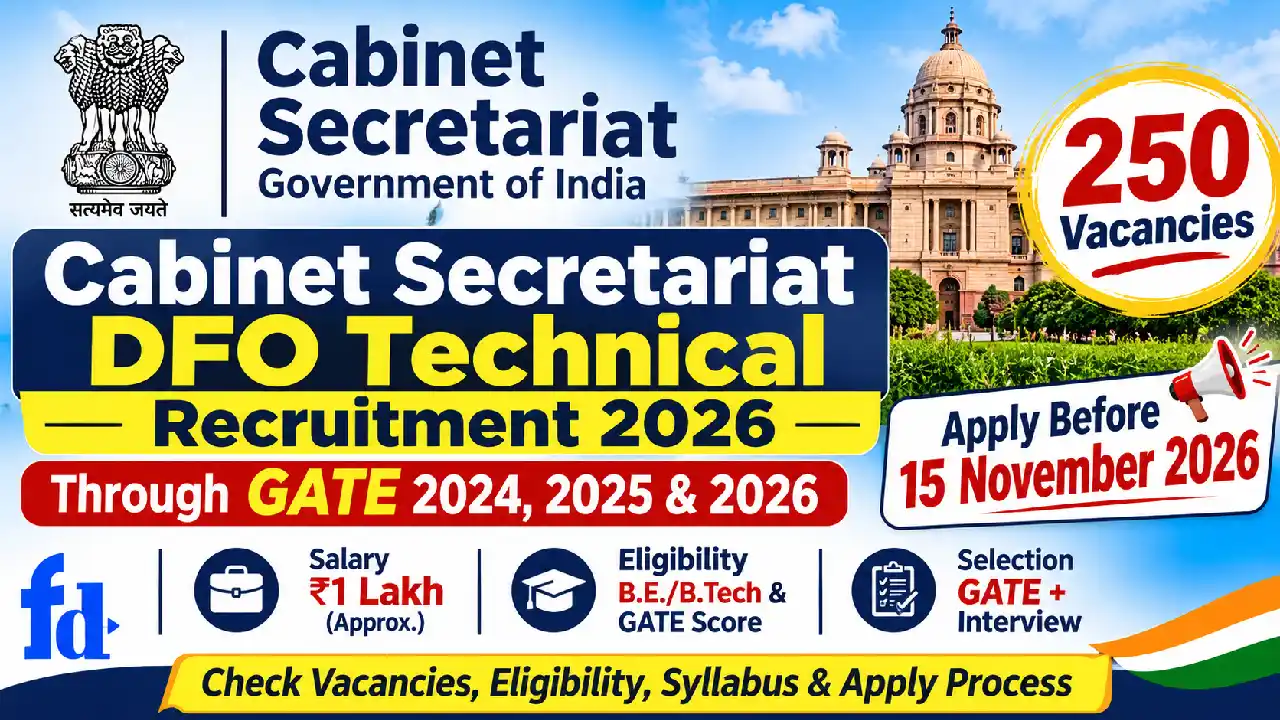
Cabinet Secretariat DFO Technical Recruitment 2026 offers 250 vacancies through GATE 2024–2026. Check eligibility, salary, selection, vacancies and apply by November 15.
Cabinet Secretariat DFO Technical Recruitment 2026 – Overview
The Cabinet Secretariat Deputy Field Officer (Technical) Recruitment 2026 presents an important opportunity for engineering and science graduates seeking a prestigious technical position under the Government of India.
Through Advertisement No. 02/2026, the Cabinet Secretariat has announced recruitment for 250 Deputy Field Officer (Technical) vacancies across nine academic disciplines.
This recruitment is particularly attractive to candidates holding BE/B.Tech degrees or specified postgraduate science qualifications who have secured valid Graduate Aptitude Test in Engineering (GATE) scores in 2024, 2025 or 2026.
Unlike conventional government recruitment examinations, this selection process uses the corresponding GATE score for initial shortlisting, followed by a personal interview and other prescribed verification procedures.
The advertised post falls under Group B, Non-Gazetted, Pay Level 7. The notification indicates approximate initial monthly emoluments of ₹1,00,000, including allowances, for candidates posted in New Delhi.
One particularly important aspect of this recruitment is its application procedure. Candidates must submit their applications through ordinary post in the prescribed format. It is not a conventional online application process, and candidates must ensure that their applications reach the designated postal address before the closing date.
With 112 vacancies each for Computer Science/Information Technology and Electronics/Communication, this recruitment provides substantial opportunities for candidates from these two technical backgrounds. Additional vacancies are available in Data Science, Physics, Mechanical Engineering, Civil Engineering, Chemistry, Mathematics and Statistics.
Candidates interested in this opportunity should carefully examine the eligibility requirements, GATE subject matching conditions, application instructions and selection procedure before submitting their applications.
Cabinet Secretariat DFO Technical Recruitment 2026: Important Highlights
Particular | Details |
Recruiting Organisation | Cabinet Secretariat, Government of India |
Recruitment Name | Cabinet Secretariat DFO Technical Recruitment 2026 |
Advertisement Number | 02/2026 |
Post Name | Deputy Field Officer (Technical) |
Total Vacancies | 250 (tentative) |
Job Category | Central Government Job |
Employment Type | Direct Recruitment |
Group | Group B, Non-Gazetted |
Pay Level | Level 7 |
Initial Monthly Emoluments | Approximately ₹1,00,000, including allowances, at New Delhi |
Educational Qualification | Relevant BE/B.Tech or specified Master’s degree in Science |
GATE Requirement | Valid GATE 2024, 2025 or 2026 score |
Maximum Age | 30 years |
Application Mode | Offline – Ordinary Post |
Application Fee | Nil |
Job Location | New Delhi initially; all-India transfer liability |
Notification Publication | Employment News, 17–23 October 2026 |
Last Date | 15 November 2026 |
Official Website |
About the Cabinet Secretariat
The Cabinet Secretariat is one of the important administrative institutions of the Government of India. It functions directly under the Prime Minister and plays a significant role in facilitating coordination between different ministries and government departments.
The organisation traces its institutional origin to the Secretariat of the Executive Council. On 5 September 1946, the office was designated as the Cabinet Secretariat, marking an important development in the administrative structure of the country.
Its responsibilities extend beyond routine administrative coordination. The Secretariat supports the Cabinet and Cabinet Committees, facilitates inter-ministerial discussions, helps resolve administrative differences and assists the government in implementing important policy decisions.
Some of its major responsibilities include:
- Providing secretarial assistance to the Cabinet and its committees.
- Coordinating activities between various ministries and departments.
- Administering the Government of India (Transaction of Business) Rules, 1961.
- Administering the Government of India (Allocation of Business) Rules, 1961.
- Facilitating inter-ministerial coordination and consensus-building.
- Supporting the management of major national crisis situations.
- Assisting government decision-making through appropriate administrative mechanisms.
The Cabinet Secretariat operates in an environment where confidentiality, coordination, administrative discipline and effective communication are important.
For technical graduates, recruitment as Deputy Field Officer (Technical) represents an opportunity to work in a government environment where technical knowledge can support wider national responsibilities.
Candidates should understand that this is not an ordinary engineering department recruitment. The nature of the organisation and the all-India transfer liability make it important to carefully consider the service requirements before applying.
Cabinet Secretariat DFO Technical Vacancy Details 2026
The Cabinet Secretariat has announced 250 tentative vacancies across nine disciplines.
The detailed subject-wise distribution is provided below.
Discipline | GATE Paper Code | Vacancies |
Computer Science / Information Technology | CS | 112 |
Electronics / Communication / Telecommunication | EC | 112 |
Data Science / Artificial Intelligence | DA | 10 |
Physics | PH | 5 |
Mechanical Engineering | ME | 4 |
Civil Engineering | CE | 3 |
Chemistry | CY | 2 |
Mathematics | MA | 1 |
Statistics | ST | 1 |
Total | 250 |
Which discipline has the highest number of vacancies?
Computer Science/Information Technology and Electronics/Communication/Telecommunication jointly account for 224 vacancies.
This represents approximately 89.6% of the advertised vacancies.
Consequently, candidates from these two disciplines have the largest number of advertised positions to compete for. However, the actual competitiveness will also depend on the number of eligible applicants, their GATE scores and the interview process.
Is category-wise vacancy distribution available?
The subject-wise vacancy table provides the advertised discipline-wise distribution. Candidates should consult the original notification for the applicable reservation provisions.
A separate SC, ST, OBC, EWS and UR vacancy split should not be assumed without an official subject-wise reservation statement.
Detailed Job Profile and Responsibilities of Deputy Field Officer (Technical)
The Deputy Field Officer (Technical) position is a specialised government appointment requiring relevant technical qualifications and an appropriate GATE score.
Unlike a conventional engineering position in a manufacturing company or infrastructure organisation, candidates should understand that the technical designation is associated with the Cabinet Secretariat’s wider governmental responsibilities.
The detailed day-to-day operational duties, reporting arrangements and technical systems are not comprehensively described in the public recruitment advertisement. Therefore, applicants should not interpret the following illustrative areas as an officially published job description.
Based on the technical disciplines included in the recruitment, relevant professional capabilities may include:
Technical analysis: Applying engineering and scientific knowledge to technical problems, interpreting information and preparing accurate technical observations.
Information technology: Understanding computer systems, software, databases, networking, operating systems and information security concepts relevant to the candidate’s discipline.
Electronics and communication: Understanding communication systems, electronic circuits, signal processing and related technical infrastructure.
Scientific knowledge: Applying specialised knowledge in physics, chemistry, mathematics or statistics wherever relevant to assigned responsibilities.
Technical documentation: Preparing structured reports, maintaining accurate records and communicating technical findings clearly.
Coordination: Working with designated teams and following prescribed administrative and operational procedures.
Working environment
The Cabinet Secretariat is a central government institution with significant administrative responsibilities. Candidates should therefore be prepared for a professional environment requiring discipline, discretion, confidentiality and adherence to official instructions.
The advertised position carries all-India transfer liability. Although New Delhi is identified as the initial posting location, candidates should not assume that they will remain permanently stationed there.
Eligibility Criteria for Cabinet Secretariat DFO Technical Recruitment 2026
Candidates must satisfy the educational, GATE, age and nationality requirements specified in Advertisement No. 02/2026.
A. Educational Qualification
Applicants must possess the relevant qualification in the subject for which they are applying.
The notification provides for eligible candidates holding:
- Bachelor’s degrees in Engineering or Technology, such as BE/B.Tech, in the relevant discipline.
- Master’s degrees in Science in the specified eligible subjects.
Candidates should carefully verify the precise qualifying-degree and subject combinations in the official advertisement.
Merely possessing an engineering or science degree does not automatically establish eligibility for every advertised discipline.
B. GATE Score Requirement
A valid GATE score from any one of the following examination years is required:
- GATE 2024
- GATE 2025
- GATE 2026
The GATE paper must correspond to the subject for which the candidate is applying.
Recruitment Discipline | Required GATE Paper |
Computer Science / IT | CS |
Electronics / Communication | EC |
Data Science / AI | DA |
Physics | PH |
Mechanical Engineering | ME |
Civil Engineering | CE |
Chemistry | CY |
Mathematics | MA |
Statistics | ST |
Candidates must ensure that their GATE scorecard is valid and that their examination subject matches the relevant recruitment discipline.
A score from an unrelated GATE paper should not be treated as automatically acceptable.
C. Age Limit
The maximum age limit is 30 years as on 15 November 2026.
Candidates must calculate their age with reference to the specified cut-off date rather than the date on which they complete or dispatch the application.
D. Age Relaxation
Applicable age relaxation is available under the relevant Government of India rules for eligible reserved categories and other recognised categories.
Candidates claiming relaxation should carefully examine the notification and attach the prescribed supporting certificates.
Do not rely solely on a general age-relaxation table from another recruitment examination because the applicable provisions and certificate requirements must be checked against Advertisement No. 02/2026.
E. Nationality
The recruitment is intended for eligible Indian nationals.
Candidates should provide the prescribed nationality information and supporting documents wherever required.
F. Physical and Medical Standards
The recruitment includes a prescribed medical examination as part of the verification and selection process.
Candidates should refer to the official advertisement and subsequent recruitment communications for the applicable medical requirements. A separate detailed physical-efficiency test or physical measurement table should not be assumed from the available recruitment information.
Salary, Pay Scale and Benefits
One of the most attractive aspects of Cabinet Secretariat DFO Technical Recruitment 2026 is its Level 7 government pay structure.
The notification specifies the post under the 7th Central Pay Commission Pay Matrix, Level 7.
The initial basic pay corresponding to Level 7 is ₹44,900 per month.
In addition to basic pay, eligible employees may receive allowances according to applicable government rules and their place of posting.
Salary overview
Salary Component | Details |
Pay Level | Level 7 |
Initial Basic Pay | ₹44,900 per month |
Initial Monthly Emoluments | Approximately ₹1,00,000 at New Delhi, including allowances |
Dearness Allowance | As applicable under Government rules |
House Rent Allowance | As applicable to posting and eligibility |
Transport Allowance | As applicable |
Other Benefits | Subject to applicable service rules |
The approximately ₹1 lakh figure is the advertised initial monthly emolument estimate for New Delhi, not a guaranteed take-home salary.
Actual in-hand salary will depend on applicable allowances, deductions, tax liabilities and other individual circumstances.
Additional government service benefits
Eligible employees may receive benefits under the applicable central government service framework, including:
- Dearness allowance.
- House rent allowance or eligible government accommodation provisions.
- Transport allowance.
- Leave benefits.
- Medical facilities under applicable rules.
- Retirement benefits under the applicable government pension framework.
- Other admissible service-related allowances.
Candidates should also understand that the actual working conditions and benefits may depend on the nature of posting and applicable departmental instructions.
Is this salary competitive?
A Level 7 appointment with approximately ₹1 lakh in initial monthly emoluments at New Delhi is an attractive proposition for eligible engineering and science graduates.
Compared with many entry-level private-sector technical positions, the government appointment offers a structured pay matrix and applicable service benefits.
However, a direct salary comparison must consider the differences between government gross emoluments, private-sector CTC, bonuses, stock compensation, deductions and location-based benefits.
Important Dates – Cabinet Secretariat DFO Technical Recruitment 2026
Candidates should carefully note the following dates.
Event | Date |
Advertisement Number | 02/2026 |
Employment News Publication | 17–23 October 2026 |
Application Opening Date | Not separately specified |
Last Date for Receipt of Application | 15 November 2026 |
Age Calculation Date | 15 November 2026 |
Interview Date | To be communicated to shortlisted candidates |
Document Verification | As notified |
Medical Examination | As notified |
Important: The application must reach the designated postal address by 15 November 2026. Candidates should dispatch their applications sufficiently early to avoid postal delays.
Selection Process and GATE Examination Pattern
The Cabinet Secretariat has adopted a selection process based on GATE scores and subsequent interview and verification stages.
Unlike SSC, UPSC or Railway recruitment examinations, this advertisement does not prescribe a separate written examination conducted by the Cabinet Secretariat.
Selection stages
Stage 1: Application screening
The recruitment authority examines the submitted applications to determine whether candidates satisfy the prescribed educational, age, nationality and GATE eligibility conditions.
Stage 2: GATE-based shortlisting
Eligible candidates are shortlisted according to their GATE scores in the corresponding subject.
The notification indicates that approximately five times the number of vacancies will be shortlisted for interviews.
This means that the number of candidates called for interviews may be considerably larger than the final number of available positions.
Stage 3: Personal interview
Shortlisted candidates are required to attend a personal interview.
The interview may assess technical understanding, subject knowledge, analytical ability, communication and suitability for the position.
Stage 4: Document verification
Candidates must produce original educational certificates, GATE scorecards, identity documents and other prescribed supporting records.
Stage 5: Character and antecedent verification
The prescribed background and character verification procedures are conducted.
Stage 6: Medical examination
Candidates must satisfy the applicable medical requirements.
Stage 7: Final selection
Final appointment is subject to the recruitment authority’s selection decision and completion of all prescribed formalities.
GATE 2026 examination pattern
The GATE examination is a computer-based examination conducted by IIT Guwahati for 2026.
Examination Component | Details |
Examination Mode | Computer-Based Test |
Duration | 3 Hours |
Total Questions | 65 |
Total Marks | 100 |
General Aptitude | 15 Marks |
Engineering Mathematics | 13 Marks in applicable papers |
Subject-Specific Questions | Remaining marks |
Question Types | MCQ, MSQ and NAT |
Examination Language | English |
For the relevant engineering papers, the standard distribution is 15 marks for General Aptitude, 13 marks for Engineering Mathematics and 72 marks for the remaining subject questions.
For CY, DA, MA, PH and ST, the distribution is 15 marks for General Aptitude and 85 marks for subject-specific questions.
Negative marking
Negative marking applies to incorrect MCQ answers:
- One-mark MCQ: deduction of 1/3 mark.
- Two-mark MCQ: deduction of 2/3 mark.
- MSQ: no negative marking.
- NAT: no negative marking.
The GATE pattern is relevant because the recruitment uses corresponding GATE scores. Candidates should not confuse this examination structure with a separately prescribed Cabinet Secretariat recruitment examination.
Comprehensive GATE Syllabus and Preparation Strategy
Since GATE performance plays a central role in shortlisting, candidates should focus on the official syllabus of their relevant GATE paper.
The following subject-wise preparation guide identifies the major areas candidates should revise. It is a preparation overview rather than a replacement for the official GATE 2026 syllabus.
A. Computer Science and Information Technology – CS
This discipline has 112 advertised vacancies.
Important topics include:
- Engineering Mathematics.
- Discrete Mathematics.
- Digital Logic.
- Computer Organisation and Architecture.
- Programming and Data Structures.
- Algorithms.
- Theory of Computation.
- Compiler Design.
- Operating Systems.
- Databases.
- Computer Networks.
Preparation strategy: Give particular importance to data structures, algorithms, operating systems, DBMS and computer networks. Practise numerical and conceptual questions, and revise previous-year GATE papers regularly.
B. Electronics and Communication – EC
This discipline also has 112 vacancies.
Important topics include:
- Engineering Mathematics.
- Network Theory.
- Electronic Devices.
- Analog Circuits.
- Digital Circuits.
- Signals and Systems.
- Control Systems.
- Communications.
- Electromagnetics.
Preparation strategy: Strengthen fundamentals in network theory, analog electronics, digital circuits and communication systems. Regular numerical practice is essential.
C. Data Science and Artificial Intelligence – DA
Important topics include:
- Probability and Statistics.
- Linear Algebra.
- Calculus and Optimisation.
- Programming and Data Structures.
- Database Management and Warehousing.
- Machine Learning.
- Artificial Intelligence.
- Data Analytics.
Preparation strategy: Focus on probability, statistical inference, linear algebra and machine learning fundamentals. Understand the mathematical principles behind regression, classification and optimisation rather than memorising definitions.
D. Physics – PH
Important topics include:
- Mathematical Physics.
- Classical Mechanics.
- Electromagnetic Theory.
- Quantum Mechanics.
- Thermodynamics and Statistical Physics.
- Atomic and Molecular Physics.
- Nuclear and Particle Physics.
- Solid State Physics.
- Electronics.
Preparation strategy: Develop strong conceptual understanding and practise derivations, numerical problems and standard physical models.
E. Mechanical Engineering – ME
Important topics include:
- Engineering Mathematics.
- Engineering Mechanics.
- Strength of Materials.
- Theory of Machines.
- Vibrations.
- Thermodynamics.
- Fluid Mechanics.
- Heat Transfer.
- Manufacturing Engineering.
- Industrial Engineering.
Preparation strategy: Prioritise thermodynamics, fluid mechanics, strength of materials and manufacturing. Revise important formulas and solve timed numerical problems.
F. Civil Engineering – CE
Important topics include:
- Engineering Mathematics.
- Structural Engineering.
- Geotechnical Engineering.
- Water Resources Engineering.
- Environmental Engineering.
- Transportation Engineering.
- Geomatics.
- Engineering Mechanics.
- Construction Materials and Management.
Preparation strategy: Focus on structural analysis, soil mechanics, environmental engineering and water resources. Practise numerical questions and revise standard engineering concepts.
G. Chemistry – CY
Important topics include:
- Physical Chemistry.
- Inorganic Chemistry.
- Organic Chemistry.
- Atomic Structure.
- Chemical Bonding.
- Chemical Thermodynamics.
- Chemical Kinetics.
- Spectroscopy.
- Coordination Chemistry.
Preparation strategy: Maintain a balanced revision schedule for all three major branches. Practise reaction mechanisms, numerical problems and conceptual questions.
H. Mathematics – MA
Important topics include:
- Linear Algebra.
- Calculus.
- Real Analysis.
- Complex Analysis.
- Ordinary Differential Equations.
- Partial Differential Equations.
- Abstract Algebra.
- Numerical Analysis.
- Topology.
- Linear Programming.
Preparation strategy: Develop proof-based understanding and practise problems involving theorems, calculations and mathematical reasoning.
I. Statistics – ST
Important topics include:
- Probability.
- Probability Distributions.
- Statistical Inference.
- Estimation.
- Testing of Hypotheses.
- Regression Analysis.
- Sampling Distributions.
- Multivariate Analysis.
- Stochastic Processes.
- Design of Experiments.
Preparation strategy: Focus on probability distributions, estimation, hypothesis testing and regression. Practise numerical problems and understand the assumptions behind statistical methods.
Suggested preparation timetable
Candidates preparing for the technical interview or revising their GATE subject knowledge can follow this structured plan.
Preparation Activity | Suggested Daily Time |
Core Technical Subject | 3 Hours |
Numerical Problem Practice | 1 Hour |
General Aptitude | 30 Minutes |
Previous-Year Questions | 1 Hour |
Revision and Formula Practice | 30 Minutes |
Total | 6 Hours |
For candidates who already possess a valid GATE score, preparation should shift towards consolidating core concepts, reviewing previous examination topics and preparing for technical interview questions.
Interview preparation tips
Candidates shortlisted for an interview should:
- Revise important concepts from their graduation and postgraduate subjects.
- Understand the fundamentals of their GATE paper.
- Practise explaining technical concepts clearly.
- Review major developments in their technical discipline.
- Prepare to discuss academic projects and research work.
- Maintain confidence and professional communication.
- Carry all original certificates and required supporting documents.
Candidates should also be prepared to understand the responsibilities and service conditions associated with the advertised position.
Application Fee and Payment Mode
One favourable aspect of this recruitment is that the application fee is Nil.
Category | Application Fee |
General / UR | ₹0 |
OBC | ₹0 |
SC | ₹0 |
ST | ₹0 |
EWS | ₹0 |
PwBD | ₹0 |
There is no application payment to be made through an online payment gateway.
Candidates should be cautious of unofficial websites or individuals demanding money in exchange for application submission, shortlisting or selection.
The prescribed application must be completed and sent through ordinary post.
How to Apply for Cabinet Secretariat DFO Technical Recruitment 2026
The application procedure is offline. Candidates must obtain the prescribed application format and submit the completed application with the necessary supporting documents.
Follow these steps carefully.
Step 1: Read the official notification
Download and read Advertisement No. 02/2026.
Check the educational qualification, GATE paper requirements, age limit, application format and postal instructions.
Step 2: Obtain the prescribed application form
Use the application form accompanying the recruitment notification.
Candidates should not substitute an ordinary handwritten application or an unrelated recruitment form.
Step 3: Complete the application form
Fill in the required information accurately.
Important details generally include:
- Candidate’s full name.
- Father’s or mother’s name, as requested.
- Date of birth.
- Nationality.
- Category.
- Residential and correspondence address.
- Contact information.
- Educational qualifications.
- GATE examination year.
- GATE paper code.
- GATE score and roll number.
- Other declarations and details requested in the form.
The notification instructs candidates to complete the form in English block letters, using the prescribed format.
Step 4: Attach photographs
Attach the prescribed recent passport-size colour photographs.
The notification specifies two recent passport-size colour photographs, with the candidate’s name and date of birth written on the reverse.
Ensure that the photographs are clear and comply with the original instructions.
Step 5: Attach supporting documents
Candidates should prepare the applicable self-attested supporting documents.
These may include:
- Educational qualification certificates.
- Mark sheets.
- GATE scorecard.
- Date-of-birth proof.
- Category certificate, where applicable.
- No Objection Certificate, where applicable.
- Other documents specifically required by the notification.
Check the prescribed annexures before finalising the envelope.
Step 6: Review the application
Before dispatching the application, verify:
- Correct personal details.
- Correct GATE paper and score.
- Correct educational qualification.
- Correct category information.
- Properly attached photographs.
- Complete supporting certificates.
- Signature and declarations wherever required.
Incomplete or incorrectly completed applications may face rejection.
Step 7: Prepare the postal envelope
Superscribe the envelope with:
APPLICATION FOR THE POST OF DEPUTY FIELD OFFICER (TECHNICAL)
Step 8: Send the application
Send the completed application through ordinary post to:
Post Bag No. 001
Lodhi Road Head Post Office
New Delhi – 110003
Step 9: Ensure timely delivery
The application must reach the designated address by 15 November 2026.
Do not wait until the final date. Allow sufficient time for postal delivery and retain a copy of the completed application and relevant documents for your records.
Official Links – Cabinet Secretariat DFO Technical Recruitment 2026
Candidates should use the following links to access recruitment information.
Purpose | Link |
Official Recruitment Notification PDF | |
Official Cabinet Secretariat Website | |
Official Vacancies Section |
Important application clarification: The recruitment notification prescribes offline submission through ordinary post. The Cabinet Secretariat website is the official departmental website, but candidates should not assume that it provides a separate online application portal for this particular recruitment. The PDF application form and postal instructions should be followed.
Conclusion – Should You Apply for Cabinet Secretariat DFO Technical Recruitment 2026?
The Cabinet Secretariat DFO Technical Recruitment 2026 is a significant opportunity for eligible engineering and science graduates seeking a central government career.
With 250 tentative vacancies, Pay Level 7, approximately ₹1 lakh in initial monthly emoluments at New Delhi and a selection process based on valid GATE scores followed by an interview, the recruitment deserves serious consideration.
The availability of 112 vacancies each in Computer Science/IT and Electronics/Communication makes this recruitment particularly noteworthy for candidates from these disciplines. Candidates from the remaining seven disciplines should also evaluate their eligibility carefully because the recruitment provides opportunities across a broad range of technical and scientific subjects.
However, candidates must not overlook the application procedure. This is an offline recruitment, and the completed application must reach the designated postal address by 15 November 2026.
Before applying, verify your educational qualification, corresponding GATE paper, scorecard validity, age eligibility and supporting documents against the original advertisement.
Final advice: Do not wait until the last few days to send your application. Read the official notification carefully, complete the prescribed form accurately, attach the required documents and ensure timely postal delivery.
For eligible candidates with a valid GATE score, this recruitment offers an opportunity to pursue a specialised technical position in an important institution of the Government of India.
Apply carefully, prepare confidently and do not miss the 15 November 2026 deadline.
Frequently Asked Questions (FAQs)
Q1. How many vacancies are available in Cabinet Secretariat DFO Technical Recruitment 2026?
A total of 250 tentative vacancies have been announced across nine disciplines, including Computer Science, Electronics, Data Science, Physics, Mechanical Engineering, Civil Engineering, Chemistry, Mathematics and Statistics.
Q2. What is the last date to apply?
The last date for receipt of applications is 15 November 2026. Candidates must ensure that their applications reach the designated postal address by this date.
Q3. Is a GATE score compulsory for this recruitment?
Yes. Candidates must possess a valid GATE score from 2024, 2025 or 2026 in the corresponding eligible paper.
Q4. Can candidates with a GATE 2024 score apply?
Yes. The recruitment accepts valid GATE scores from 2024, 2025 or 2026, subject to the other eligibility conditions.
Q5. What is the maximum age limit?
The maximum age limit is 30 years as on 15 November 2026. Applicable relaxations are available under the relevant Government of India rules.
Q6. What is the salary of a Deputy Field Officer (Technical)?
The position carries Pay Level 7. The notification indicates approximately ₹1,00,000 in initial monthly emoluments, including allowances, for a New Delhi posting.
Q7. Is the application process online or offline?
The application process is offline. Candidates must complete the prescribed application form and send it through ordinary post to the designated address.
Q8. Is there an application fee?
No. The application fee is Nil.
Q9. Is there a separate written examination conducted by the Cabinet Secretariat?
The notification specifies GATE-based shortlisting followed by an interview and prescribed verification stages. It does not advertise a separate Cabinet Secretariat written examination.
Q10. Where should candidates send their applications?
Applications must be sent through ordinary post to:
Post Bag No. 001,
Lodhi Road Head Post Office,
New Delhi – 110003.
Candidates must ensure that their applications reach the address before 15 November 2026.
Q11. Which GATE papers are accepted?
The notified paper codes are CS, EC, DA, PH, ME, CE, CY, MA and ST, corresponding to the nine recruitment disciplines.
Q12. Is the job limited to New Delhi?
New Delhi is mentioned as the initial posting location, but the post carries all-India transfer liability. Candidates should be prepared for transfers and field postings according to departmental requirements.
